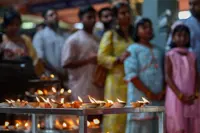
GEORGE TOWN: Year-old twins G. Arulini and G. Arullvini marked Deepavali by visiting the Sri Mahamariamman Temple in Queen Street, joining hundreds of devotees offering prayers and seeking blessings.
Their parents, supervisor K. Ganesan, 44, and food technologist S. Gopulavani, 41, awoke at 5am yesterday to begin the day with prayers at home and a traditional oil bath before heading to the temple.
The pre-dawn oil bath, commonly practised among Hindu families, symbolises purification and renewal, marking an auspicious start to the Festival of Lights.
Gopulavani said the family used the occasion to teach their older children, Yalini, five, and Dessvanth, four, about the significance of the celebration.
“We tell them the story of Lord Krishna’s victory over the demon Narakasura, which symbolises the triumph of light over darkness,” she said.
In Hindu tradition, this victory represents the triumph of good over evil.
Gopulavani said the family would visit relatives here before travelling to Ipoh today to celebrate with her family.
“We prayed for the good health of all in the family and loved ones,” she said.
For sisters S. Vinishaa, 26, and S. Kavisha, 23, students from Bayan Lepas, visiting a temple on Deepavali morning has been a tradition since childhood.
Vinishaa said the festival’s most important message is about bringing light into one’s life.
The sisters spend the rest of the day visiting relatives and attending open houses.
Foreign tourists also got a taste of the celebration. German computer scientist Benjamin Biegel, 43, was here with his wife Julia Olk, 40, a TV station editor, and four-year-old son Bjarne.
“We are very lucky to come during Deepavali and witness the prayers and rituals,” said Benjamin, who was on a guided tour of Penang over a six-week Asian holiday.
Among the other foreign visitors were three young Chinese tourists in their 20s from Guangdong who embraced the festive spirit by dressing in traditional Indian attire – the woman wearing a red kurti set and the two men donning kurtas.
Devotees had begun arriving at the temple as early as 6am, dressed in traditional attire to offer prayers.
Clay oil lamps illuminated the shrine while priests applied tilak, a religious mark, to devotees’ foreheads as a symbol of blessing.
Visitors were treated to traditional Indian sweets and savoury snacks, including laddu, muruku and sweet boondi.