GEORGE TOWN: The Malayalee community in Malaysia has its own story to tell when it comes to Deepavali – one that is shaped by its rich Kerala heritage, family traditions and a strong sense of cultural identity.
Although Deepavali is widely celebrated among Tamil Hindus, the Malayalee Hindu community incorporates the festival’s familiar practices into their celebrations while retaining elements of their own Kerala heritage.
North Malaysia Malayali Samajam (NMMS) vice-president (II) NS Balan Menon, 68, said for the community in Malaysia, Deepavali remains a meaningful occasion to welcome prosperity, offer prayers, strengthen family ties and share the joy of the festive season.
He said as a third-generation Malayalee in Malaysia, his family has naturally embraced the local way of celebrating Deepavali.
“We have grown up embracing both our ancestral culture and the multicultural environment around us.
“On Deepavali day, we observe the oil bath, wear new clothes, visit temples and welcome friends into our homes.
“Since Deepavali is a public holiday, that is the time we can prepare non-vegetarian dishes and invite friends from all religions and races over.
“So, it is all very much about friendship, sharing and togetherness,” he said at the pre-Deepavali luncheon held at the NMMS in Jalan Masjid Negeri recently.
Committee member Dr Asha B. Dass, 62, said Deepavali is not a defining festival of Malayalee culture with Onam and Vishu holding more important significance.
“But in Malaysia, it is still an occasion through which Malayalee Hindu families celebrate their faith, preserve their heritage and strengthen their sense of belonging as a Malaysian Indian community.
“This reflects our shared Malaysian Indian identity while respecting and preserving our distinct Malayalee cultural and religious traditions,” she said.
As in all other festivals, food also takes centre stage but the traditional Kerala-style delicacies and snacks are only prepared during Onam and Vishu.
“Since we welcome Tamil Hindu and non-Indian friends into our home during the festive season, we usually prepare familiar Deepavali delicacies that everyone can enjoy,” she added.
NMMS president Sumathi KV Nair, 70, said 24 members and their family members attended the lunch.
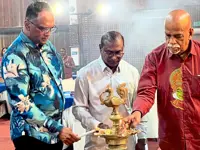
“One of the important things we do before starting any celebration is to light up the traditional Nilavilakku, which is similar to the Tamil’s Kuthu vilakku.
“This is how Malayalee families welcome auspiciousness and celebrate the triumph of light over darkness.”
Sumathi said another important element of any Malayalee celebration is the pookalam, which is traditional floral arrangement created on the floor, similar to a kolam.
“The kolam uses a rice flour or coloured rice while the pookalam is wholly made up of flowers and flower petals,” she said, adding that poo means flower and kalam means decorative design or artwork.
Sumathi’s daughter-in-law Cheng Yi Xin, 43, a pharmacist, said it was her seventh year celebrating Deepavali with the community.
“It is fun to attend the celebration and meet some of the members and their families.
“At the same time, I also get to pick up the language and learn other things,” she said, adding that she has learnt to make muruku and is also getting better at the pookalam arrangement.
“I hope to learn more of the Malayalee practices and start cooking, so that I can keep the tradition going.”