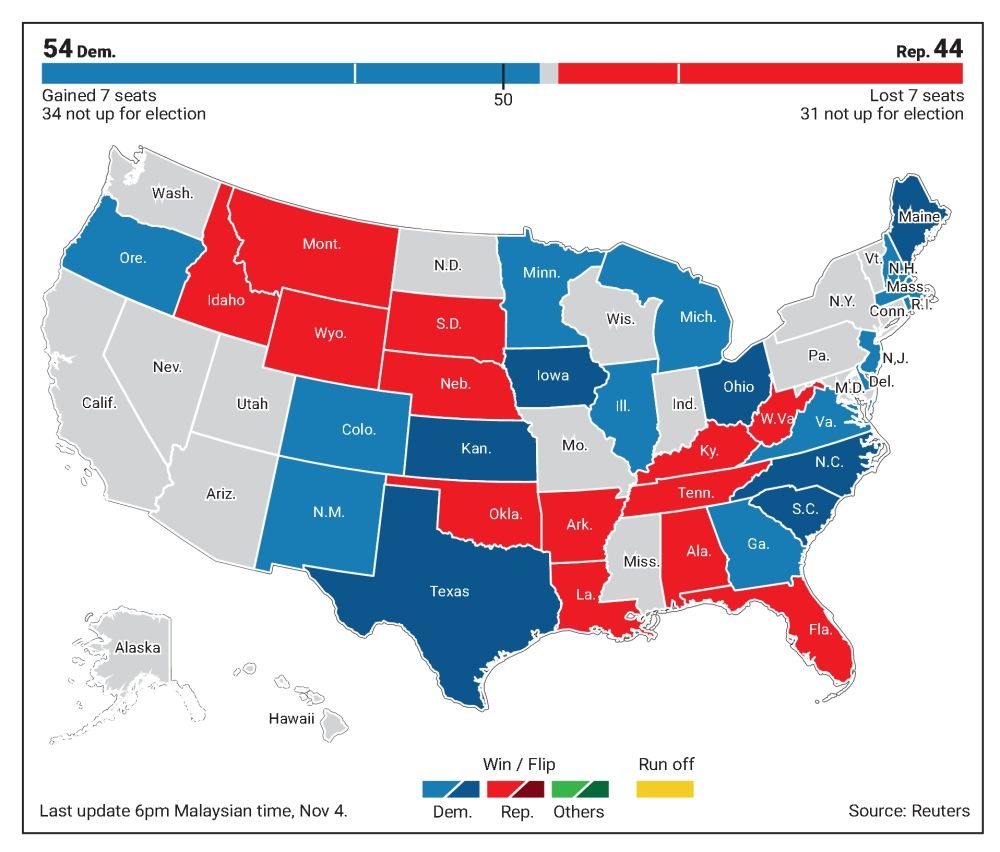
PETALING JAYA: The Democrat victory in US mid term-elections is unlikely to bring any major change to Malaysia’s economic outlook.
Although the Democrats won both chambers of the US Congress, Republican President Donald Trump still has considerable clout to maintain his policies, say economists and analysts.
A Democrat-controlled Congress could make it harder for Trump to push through new legislation, though, but any effort to reverse his controversial economic policies would also face significant obstacles, says Institute of Strategic and International Studies (Isis) Malaysia analyst Jaideep Singh.
The Democrats wrested control of both the House of Representatives and the Senate in Tuesday’s elections, with two years left on Trump’s term.
Jaideep said the next two years could effectively become a “lame duck” period, with lawmakers struggling to introduce major policy changes.
ALSO READ: Low impact on Bursa from US midterms
This is likely to lead to an impasse, he added.
He said Democrats were likely to push for the removal or reduction of certain reciprocal tariffs, but tariffs on Canadian imports would probably be prioritised due to their unpopularity among households and businesses.
It was less likely that they would seek to reverse the more extensive Section 301 tariffs affecting Malaysia and other countries, he added.
The US Agreement on Reciprocal Trade with Malaysia, which remains unratified more than a year after it was signed, is also likely to remain in limbo.
Jaideep said Malaysia could use the opportunity to renegotiate the agreement, particularly as its market access provisions needed updating following changes in US tariff rates.
However, he expects policymakers to adopt a wait-and-see approach.
He also said the growth of Malaysia’s semiconductor industry was unlikely to be affected by US opposition to data centre investments here.
Malaysia’s established semiconductor ecosystem, particularly in chip assembly and packaging, served a wide range of industries and was not solely dependent on demand from data centres, Jaideep said.
Bank Muamalat Malaysia Bhd chief economist Mohd Afzanizam Abdul Rashid said any local impact would depend on how the election results translated into changes in US economic and trade policies.
“A Democrat-controlled Congress could impose greater scrutiny on Trump’s agenda, but it would not automatically reverse existing tariffs or protectionist measures.
“The Democrat win should not be interpreted as a return to freer trade,” he said.
Mohd Afzanizam, too, did not expect the election results to derail Malaysia’s semiconductor expansion, saying the demand was driven by investment in artificial intelligence (AI), computing, data centres and digital infrastructure rather than the electoral fortunes of either party.
He said it was also important to distinguish between tariffs and export controls.
“Tariffs affect the cost of entering the US market, while export controls can restrict access to advanced chips, equipment or particular customers.
“Malaysia’s semiconductor exports remain exempt from US tariffs, but businesses should continue monitoring policy developments,” he said.
Even with Democrats taking control both houses of Congress, it will still be very difficult to stop tariffs because Trump can resort to his veto power or existing trade legislations, said Nusantara Academy for Strategic Research senior fellow Dr Azmi Hassan.
However, Trump’s ability to pursue his tariff policies against countries like China, Canada and Malaysia could be constrained.
“Such a situation could be more advantageous for Malaysia,” he said.
Azmi also expected implications for US foreign policy, particularly on Palestine.
“A few hours before the polls opened in the US, Trump did put out a statement that foreign aid, including military aid to Israel, would be stopped by the end of the year.
“I think Trump understands that there will be pressure on foreign policy, especially with regard to Israel and the war in Iran,” he said.