



Employers favour flexible work options over blanket age hike
PETALING JAYA: Malaysia should prioritise flexible post-retirement employment over a blanket increase in its mandatory retirement age, as employers are divided on whether to follow Singapore’s move to extend working age.
Singapore will raise its retirement age to 65 and reemployment age to 70 from Jan 1, 2029, to support its ageing population and promote age-friendly workplaces.
SME Association of Malaysia national president Dr Chin Chee Seong said Malaysia should either gradually raise retirement age from 60 to 65, or introduce a flexible reemployment arrangement similar to Singapore’s.
He said many people in their 60s remain healthy, energetic and capable of contributing to the workforce, adding that their experience and skills should not be lost simply because they had reached retirement age.
“Retirement should not be determined by age alone, but also by an individual’s health, ability, productivity and willingness to continue contributing,” he said.
Chin said retaining older workers could benefit small and medium enterprises (SMEs) through their technical knowledge, leadership and problem-solving abilities, while allowing them to mentor younger employees.
However, he acknowledged that some businesses could face additional costs for salaries, medical benefits, insurance and workplace adjustments.
He called for a gradual and flexible approach supported by government incentives such as tax deductions, wage subsidies and training grants, particularly for SMEs.
“Extending employment should be an option and not an obligation,” he said, adding that employers and employees should agree on suitable arrangements based on job requirements, health, performance and business needs.
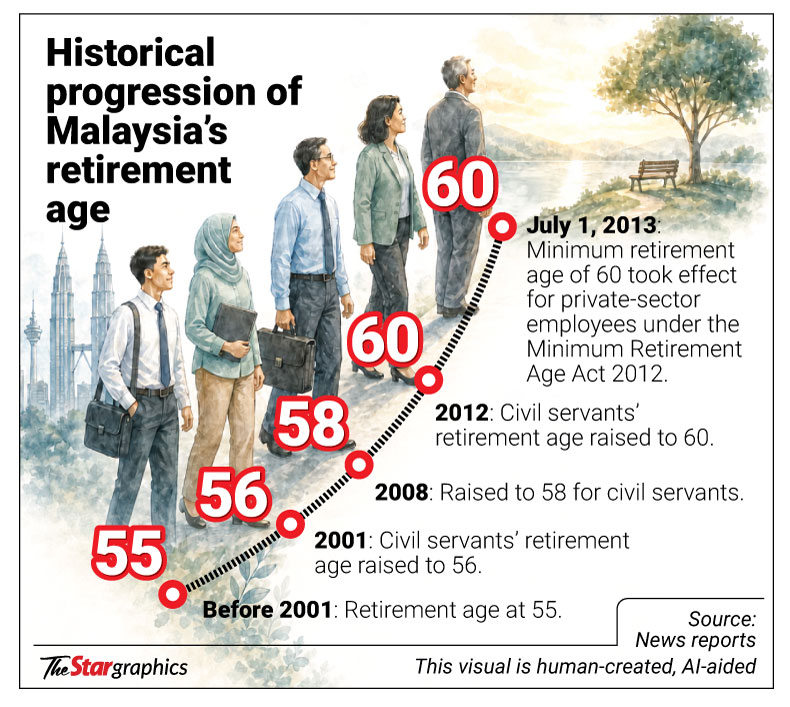
However, the Malaysian Employers Federation (MEF) is not in favour of raising the statutory minimum retirement age at this stage, saying Malaysia must consider its labour market conditions and employers’ financial capacity.
MEF said the current minimum retirement age of 60 under the Minimum Retirement Age Act 2012 provided a balance between employees’ retirement choices and employers’ workforce management needs.
Instead of raising the age across the board, it supports re-engaging suitable retirees through annual fixed-term contracts via mutual agreement.
This would allow businesses to retain specialised skills, facilitate knowledge transfer and address workforce shortages, while reviewing remuneration, responsibilities and working conditions periodically.
MEF also cautioned that a mandatory increase could raise employment costs, including statutory contributions, medical and insurance benefits, leave entitlements and workplace adjustments. These expenses could be particularly challenging for micro, small and medium enterprises operating on tight margins.
A blanket increase could also affect succession planning and career progression for younger workers in some organisations, although MEF acknowledged the benefits of mentoring in a multigenerational workforce.
Meanwhile, Association for Residential Aged Care Operators (Agecope) Malaysia president Delren Terrence Douglas said longer life expectancy and low birth rates meant societies would increasingly have to balance support for older people with the need to maintain an adequate workforce.
He said ageing populations and shortages of younger workers were placing pressure on economies and families, particularly in East Asian countries.
Delren cautioned that extending working lives could leave people feeling compelled to work indefinitely when they should rest and enjoy their retirement.
He acknowledged that some older people do not have sufficient savings to support themselves throughout retirement, making continued employment a necessity.
Allowing older workers to remain employed should therefore be an option rather than a mandatory requirement, he said.
Delren added that although migrant workers could help address manpower shortages, they would not resolve all the challenges associated with longer life expectancy and supporting senior citizens.
He also said that some young people remain unemployed, highlighting the need to balance workforce requirements with employment opportunities across generations.
In Malaysia, proposals to raise the retirement age from 60 to 65 have been debated for several years.
In May 2025, Prime Minister Datuk Seri Anwar Ibrahim said the proposal deserved consideration but required further study, including financial implications on businesses, and impact on job opportunities.
The government subsequently reviewed the proposal, but in July 2026, the Cabinet decided there was no need to raise the retirement age, maintaining the current limit of 60.

