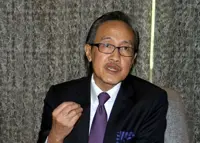
KUCHING: Sarawak has defended the proposed new Kuching International Airport (NKIA) project at Tanjung Embang as a long-term strategy for aviation infrastructure needs and economic growth.
State Transport Minister Datuk Seri Lee Kim Shin said it would be shortsighted to cancel the project, as called for by Chong Chieng Jen (DAP-Padungan).
He also said Chong's proposal to upgrade the existing Kuching International Airport would not resolve limitations involving runway capacity, aircraft movements, airside infrastructure, cargo facilities, maintenance, repair and overhaul facilities and future expansion due to limited land size.
"Besides, having an airport in the middle of the city limits the development of high-rise buildings within the surrounding areas," he told the Sarawak Legislative Assembly in his winding-up speech on Monday (Oct 19).
Last Wednesday, while debating the state budget, Chong urged the Sarawak government not to proceed with the RM10bil NKIA due to its substantial cost and instead upgrade the existing airport.
Lee said a feasibility study by Netherlands Airport Consultants in collaboration with local consultant Jurutera Jasa Sdn Bhd concluded that Tanjung Embang was technically and operationally viable for the proposed NKIA.
He said the study projected that NKIA could contribute RM1.8bil annually to Sarawak's gross domestic product (GDP) by 2050 and support 37,919 jobs.
"The study also projects that increased passenger traffic could generate RM3.99bil in tourism receipts by 2050.
"Building on the completed feasibility study, the project’s scope and implementation structure will be assessed against market demand, technical and regulatory requirements and financial viability," Lee said.
He added that funding options include public-private partnerships, private finance initiatives and joint ventures.
"It is not necessary to be fully funded by the government."
On Chong's call to halt further development of the autonomous rapid transit (ART) system and convert its infrastructure into traffic lanes, Lee said Kuching needs a dependable, high-capacity public transport system as a genuine alternative to private vehicles.
"Converting dedicated public transport corridors into general traffic lanes would undermine the purpose for which this infrastructure is being developed," he said.