PETALING JAYA: Alien fish pose a physical danger to humans alongside aquatic ecosystems, as highlighted by an incident where five Fisheries Department officers were injured capturing a giant arapaima in Melaka.
Fisheries director-general Datuk Adnan Hussain (pic) said the injuries suffered by the officers showed the risk posed by the size and strength of some alien species.
“In 2024, five officers were injured in Melaka when a thrashing giant arapaima struck them with its head,” Adnan said.
“While arapaimas do not actively attack humans, their sheer size and strength can inflict serious injuries when provoked or netted.”
“That is why we advise the public not to attempt to catch or approach unfamiliar alien species. If they spot one, they should report it to the Fisheries Department for further action and inspection,” he told The Star.
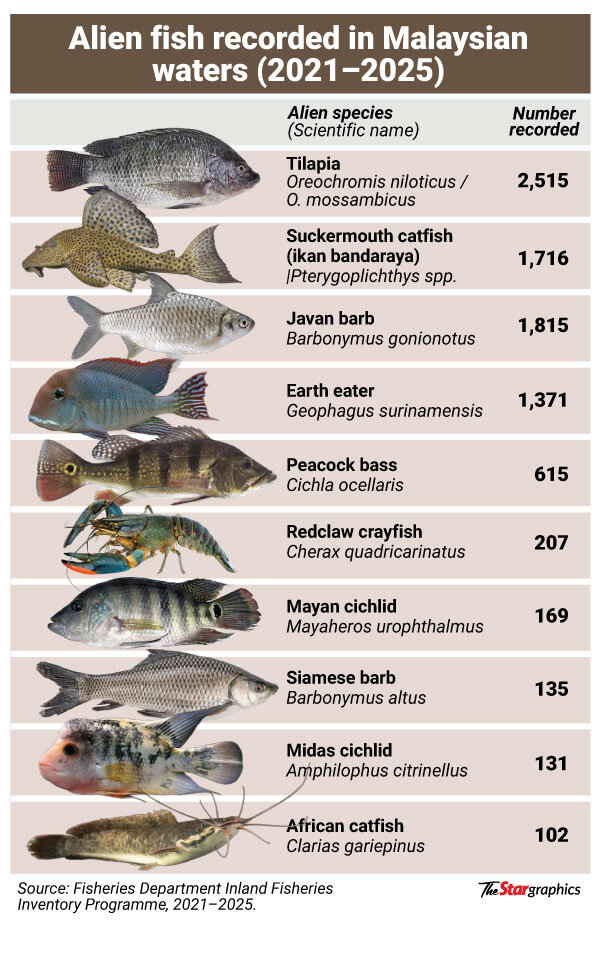
He said at least 10 alien fish species have been recorded in Malaysian waters, such as rivers, lakes and dams, between 2021 and 2025.
Data from the department’s Inland Fisheries Inventory Programme showed that the alien species detected included tilapia, Javan barb, suckermouth catfish or ikan bandaraya, earth eater, peacock bass, redclaw crayfish, Mayan cichlid, Siamese barb, Midas cichlid and African catfish.
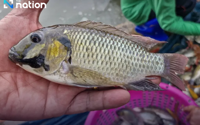
The safety reminder follows the recent catch of a fish exhibiting piranha-like characteristics from the Pygocentrus genus at Klau Dam in Raub, Pahang.
The fish was caught by an angler on Aug 26. A technical assessment based on photographs and video footage was carried out by the Glami Lemi Fisheries Research Institute.
However, confirmation at species level could not be made because the physical specimen was unavailable for further examination.
The Fisheries Department said its inland fisheries inventories had not previously recorded piranha or fish from the Pygocentrus genus in Malaysian waters.
There had also been no report of such fish at Klau Dam in the 11 years since the dam began operating in 2015.
Based on investigations involving witnesses and the local community, the department said the suspected piranha may have been released by an irresponsible party.
As of Sept 22, no additional catches of fish with similar characteristics, or related safety incidents, had been recorded at the dam.
Monitoring at Klau Dam and surrounding areas is continuing.
The department said piranhas are omnivorous and active predators that feed on aquatic organisms including fish, frogs, small crustaceans and insects. They may also feed opportunistically on carrion.
While there is no evidence that piranhas have bred or established a wild population in Malaysia, the department said the country’s tropical climate generally shares temperature and environmental conditions with the fish’s native range in South America.
The department said a total of 127 inventory exercises were carried out between 2021 and 2025 at rivers, lakes, ponds, former mining pools, dams and irrigation canals to monitor the presence and spread of alien fish species.
Between 2022 and 2025, the department conducted 37 removal operations, clearing nearly 20 tonnes (19,598.8kg) of alien aquatic species from public waters.
In Pahang, Asian redtail catfish (Hemibagrus wyckioides) has been detected in Sungai Pahang.
The state Fisheries Department has also carried out 10 alien species mitigation programmes since 2022 in Jerantut, Lipis, Pekan, Temerloh and Raub.