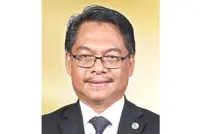
KOTA KINABALU: Budget 2027 must mark a fairer distribution of federal development funding for Sabah and Sarawak to address historical disparities with Peninsular Malaysia, says Datuk Seri Dr Jeffrey Kitingan.
The Sabah STAR president and Keningau MP said rectifying regional imbalances is both a constitutional obligation and a prerequisite for national stability.
Kitingan urged the Federal Government to use Budget 2027 as a turning point to correct long-standing regional inequities.
He said federal development funds have favoured Peninsular Malaysia for decades, with 86% to 87% allocated to the peninsula while Sabah and Sarawak receive a paltry 12% to 15% annually.
“Sabah remains 30 to 40 years behind Peninsular Malaysia in development,” Kitingan said yesterday, adding that existing formulas ignore the size, infrastructure deficit and economic potential of the Borneo states.
He urged Putrajaya to stop treating Sabah and Sarawak as single units against Peninsular Malaysia’s 11 individual states.
“Such an approach ignores the special constitutional status of the Borneo states and the 1963 Malaysia Agreement,” he said, pointing out that Sabah’s vast administrative regions dwarf several peninsular states.
“For instance, the Keningau parliamentary constituency alone is larger than Penang, Melaka and Perlis combined.
“Yet Sabah remains the poorest state in Malaysia, harbouring eight of the nation’s 10 poorest districts,” he said.
Kitingan, who is also Tambunan assemblyman, noted that Sabah’s GDP per capita is less than half the national average, with rural communities still relying on untreated gravity-fed water systems due to persistent infrastructure gaps.
To close this gap, Kitingan called for development funding to directly reflect land area, population needs, infrastructure backlogs and economic contributions.
He urged the Federal Government to calculate and disburse Sabah’s constitutional 40% net revenue entitlement starting from 2026.
“As for the entitlement for the “lost years” from 1974 to 2021, it can be discussed and negotiated separately between the Federal and Sabah governments,” he added.
“Materialising this payment would not only fulfil a constitutional obligation but also provide Sabah with the financial resources needed to improve essential infrastructure, eradicate poverty, stimulate economic growth and uplift the overall well-being of its people,” he said.
“Moving forward, the immediate priority must be to stop the continuing accumulation of unpaid entitlements and establish a clear and transparent mechanism for the proper calculation and payment of Sabah’s 40% entitlement.”