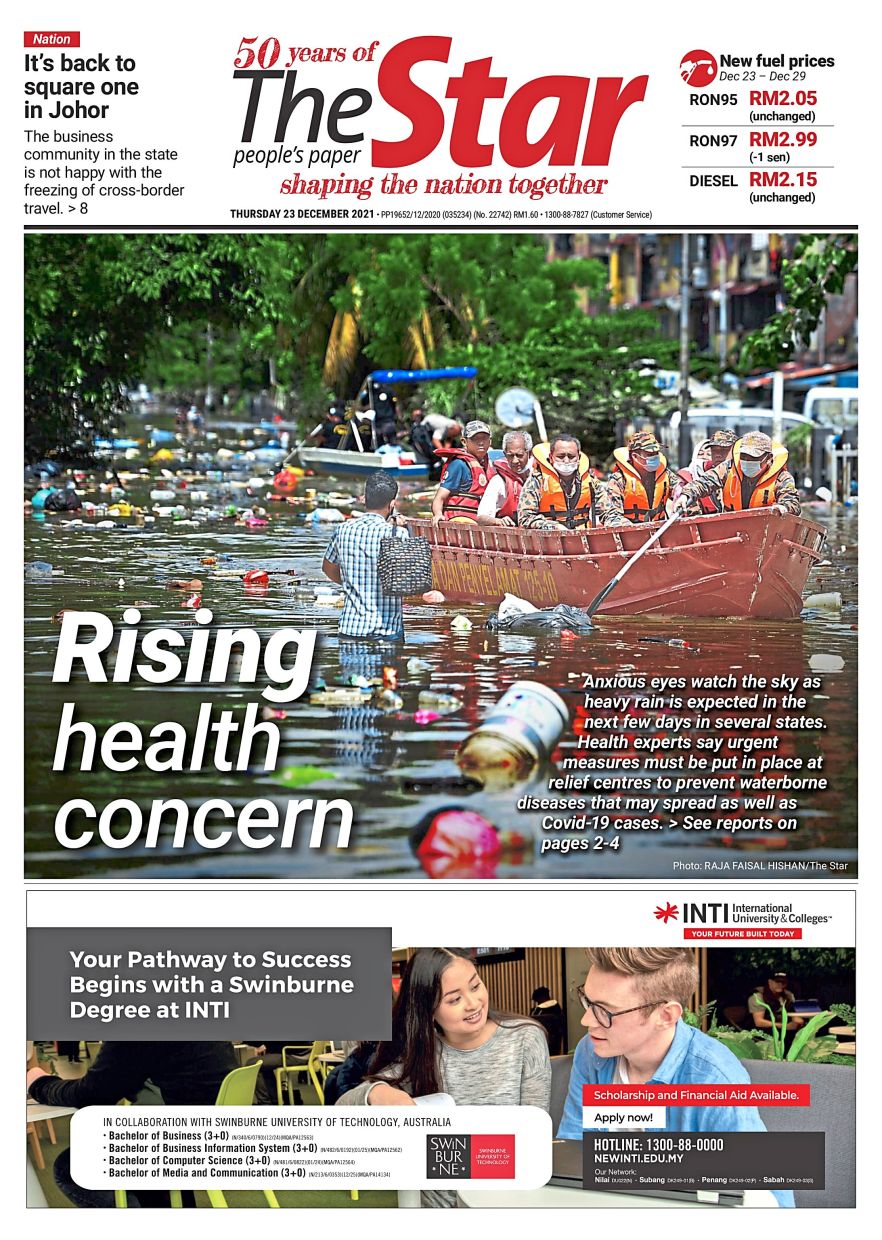
Iconic cover: Dec 23, 2021
PETALING JAYA: The man was bedridden, and his family – including his daughter – just could not leave him as the floodwaters rose around them.
For more than 24 hours, they remained trapped in the upper floor of their home in Shah Alam, without food or water.
When relief workers finally arrived, the first thing they did was throw bread and water through a window, and then climb onto the roof.
“They had to ‘roll’ the bedridden man in a foam mattress and got him out of there,” says former The Star reporter Wani Muthiah.
For Wani, the December 2021 floods that hit the Klang Valley, especially Taman Sri Muda in Shah Alam, was a shocking one.
The scale of the devastation and deaths was unimaginable for her.
“The devastation was horrendous and the fact that there were deaths shocked me,” she said.

At the affected areas, she found scenes of mud, foul smells and belongings strewn everywhere. Even after the floodwaters receded, the trauma remained.
The rescued man died several months later, but the daughter remained traumatised.
“She stored food, drinks, candles and power banks in the upstairs bedroom for a few years after the incident,” Wani said.
Like Wani, other journalists and photographers who covered the devastating floods still find it hard to forget the tragedy.
For The Star photographer Raja Faisal Hishan, one of the most vivid memories was travelling behind an Armed Forces rescue boat to deliver food to victims trapped in their homes.
“The roads and highways were all submerged. It felt like riding a boat in a huge river but with road signs sticking out,” he said.
Raja Faisal said getting the story remained his priority, but he never ignored safety instructions from authorities.
He sought permission to accompany the Armed Forces on their rescue rounds, which allowed him to document the situation from the heart of the flooded areas.
He remembers the relief on the faces of residents who saw the rescue boats approaching.
“They asked for rice as they were hungry. Some even said they had not eaten rice for three days,” he said.
However, with the boats already carrying supplies and rescued victims, the team could only throw biscuits and water to some of those stranded, while telling others that another boat would come for them.
Journalist Justin Zack, recalls how difficult it was to even reach the worst-hit areas, with high water levels and safety concerns.
And he was sent to the scene after the weather improved.
“It was chaotic,” he said, recalling angry residents confronting politicians who visited after conditions had improved.
Justin, too, managed to secure a place on an Armed Forces boat into the flooded areas.
“It was worse than I imagined, like one of those post-apocalyptic movies,” he said.
Floating dog carcasses, destroyed cars and devastated homes were among the scenes he encountered.
“The photos we took couldn’t really capture the scale of the damage.
“A lot of people lost their entire homes and livelihoods, and all they could do was vent to people like us in the hope the government would do something about it,” he said, adding that the experience left him drained.
One elderly woman, however, left a lasting impression.
She waved to the boat from her two-storey home and politely asked whether the team had any food.
The journalists only had bottled water, but promised to arrange supplies later. The woman even created a small pulley system to receive bottled water and packet drinks from the boat.
She declined their offer to evacuate, though, preferring to remain in her home.
“She had every reason to be angry at the world but she was so polite and sweet, asking if we were ok as well,” Justin said.
Photographer Samuel Ong remembers the aftermath as being like a “mini tsunami”.
“The place was in a total mess, muddy, smelly with rubbish everywhere. It was like mini tsunami had hit,” he said.
Having covered difficult assignments during his years with The Star, Samuel said he arrived prepared for the conditions, although the Covid-19 pandemic at the time meant safety remained an additional concern.
“We have to work smart when things become dangerous,” he said.
He admitted that the pursuit of a compelling image could sometimes test those boundaries.
“Sometimes, I break the rules just to get nice pictures,” he said.
Ultimately, what stayed with Ong was the way Malaysians came together after the disaster.
“Everyone was helpful. They helped, donated food, clothes, and cleaned,” he said.
At the end of the day, for the journalists and photographers who witnessed the floods, the assignment was about more than getting a story or a photograph.
It meant encountering people who had lost homes, possessions and loved ones, and documenting their struggles.
Five years on, those moments remain part of their own history - and a reminder of the human stories behind one of Malaysia’s most devastating floods in recent memory.