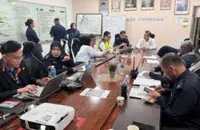
PUTRAJAYA: The civil service is determined to manage its human resources in the most impactful way to ensure no civil servants are victimised, says Public Service Department director-general Tan Sri Dr Wan Ahmad Dahlan Abdul Aziz.
He said human resource management personnel in the civil service must be up to date with reforms and transformations to ensure mistakes do not recur and they are not at a disadvantage despite years of service.
He was speaking to the media after officiating a Public Sector Human Resource Management Conference held here on Monday (Sept 14) attended by hundreds of civil servants from the human resource departments of various ministries and government agencies.
Wan Ahmad Dahlan also said that salary adjustments under the Public Service Remuneration System (SSPA) would further address the problem of those earning below RM5,000.
"We face many issues relating to human resource management because it involves a broad range of dimensions, from federal to state level, (as well as) local authorities.
"As an example... an issue... at the Kelantan Forestry Department, where mistakes in human resource management could potentially lead to officers who served for decades being unable to receive their pension benefits.
"There are many other examples, such as those involving CIDB (the Construction Industry Development Board) and development corporations," he added.
In the case of the Kelantan Forestry Department, an due to retire was found to have not updated his human resource records, and was therefore due to earn a lower pension than entitled.
"These are among the matters on which we want to provide a more accurate and clearer understanding to all human resource management personnel.
"We do not want public servants who have devoted many years of service to ultimately be denied the welfare and benefits they should receive when they retire or end their service," Wan Ahmad Dahlan added.
On the matter of two-thirds of public servants earning below RM5,000 monthly, he said the SSPA would help address this.
"When we talk about insufficiency of income, there will never be a point at which everyone says, 'I have enough.' However, this time we can clearly see that we have implemented a salary adjustment under the SSPA.
"Of course, we need to balance this with the government’s financial capacity. In my view, with the salaries they currently receive, public servants are not below the poverty line.
"What remains is how individuals manage and plan their expenditure. At the same time, we are also studying various measures that could... improve the income of public servants."
In his speech at the event, Wan Ahmad Dahlan stressed the need for results to be directly felt by the people when public servants undergo reform.
"In realising the reform agenda, rhetoric is no longer sufficient. Instead, it demands tangible results that can be directly felt by the people.
"We need to determine how these reforms are to be implemented, measured and held accountable at every level.
"Malaysia's performance in the 2026 World Competitiveness Ranking has improved significantly. However, this should not simply be regarded as a trophy for us to celebrate.
"Instead, it represents a new benchmark for the expectations and demands of the people towards our public services.
"Therefore, this is where the critical role of government human resource managers lies – in supporting the Reform Success Pillars, particularly in organisational development, human capital and service delivery.
"Reform and transformation require us to have the courage to discard outdated practices and adopt new, relevant approaches in pursuit of high-impact restructuring.
"Transformation is a continuous process, while reform involves radical change that will only become a reality when we have the courage to make the right decisions more quickly and address problems at their root.
"The most basic measure of the quality of a system is whether the same mistakes continue to recur. If they do, it indicates that the underlying causes have yet to be addressed.
"In this regard, errors involving appointments, acting appointments, promotions, salary adjustments, disciplinary matters and performance management should not become the norm.
"Cases that may appear minor at the process level can have a major impact on officers as well as the credibility of an organisation. Repeated mistakes are no longer isolated cases; rather, they indicate systemic weaknesses.
"For this reason, since 2024, the PSD has conducted 61 advisory programmes at ministry and state secretary's office (PSUK) levels through engagement sessions, direct case resolution and the sharing of the latest policies," he said.
At the same event, he also launched the book "The Institution of the Chief Director-General of the Public Service in the New Millennium".