PETALING JAYA: Motorists should face the consequences of traffic offences immediately, with demerit points imposed when summonses are issued rather than paid, say road safety experts.
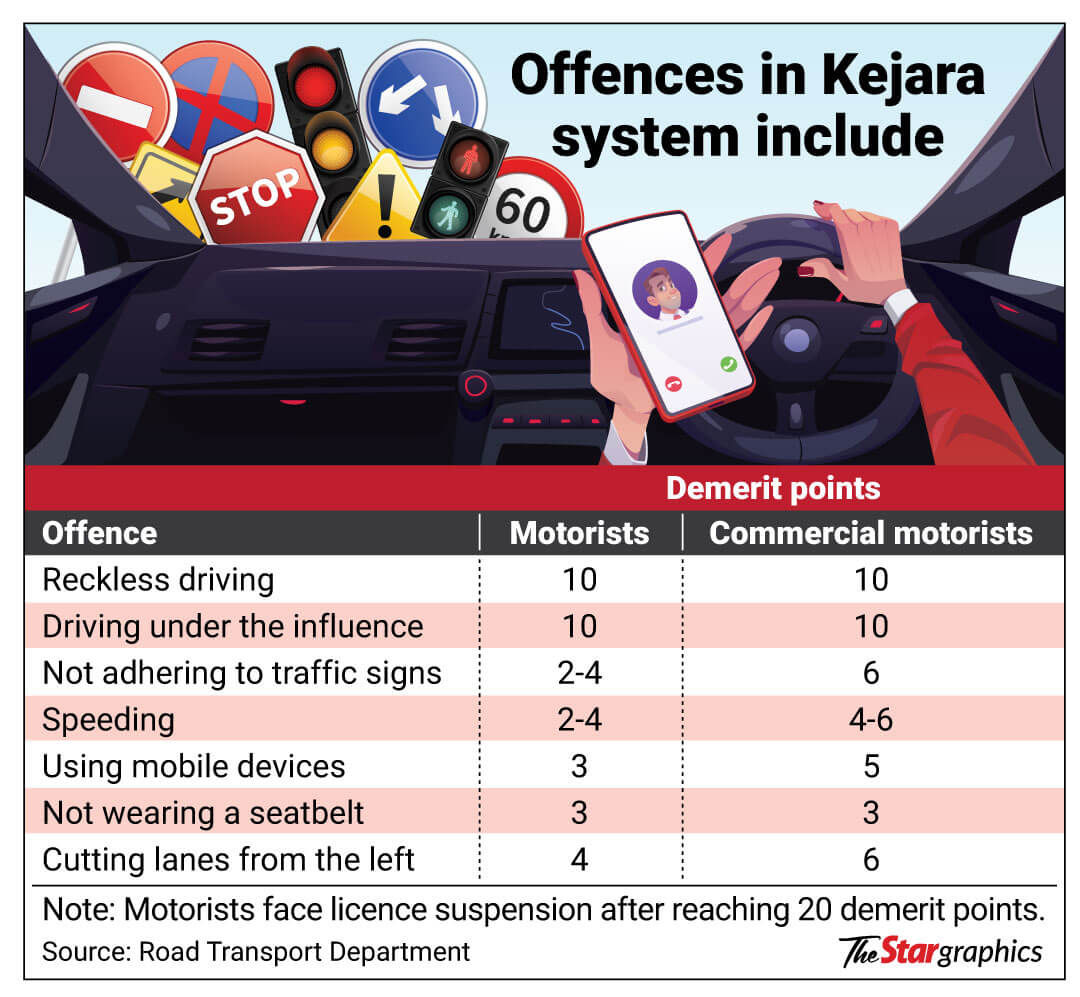
Road Safety Council of Malaysia executive council member Datuk Suret Singh said swift punitive action could influence behavioural change and should be incorporated into the revamped Kejara or Demerit Points System for Traffic Offences.
Under the current system, demerit points are only awarded once a summons is paid.
“The mindset should be towards being cautious of committing traffic offences as it not only risks fines, but the immediate issuance of demerit points which can lead to licence suspensions,” he said.
“This is the desired deterrence for behaviour changes that road safety experts and activists have been advocating for.”
Suret proposed lowering the threshold for licence suspension to 15 points from the current 20.
For serious offences, he suggested imposing five demerit points each.
These include beating red lights, exceeding the speed limit, tailgating, overtaking in prohibited zones, using mobile devices, failing to wear seatbelts or helmets, and lane splitting.
His comments follow a recent spate of fatal road accidents.
On Aug 19, a man and his two daughters were killed after an Immigration Department truck veered off course following a collision at a traffic-light intersection in Kuala Lumpur.
On Aug 25, three people died in a two-vehicle crash near a petrol station in Tanjung Leman, Jalan Jemaluang, Kota Tinggi in Johor.
On Aug 31, four people were killed in an accident involving 11 vehicles along the East Coast Expressway near Lanchang, Temerloh in Pahang.
Statistics show that 6,537 people died in road accidents last year, an average of 18 fatalities a day.
Universiti Putra Malaysia Road Safety Research Centre head Assoc Prof Dr Law Teik Hua said the effectiveness of the Kejara system depended on how quickly offences were recorded and enforcement action taken.
He said motorists who were blacklisted but continued to offend should be categorised according to their risk level.
“Some may be occasional offenders, while others may be high-risk repeat offenders who repeatedly commit serious offences.
“While some may only require a licence suspension or restriction, others may require stricter action, including rehabilitation programmes or additional training,” he said.
Assoc Prof Law also called for closer monitoring of motorists returning to the road after having their licences suspended or accumulating a high number of demerit points.
He said such motorists should be treated differently from those with clean driving records.
“There must be a timely integration of relevant data between enforcement agencies.
“If traffic offences, court decisions, licence status and Kejara points can be accessed in one place, it would be easier to identify and monitor high-risk motorists and take action before an accident occurs,” he said.
Assoc Prof Law also agreed that the proposed increase in traffic fines could serve as an effective deterrent.
“However, it should not be the main solution. This must be combined with stronger enforcement and the effective management of repeat offenders,” he said.
In June last year, Transport Minister Anthony Loke said a major overhaul was needed to revive the Kejara system.
Road Transport Department director-general Datuk Aedy Fadly Ramli was later reported as saying that JPJ was in the final stage of reviewing the system.
Deputy Prime Minister Datuk Seri Dr Ahmad Zahid Hamidi also said Malaysia suffered about RM30bil in socio-economic losses from road accidents last year.