
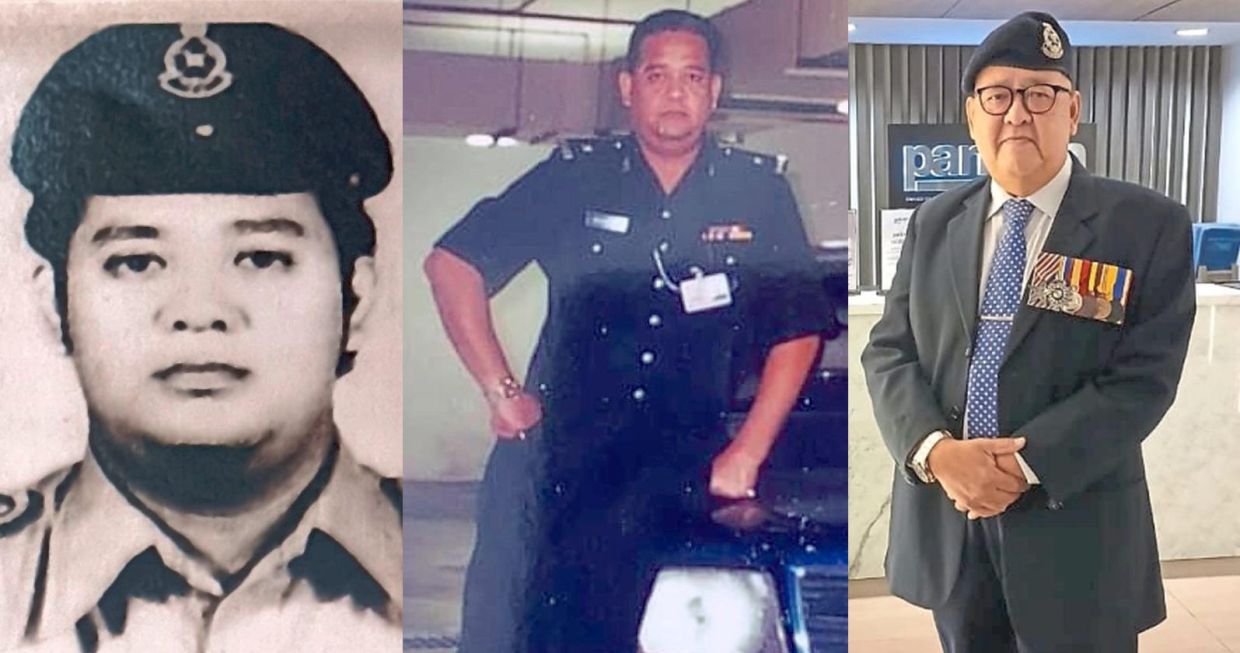
THE sight of his commanding officer lying gravely wounded on the ground stayed etched in retired Sub-Inspector Salihuddin Saisi’s mind.
Deputy Superintendent M. Thiagarajan, a Special Branch officer, had been shot twice during an intense police sting against communist terrorists (CTs) in Ampang New Village in June 1977.
Yet the courageous officer forced himself back on his feet, charged towards the enemy and fired several gunshots that killed a CT.
He then collapsed. An hour later, DSP Thiagarajan was pronounced dead at the Kuala Lumpur Hospital.
For Salihuddin, then a young 27-year-old Special Branch corporal, his grief grew into a determination to continue the fight against CTs who had taken away a man he deeply respected.
Six months later, fate gave him the chance.
Acting on a public tip-off about suspected CTs at a school in Jalan Loke Yew, Kuala Lumpur, Salihuddin and seven other personnel including two women detectives were deployed to investigate.
As the team split up to search the school compound, Salihuddin spotted a man and woman behaving suspiciously as they tried to leave the place. When he approached them, they bolted in different directions.
Salihuddin managed to apprehend the woman, handcuff her and hand her to the women detectives. Then came a deafening explosion.
The male suspect had lobbed a hand grenade in his escape bid, killing a member of the public at the school canteen.
As the CT climbed over a fence to flee, Salihuddin jumped into a police van to pursue the fleeing suspect. However, traffic had come to a standstill in the vicinity after onlookers gathered following the melee.
“I jumped out of the van and ran towards the suspect who had stopped a passing taxi. I flagged down a motorcyclist and ordered him to ride towards the suspect.
“As we got closer, I pulled out my revolver and fired a shot, which hit the CT and caused him to fall,” he said.
Salihuddin pounced on the injured CT, but the man put up a fierce struggle in the middle of the main road.
Suddenly, he noticed something what could have turned the scene into a massacre.
“The CT was gripping a hand grenade with its safety pin removed. I grabbed the man’s hand and shouted at my colleagues to save themselves.”
As his colleagues took off to safety, Salihuddin continued wrestling with the suspect, trying to prise the grenade from his grip, but the CT refused to let go.
“I slammed his hand against the road repeatedly until it bled but he still gripped the grenade tightly.
“I was terrified and had no choice but to draw my revolver and opened fire at him again,” he recalled.
As the gunshot rang out, the CT threw the grenade nearby and caused it to go off. The explosion lightly injured several onlookers before the suspect succumbed to Salihuddin’s gunshot.
“The CT’s death gave me some consolation when I recalled how brutally my commanding officer was killed,” said the father of four in a recent interview.
For his selfless act, Salihuddin was awarded the Panglima Gagah Berani, the country’s second-highest gallantry award, by the Yang di-Pertuan Agong several months later.
Hailing from Tapah, Perak, the 76-year-old joined the police force as a constable in 1969 and was posted to the police field force on completing his training the following year. Six years later, he was transferred to the Special Branch.
Unlike his other Special Branch colleagues who operated in rural areas and jungles, Salihuddin’s unit hunted CTs operating in urban areas where threats often emerged in crowded streets and public places.
Throughout his tenure with the Special Branch and until the communists surrendered in 1989, Salihuddin eliminated a total of four CTs.
As Malaysia celebrates National Day, Salihuddin has a message for those attempting to destroy the country’s harmony.
“I hope the authorities do not take such acts lightly.
“Those who stir trouble by touching on race and religion must face the full wrath of the law,” he said.