PETALING JAYA: The number of people working past retirement age is going up as Malaysia’s population grows older.
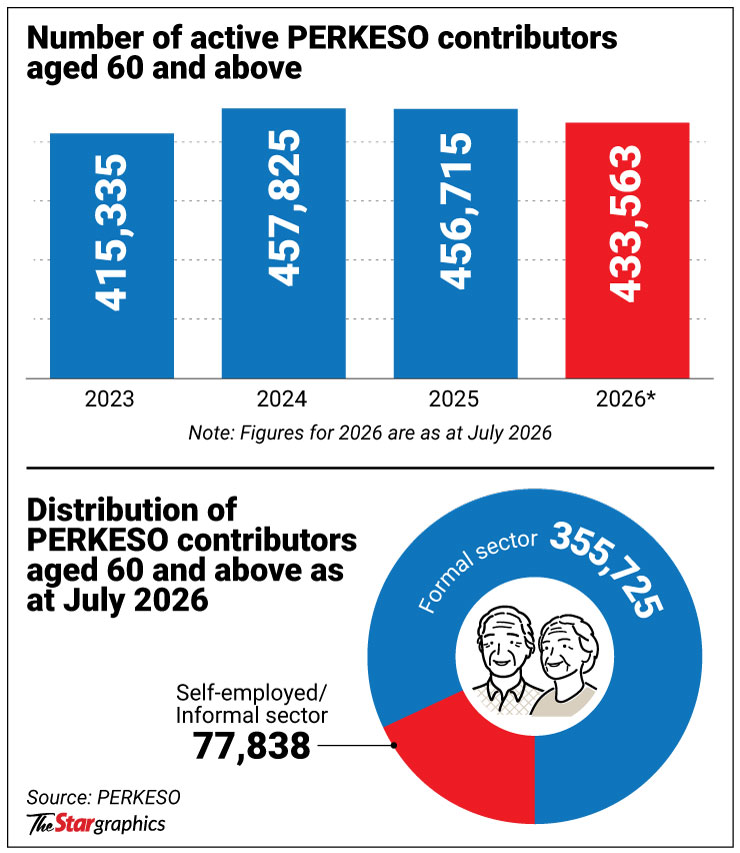
Figures from the Social Security Organisation (PERKESO) show 433,563 active contributors aged 60 and above as of July 2026, compared with 415,335 for the whole of 2023. Malaysia’s current retirement age is 60.
PERKESO deputy chief executive (Strategy and Corporate) Edmund Cheong Peck Huang said the growth points to a wider change taking place.
“Today, turning 60 does not necessarily mean that a person stops working.
“Many Malaysians remain healthy, productive and continue contributing their skills and experience to the economy well beyond 60.
“For PERKESO, social security therefore has to recognise this changing reality of working life,” Cheong said.
According to the Department of Statistics Malaysia, the country is expected to become an ageing nation in 2036, when those aged 60 and above account for more than 15% of the total population.
The population of people aged 60 and above is currently estimated at 4.2 million or 12.3% of the country’s total population of 34.4 million.
The Human Resources Ministry, in a written Parliamentary reply on Aug 13, said workers aged 60 and above, who are engaged in part-time formal sector employment, are eligible for protection under the Employment Injury Scheme of the Workers’ Social Security Act 1969.
The contribution rate is determined under the Second Schedule, with contributions paid solely by the employer.
For self-employed senior citizens in the informal sector, protection is provided under the Self-Employment Social Security Act 2017.
The Act protects individuals against occupational hazards, including work-related illnesses and accidents, even during travel related to their employment.
PERKESO currently has 11,229,871 active contributors.
According to PERKESO’s figures, of the 433,563 active contributors aged 60 and above, 355,725, or 82%, are formal-sector workers.
The remaining 77,838, or 18%, are self-employed or informal-sector workers.
“The 18% is particularly interesting because it shows that working beyond 60 is not confined to conventional employment.
“Some older Malaysians continue earning through self-employment, small businesses, agriculture, transport, services and other forms of independent work,” said Cheong.
He said the country’s social protection system cannot focus solely on the traditional employer-employee relationship.
“We must increasingly consider the different ways Malaysians continue earning a living as they grow older.”
Cheong said there were differences in PERKESO benefits for workers aged below 60 compared with those aged 60 and above.
“There are differences, because the social security needs and risks at different stages of a worker’s life are not exactly the same.”
For workers under 60, PERKESO’s protection includes employment injury as well as invalidity protection, subject to the respective schemes and eligibility requirements.
After 60, the protection framework changes, particularly in relation to invalidity protection.
However, workers who continue working remain exposed to accidents and employment-related risks simply because they have passed the age of 60.
“This is an important principle. If someone is 62, 65 or 70 and still working, an injury can still stop that person from earning an income.
“Medical treatment, rehabilitation and returning the worker safely to work or societal reintegration therefore remain extremely important.”