
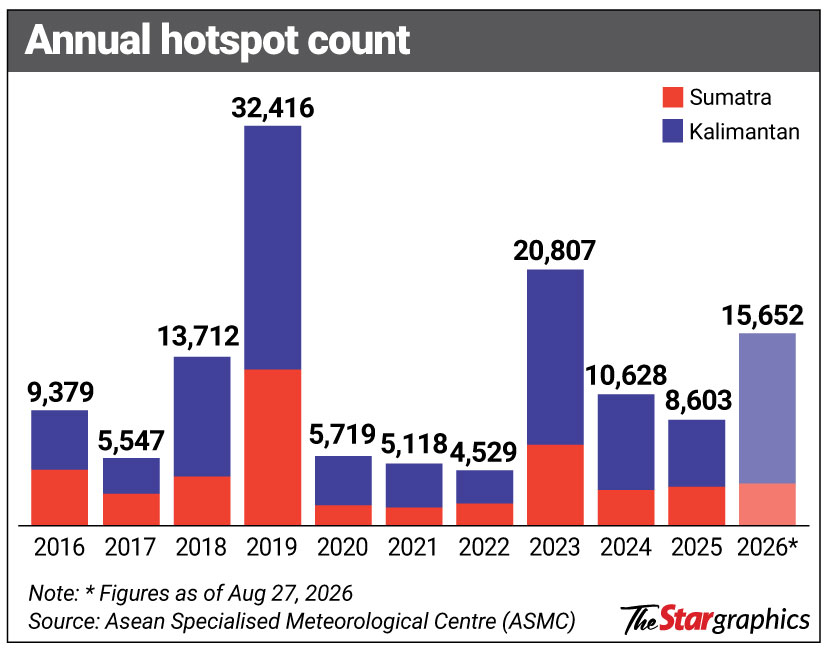
PETALING JAYA: More than 15,000 haze hotspots were detected in Indonesia’s Kalimantan and Sumatra between January and Aug 27 this year, according to data from the Asean Specialised Meteorological Centre (ASMC).
Of the 15,652 hotspots detected across the two regions, 12,212 were in Kalimantan, accounting for 78% of the combined total.
Sumatra recorded 3,440 hotspots during the same period.
Most of Kalimantan’s hotspot activity occurred in July and August, with detections rising sharply from 1,339 in July to 9,849 in August.
Kalimantan has already recorded its third-highest annual hotspot count in the past decade, despite the 2026 figure covering only the period up to Aug 27.
The region recorded 19,681 hotspots in 2019 and 14,219 in 2023.
On Aug 3, ASMC activated Alert Level 2 for the southern Asean region following an increase in hotspot and smoke haze activity, particularly in Kalimantan.
The alert was raised to Level 3 on Aug 26 as the situation deteriorated further.
The centre said widespread moderate to dense smoke haze was observed from clusters of hotspots in Kalimantan, with moderate to dense transboundary haze drifting northwards from hotspot clusters in West Kalimantan.
Moderate to dense smoke haze was also observed across large parts of southern and central Sumatra.
ASMC warned that the situation could worsen as dry conditions were forecast to persist across most of the southern Asean region, compounded by El Nino conditions expected to strengthen in the coming months.
According to the ASMC portal, its hotspot figures represent locations where possible fires have been detected by satellites and do not necessarily correspond to actual land fires.
Hotspot detection can also be affected by factors such as cloud cover, fires beneath forest canopies, incomplete satellite passes, and the size of fires.
The data analysed are based on daytime, high-confidence Visible Infrared Imaging Radiometer Suite observations.