
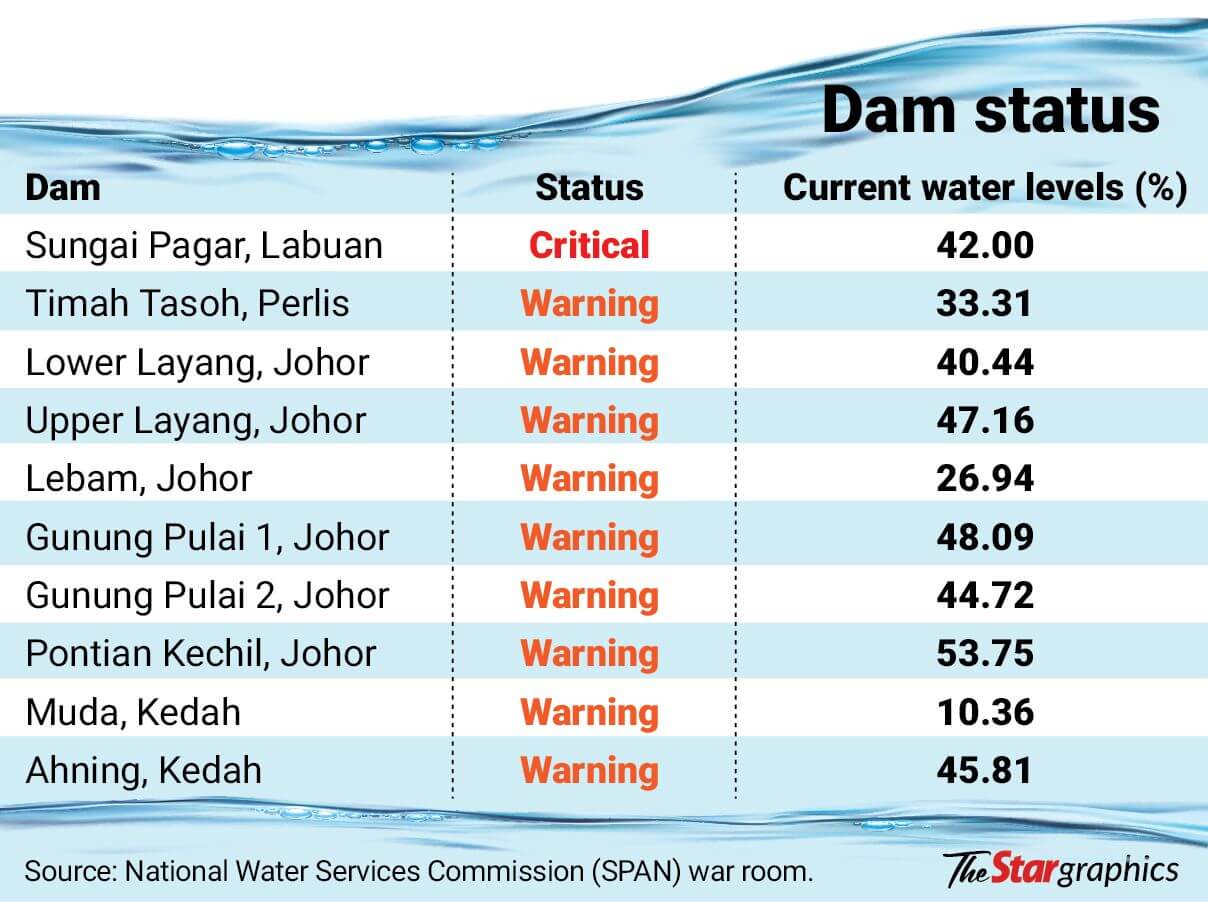
PETALING JAYA: Sungai Pagar Dam remains at a critical water level, but Timah Tasoh Dam in Perlis has improved from critical to warning status in the latest dam-level monitoring by the National Water Services Commission (SPAN).
The update, displayed at SPAN’s war room yesterday, showed that nine dams are now at warning level while two others are at alert level.
Apart from Timah Tasoh, the dams on warning status are Lower Layang, Upper Layang, Lebam, Gunung Pulai 1, Gunung Pulai 2 and Pontian Kechil in Johor, as well as Muda and Ahning in Kedah.
Labong dams in Johor and Jus dams in Melaka remain at alert levels.
The latest reading narrows the number of dams at critical status to one, after Timah Tasoh was previously listed alongside Sungai Pagar as being at that level the previous day.
However, the overall picture remains a concern, with 12 dams still classified as being at critical, warning or alert levels.
Johor accounts for the largest number of affected reservoirs, with six dams at warning level – Lower Layang, Upper Layang, Lebam, Gunung Pulai 1, Gunung Pulai 2 and Pontian Kechil – and Labong at alert level.
Sungai Pagar’s continued critical status will also require close monitoring, including the availability of alternative water sources and measures to ensure consumers in the areas it serves are not affected.
The improved status at Timah Tasoh comes after the Perlis dam had been placed at a critical level. The reservoir is a key multipurpose water source for the state, with significance for domestic supply and agricultural activity.
The Perlis government recently said it was preparing cloud-seeding operations to help raise the level of Timah Tasoh Dam, subject to suitable weather conditions.
Muda and Ahning dams in Kedah are also being closely watched, given their importance to water supply and agricultural activity in the northern region.
SPAN’s dam-status monitoring system is intended to provide an early warning on reservoirs facing falling levels, allowing operators and state authorities to take mitigation steps before household supply is affected.
These measures can include managing dam releases, maximising alternative raw-water sources, reducing system losses, intensifying repairs to leaks, advising consumers to conserve water and, where necessary, deploying emergency supply arrangements.
The Star has reached out to SPAN and the relevant state water authorities on the current storage levels, mitigation measures and whether consumers face any risk of supply disruption.
Meanwhile, a check at Sungai Pahang found a dried-up riverbed that allowed villagers to walk or drive to an island in the middle of the river, which was previously accessible only by boat.
There were reports of villagers bringing water buffaloes to graze on grass at the dry riverbed on the island.
Consumers in areas served by the affected dams are advised to use water prudently and to report leaks and pipe bursts to their respective water operators.
Last week, the Malaysian Meteorological Department (MetMalaysia) told The Star that hotter days and longer dry spells have an 81% chance of reaching “strong” to “extremely strong” levels from October.
It said the conditions were expected to persist until the end of the year, with a 97% chance that El Nino would continue into early next year.
The weather outlook up to January next year also points to below-average rainfall, particularly along the west coast, east and southern parts of the peninsula, central and western Sarawak and eastern Sabah.
In its drought monitoring report, MetMalaysia said several locations could record rainfall deficits exceeding 35% for a three- to six-month period owing to drier than usual conditions.
They are in Negri Sembilan, Melaka, southern Pahang, most parts of central and western Sarawak as well as southern Johor.