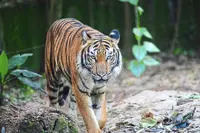
SUNGKAI: A Malayan Tiger will be released into its natural habitat from the National Wildlife Rescue Centre (NWRC) here for the very first time early next month.
Natural Resources and Environmental Sustainability Minister Datuk Seri Arthur Joseph Kurup said the female Malayan tiger, named ‘Yong Choh’, was found to be in good health and sufficiently aggressive to survive independently after being captured by the Department of Wildlife and National Parks (Perhilitan) in Sungai Choh, Ulu Kinta on July 22.
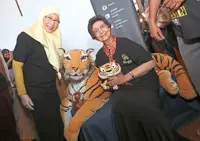
"We are planning to release this animal (Yong Choh) into its natural habitat in early September,” he said at a press conference after attending the Minister’s Working Visit Programme to the NWRC here on Friday (Aug 21).
He also shared that under the Malayan Tiger Breeding-in-Captivity Programme (MyBIT), which began in 2023, a total of 13 tiger cubs had been born, with nine surviving and continuing to grow at the NWRC.
The MyBIT programme recorded significant success in 2026, with five tiger cubs born as of July 28 to the breeding pair ‘Mek Santong’ and ‘Yeop Kuang’ and the pair successfully produced two litters in the same year, in January and July.
"The cubs are still being monitored, fed and carefully cared for. Most importantly, we need to ensure that they are sufficiently healthy.
"After that, we will assess their condition, but we usually wait a few years to see whether they can be acclimatised to a habitat before considering releasing them into their natural habitat,” he said, adding that the priority was to preserve and ensure the safety of the animals, particularly endangered species, before plans are made to release them into their natural habitats.
According to Arthur, MyBIT has recorded four birth events involving three breeding pairs: Cindai and Bobby (one cub on April 12, 2025); Mek Santong and Yeop Kuang (three cubs on Jan 2, 2026, and five cubs on July 28, 2026); and Queen and Awe Jeli (four cubs on March 7, 2026).
Arthur said the MyBIT programme also plays a role in increasing the tiger population, maintaining genetic diversity, providing individuals for conservation strategies and strengthening local expertise in captive tiger breeding management.
"And if there is a need, we acknowledge that this is one of the only wildlife rescue centres in Peninsular Malaysia and we still have plenty of space.
"So far, we are only using about 24 acres, but this reserve covers around 3,000 acres. Therefore, if there is a need to further increase capacity, we can work towards that,” he said. - Bernama