‘It should be part of occupational risk management’
PETALING JAYA: Stringent drug testing should not be a requirement only for the aviation industry but also for other high-risk sectors.
While employers say that the deed of beating a drug test by faking the specimen is not prevalent in Malaysia, an employee who had been found guilty of doing so can face dismissal.
One such high-risk industry that carries out strict tests is the trucking industry.
ALSO READ: When another’s sample is used to cheat drug tests
Malaysia Trucking Federation president Datuk Ng Koong Sinn said drug and alcohol tests for potential new drivers are carried out without any prior information being relayed.
“We just call them up and get them to the clinic for the tests.
“For existing drivers, companies will select 10% of their pool and conduct random tests as well,” he said, adding that this ensures test results are not tampered with.
ALSO READ: Airlines step up drug, alcohol tests
Ng also said there are procedures in place to check whether drivers are carrying any prohibited substances in their vehicles before leaving on their trips.
“These inspections are carried out together with checks on other aspects of the vehicle such as the tyre conditions and more,” he said.
Veteran criminologist Datuk P. Sundramoorthy said the recent arrest of the Malaysian pilot for drug trafficking calls for wider drug testing in high-risk occupations.
“The central question should be how to reduce risk to public safety while maintaining fairness, proportionality and the rights of employees.
“Not every occupation carries the same potential consequences when an individual is impaired by drugs.
“Therefore, Malaysia should consider adopting a risk-based drug-vetting framework, rather than simply expanding testing across the entire workforce. Occupations where impaired judgment could result in multiple deaths or serious public harm should receive the highest priority.
“Commercial pilots are an obvious category.
“Others could include air-traffic controllers, ship and ferry crews, train drivers and other railway safety personnel, heavy vehicle and public bus drivers, hazardous-materials transport operators, certain industrial workers operating heavy machinery, and personnel responsible for critical infrastructure or high-risk chemical and energy facilities,” he said.
He added that the goal should not be to criminalise workers, but to ensure those entrusted with “significant” responsibilities are fit for “safety-critical” jobs.
“However, random testing must be designed carefully. A positive test does not automatically establish that a person was impaired while performing their duties, nor does it necessarily establish involvement in drug trafficking.
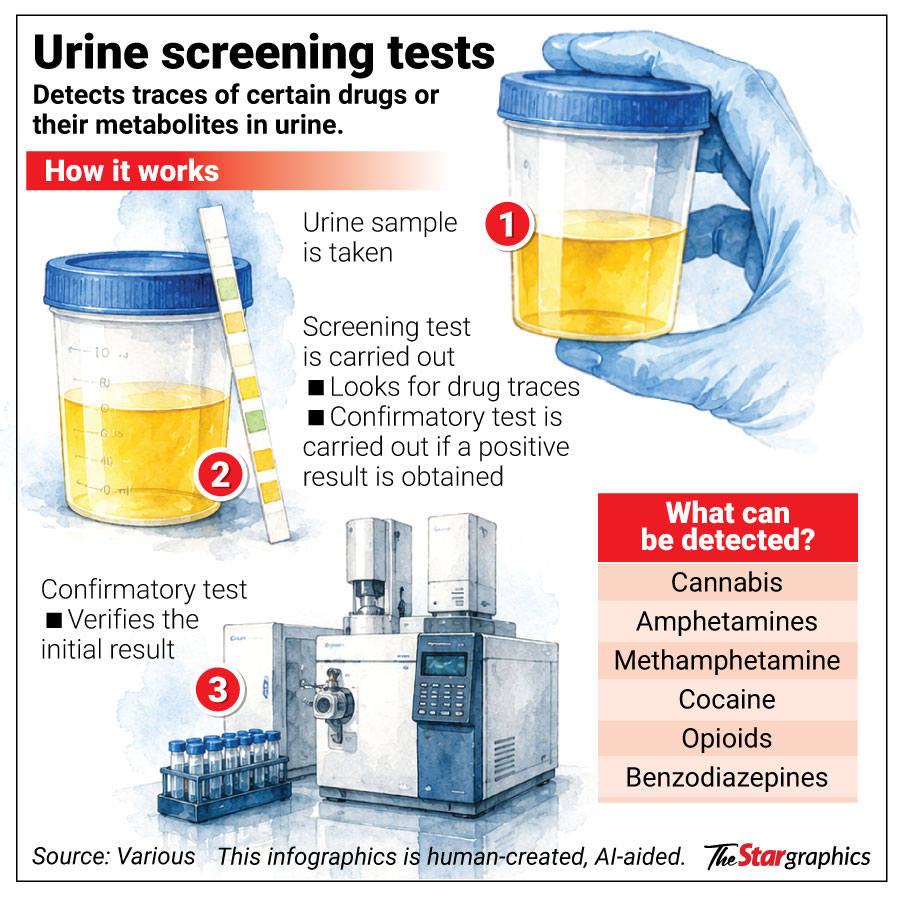
“Testing protocols, therefore, need clear scientific standards, confirmatory testing, confidentiality safeguards and a transparent process for challenging results.
“Employers should also distinguish between drug use, impairment, dependency and criminal trafficking, because these are criminologically and legally different phenomena,” he said.
He also reiterated that a positive result should lead to treatment and rehabilitation where appropriate.
“Where appropriate, individuals with substance use problems should be offered assessment, treatment and rehabilitation, while trafficking, deliberate concealment and conduct that places public safety at serious risk should attract much stronger sanctions.
“Ultimately, the objective should be prevention rather than punishment. Drug testing should form one component of a broader occupational risk management strategy.”
Malaysian Employers Federation (MEF) president Datuk Dr Syed Hussain Syed Husman said companies generally rely on qualified medical practitioners and accredited medical centres to conduct pre-employment medical examinations, adding that employers expect healthcare providers to adhere to established medical protocols and professional standards to ensure the integrity and reliability of the testing process.
He said the substitution of urine samples with someone else’s urine is not prevalent or a major concern, as medical centres have standard operating procedures in place to safeguard the testing process.
At this stage, MEF has no evidence to suggest that fake urine samples represent a widespread concern requiring major changes to current practices.
“These may include proper identification of individuals, supervised sample collection where appropriate, specimen handling protocols and chain-of-custody procedures for tests that require a higher level of assurance,” he said.
“If an employer subsequently discovers that an applicant had deliberately falsified a medical test result, the employer would normally assess the matter based on the facts and the company’s policies.
“Such conduct may amount to dishonesty or misrepresentation during the recruitment process, and appropriate action will be taken in accordance with the terms of employment which normally will lead to dismissal,” he said.
He proposed risk-based procedures to be implemented instead of one that applies across the board, which in turn could burden employers.
Among them are continuously reviewing and strengthening standard operating procedures by medical centres, adoption of enhanced identity verification and specimen-handling procedures where necessary, and maintaining strict chain-of- custody procedures for safety-sensitive or high-risk occupations.
“Maintaining the integrity of pre-employment medical examinations is a shared responsibility.
“Employers depend on qualified medical professionals to conduct these examinations professionally, while applicants are expected to provide truthful and accurate information throughout the recruitment process,” he said.
He added that ongoing collaboration between employers’ healthcare providers and the relevant authorities are also necessary to ensure pre-employment medical screening remains credible, efficient and trusted.