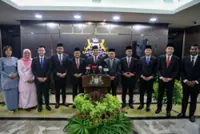
JOHOR BARU: Johor Mentri Besar Datuk Onn Hafiz Ghazi has defended the appointment of 10 deputy state executive councillors, saying the move falls within the state government’s administrative powers and does not alter the state’s executive structure or create new decision-making authority.
Onn Hafiz said the appointments were made after taking into account advice from the Johor State Legal Adviser and were intended solely to strengthen the state’s administrative capacity.
“While the government respects the right of all parties to express their views, it is important that the matter is viewed comprehensively based on the principles of governance, current needs and the legal position,” he said in a Facebook post here on Friday (July 24).
He was responding to criticism and political attacks from several Pakatan Harapan leaders over the appointments.
Onn Hafiz stressed that the state deputy executive councillors are not members of the Johor state executive council and therefore do not possess executive decision-making powers.
He said they would not attend state executive council meetings and have no authority to approve policies, financial matters or executive decisions, adding that all decision-making powers remain solely with members of the state executive council as provided under the Johor state Constitution.
“As such, these appointments do not create any new executive powers, transfer the authority of state executive council members or change the state government’s administrative structure.
“Neither do they alter the mandate given by the people through the elections. Instead, they serve as an administrative mechanism to strengthen policy implementation and the delivery of government services,” he added.
Onn Hafiz also dismissed claims that the appointments were aimed at expanding political positions or increasing bureaucracy.
Instead, he said the deputy exco members would help improve the efficiency of policy implementation, project monitoring and the resolution of issues affecting the people.
He said Johor was currently driving several strategic initiatives, including the Johor Economic Transformation Plan (JETP), the Johor-Singapore Special Economic Zone (JS-SEZ), the Rapid Transit System (RTS) Link and various high-impact projects targeted for completion by 2030.
“With these developments, the state’s administrative capacity must also be strengthened so that every policy can be translated into actions and outcomes that benefit Bangsa Johor,” he said.
Onn Hafiz added that the appointments had been made after considering the state’s financial capability and would involve only minimal financial implications through the use of existing government assets and facilities.
He said no new portfolios had been created and there would be no expansion of the state’s administrative structure that would burden public finances.
The Mentri Besar reiterated that the Johor government remained committed to administering the state in a transparent, prudent and responsible manner, with every decision guided by the interests of the people, current needs and efforts to strengthen the state’s administrative capabilities.
The Johor government recently announced the appointment of 10 deputy excos to assist members of the state executive council in carrying out their duties.
The move drew criticism from Pakatan leaders, who questioned the legality of the appointments and whether they would result in additional political positions and public expenditure.