
PETALING JAYA: Experts are divided over the Cabinet’s decision to introduce a road accident compensation mechanism, with some questioning its viability for low-income offenders and others hailing it as a breakthrough for driver accountability.
While safety advocates praise the move as a necessary step to address Malaysia’s surging road accidents, legal experts caution that the proposal could conflict with existing insurance frameworks and public sentiment.
Assoc Prof Dr Law Teik Hua, who heads the Universiti Putra Malaysia (UPM) Road Safety Research Centre, backed the proposal, calling it a positive step towards driving up accountability.
“Beyond fines, imprisonment and licence suspensions, requiring offenders to compensate victims or their families reinforces the principle that road crashes carry significant social and economic consequences,” he said.
Yesterday, Transport Minister Anthony Loke announced that the Cabinet agreed in principle to amend the Road Transport Act 1987 (Act 333), for court-ordered compensation to victims of serious traffic offences.
This would be an additional penalty for those found guilty, alongside existing punishments like jail time and fines.
While supportive, Law stressed that clear implementation guidelines are vital, especially regarding an offender’s financial status.
“The detailed implementation mechanism will be crucial. Considerations such as the assessment of compensation amounts, cases involving uninsured or financially incapable offenders, and coordination with existing insurance and civil claim processes will need careful attention to ensure the system remains fair, practical and effective,” he added.
Malaysian Road and Transportation Safety Association president Md Hairolazaman Muhamed Nor said the amendment could bypass lengthy, expensive civil suits and expedite compensation for victims.
“Launching a civil suit requires upfront capital to retain lawyers, which many low- or middle-income victims cannot afford.
“By empowering criminal court judges to issue compensation orders automatically upon conviction, this policy will relieve families of the financial burden of hiring separate legal representation,” he said.
“Right now, a victim must wait for a criminal trial to conclude before launching an entirely separate civil lawsuit to seek financial damages.
“This traditional route can drag on for several years and incur hefty legal fees. The proposed law merges compensation directly into the criminal proceedings. If an offender is found guilty, the judge can order the payout immediately as part of the sentencing phase,” he added.
Former Malaysian Bar Council president Ragunath Kesavan questioned if the decision to implement the mechanism had been influenced by public sentiment.
“There are concerns if this was driven by public sentiment. Also, currently, accident victims have recourse from the insurance coverage of the other party.
“There are also questions as to whether this mechanism could compromise and reduce insurance compensation to victims. If payouts are made, would such payments also be covered by insurance?
“Also, if the guilty party is unable to pay, will it also reduce insurance payments?” he asked.
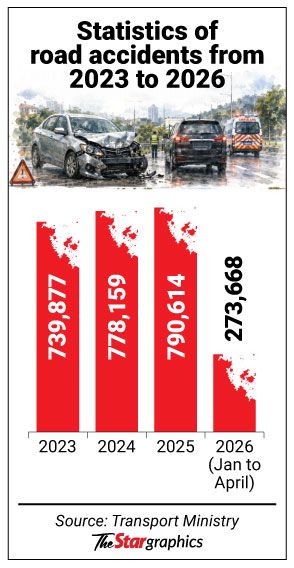
Last week, Loke revealed that road accidents in Malaysia continue to climb, with 273,668 crashes recorded in the first four months of 2026 following a record high in 2025.