PETALING JAYA: Experts are sounding the alarm over the emerging trend of fentanyl use in the country, warning that its potency – coupled with limited access to crucial overdose-reversal medication outside hospitals – could lead to more fatal overdoses.
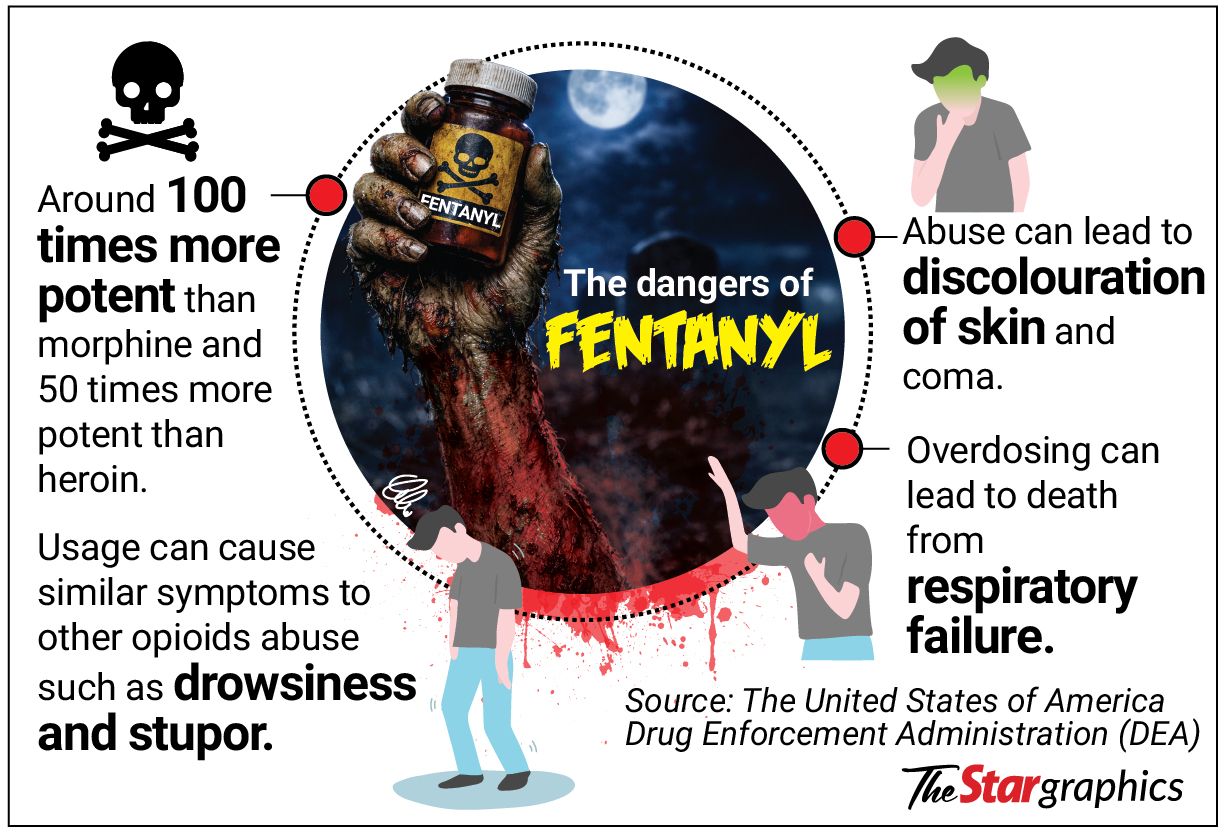
Malaysian Society for Harm Reduction (MHSR) president Prof Dr Sharifa Ezat Wan Puteh said fentanyl, an opioid used to relieve pain, is far more potent than morphine and heroin, and chemical testing is needed to confirm its use.
“It is also very difficult to test for it using the traditional method of urine screening.
“However, those already abusing other drugs are considered to be more likely to do the same with fentanyl,” she said.
ALSO READ: Slaying the ‘zombie’ threat on social media
She added that many users could also accidentally overdose because only small amounts are needed, while it would be difficult to prosecute them without clear confirmation of fentanyl use.
“Fentanyl derivatives are the largest and fastest-growing group of new synthetic opioids and thus mechanisms to detect fentanyl use, such as test strips, can be prepared to better screen or identify cases.
“While the rapid emergence of various fentanyl derivatives is designed to evade current legal laws, our chemical and narcotics departments need to work together and use more reliable and newer techniques,” she said.
Insaf Murni Association Malaysia (IMAM) president Dr Khafidz Ishak said there are fears that fentanyl has entered the illicit drug supply chain here and that there are important warning signs to watch for.
“Our Malaysian authorities are taking it seriously and some cases of fentanyl have been detected in the Klang Valley,” he said.
He added that a major concern over its use was “respiratory depression”, where a person stops breathing, as well as users becoming confused and appearing “zombie-like”.
“It is 50 times stronger than heroin and about a hundred times stronger than morphine. A person may become unconscious before realising they have taken too much.
“Some might not even be aware that fentanyl can already be mixed inside the drugs they are taking and street drugs can be contaminated with it without warning,” he said.
He added that naloxone, a medication that reverses opioid overdose, was not easily available in private clinics.
“In Malaysia, most private clinics are not equipped with tools like naloxone.
“However, hospital emergency departments are generally trained to manage opioid overdose and some healthcare facilities might have it available.
“Naloxone is crucial, as it can save lives within minutes, with it reversing the effects of respiratory depression (a disorder when breathing is too slow or shallow) long enough for emergency treatment,” he said.
Criminologist Datuk Dr P. Sundramoorthy noted that enforcement agencies might face challenges in detecting non-conventional delivery methods such as vape cartridges.
“From an enforcement perspective, vape cartridges can indeed pose certain challenges because they are small, portable, discreet and often resemble legitimate commercial products, making detection more difficult.
“However, law enforcement agencies must avoid becoming overly fixated on vapes alone, as traffickers and users may quickly shift to alternative methods once attention intensifies on a particular trend.
“Therefore, enforcement strategies should remain broad, intelligence-driven, adaptive and technologically informed, rather than concentrating solely on one consumption mechanism or concealment technique,” he said.
He added that vapes were only one of many delivery methods and that it was unlikely users would limit themselves to just one particular method.