KUALA LUMPUR: The government will provide funding support for the Elevated Autonomous Rapid Transit (E-ART) project in Johor after assessments found that the large-scale transport initiative is not fully viable if it relies solely on private financing, the Dewan Rakyat heard.
Transport Minister Anthony Loke said the financing structure, level of government commitment and repayment mechanism are currently being finalised and will be presented to the Cabinet for approval before the concession agreement is signed.
“In principle, the initial project financing was to be borne by the appointed consortium.
“However, the current assessment shows that this large-scale infrastructure project is not viable if it relies solely on private sector financing.
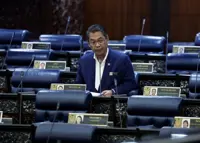
“As such, the agreed terms will subsequently be submitted to the Cabinet for consideration and approval prior to the signing of the concession agreement,” he said during a question and answer session in the Dewan Rakyat on Thursday (July 2).
Based on a comprehensive assessment that has been carried out, the contract award was made in the form of a Letter of Intent (LOI) in May to a consortium comprising DOM Industries (M) Sdn Bhd, MMC Engineering Sdn Bhd, BTS Group Holdings Public Company Limited (Bangkok) and Nylex (Malaysia) Bhd, he said.
Loke was responding to Datuk Seri Dr Wee Ka Siong (Barisan Nasional–Ayer Hitam) who enquired about the implementation status of the Johor E-ART project, specifically whether federal funding will be provided directly or through a concession model involving private sector participation.
Dr Wee had also asked for projections on expected traffic congestion when the Rapid Transit System (RTS) Link begins operations in January 2027, ahead of the completion of the E-ART project.
Dr Wee previously said Putrajaya should allocate at least RM10bil directly to the Johor government to take over and implement the E-ART project.
He said that if the federal government cannot provide a firm timeline, issue the Letter of Award (LOA) and demonstrate the urgency required, then it should provide the allocation to Johor and allow the state government to move the project forward.
Meanwhile, Loke said the E-ART project is expected to be completed within four years from the issuance of the LOA.
He also said the ministry, in collaboration with the Johor state government, has developed a traffic dispersal plan to strengthen existing public transport services.
The plan includes the expansion of the Bus Stop Transit which will extend services to 28 routes using 254 buses, including electric buses.
“Of these, 157 buses will serve the JB Sentral/Bukit Chagar corridor. This phase is expected to begin in early 2027.
“A high-frequency RTS shuttle bus service will also be introduced to connect JB Sentral/Bukit Chagar with surrounding areas,” he said.
Additionally, a Demand Responsive Transit (DRT) system will be enhanced to provide more flexible first- and last-mile connectivity from key transport hubs.
To improve bus flow, 16 dedicated bus lanes will be introduced, including along the Skudai (5.6km) and Tebrau (10.3km) corridors.