



PETALING JAYA: Buying specific high-demand trading cards and selling them later for a higher price, otherwise known as card flipping, has proven to be a lucrative gig for collectors, with some boasting profits of 100% over their initial purchases.
Ranging from as low as RM30 to hundreds of thousands of ringgit, the venture is considered a “gold mine” for card flippers.
One such card flipper, who wished to be known only as Galio, said the local market has collectors who are willing to spend big money on specific cards.
“In the four years that I have done this, I’ve seen the profit range between 20% and 100% over the initial purchase cost. In the last six months, I would say that I have averaged in the 50% range for my margins.
“It really depends on the local supply and demand, which in turn is influenced by certain cards and their perception of value,” he said in an interview recently.
The “Fomo” (fear of missing out) trend also affects the value of the cards, he said.
“There are also times when prices can be the highest in the short term, where sellers can maximise profit within a short time frame.
“I target new packs every two to four months and look out for cards with a history of doing well in the market,” he added.
He cited Van Gogh Museum’s Pokemon card titled “Pikachu with Grey Felt Hat” with a collectable listing website listing ungraded cards at US$979 (RM3,969).
“I personally have a special promotion card from the Pokemon Centre in Japan that is currently valued at US$600 (RM2,433) to US$1,000 (RM4,055), but I don’t have plans to sell it,” he said.
Walter, another card flipper, said he has mainly dealt with One Piece (a popular anime) cards for the last four years.
He noted that the tournament scene in Malaysia is robust and players would compete for “prize cards” that are unavailable after a certain period.
“These cards are valued very highly, with some reaching around RM100,000 per card in the Japanese market.
“Joining these competitions is not too expensive, with entry fees of around RM35 and an additional RM200 to RM600 to build a competitive playing deck.
“It’s hard to find buyers who would spend that much here so I need to locate buyers overseas, in particular Japan,” Walter added.
A card shop owner, who only wanted to be known as Ahmad, said he has noticed more people taking up the hobby with the sole aim of making money.
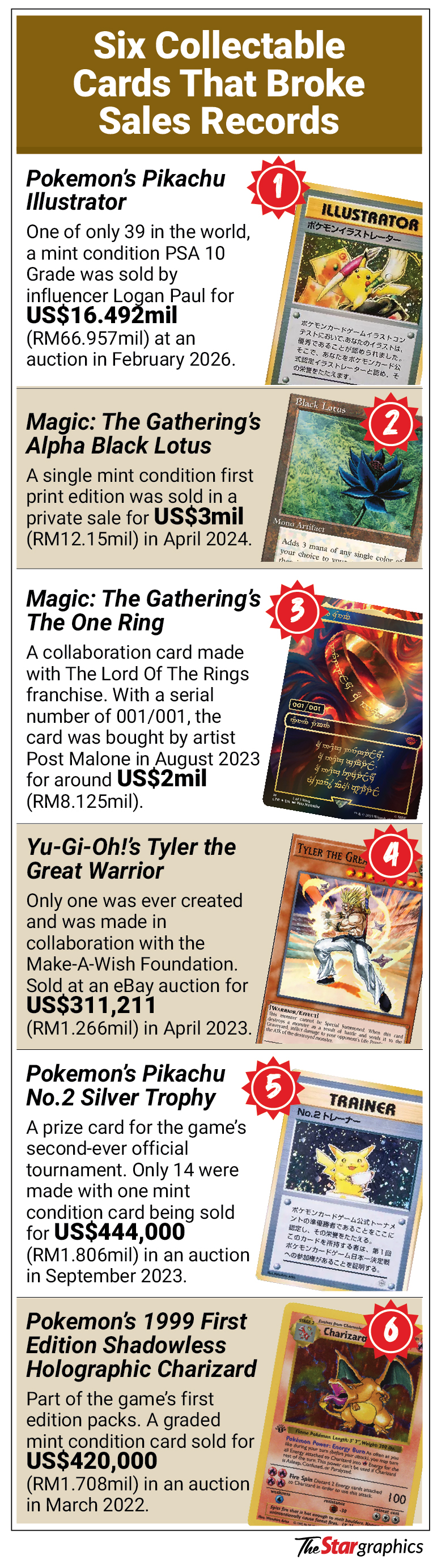
He said investing in trading card games (TCG) became popular after major social media influencer Logan Paul made headlines selling his Pokemon PSA 10 Pikachu Illustrator.
“There have been more scalpers than ever, which makes it hard for the actual players or collectors, especially children, to buy any sealed products.
“These scalpers will buy new and high-demand products, and then resell them at very high prices quickly,” the 46-year-old said.
“This is why we usually try to stop them by limiting the maximum number of products a person can buy, especially for in-demand sealed products.”
Ahmad, who has been running his card store since 2012, said most high-value transactions in the TCG are done at big events such as TCGKL.
“The most in-demand cards collectors look for are the super illustration rare and vintage cards for Pokemon TCG and mostly manga art rarity for the One Piece TCG.
“Many also come to my store looking for graded cards that are also available for high collector value and can be made as assets, but we don’t sell those here,” he said.
