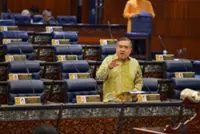
JOHOR BARU: The Elevated Autonomous Rapid Transit (E-Art) system should be implemented as soon as possible as a crucial link to prevent the city area from being paralysed due to the rapid development taking place here, says MCA president Datuk Seri Dr Wee Ka Siong (pic).
He noted that the Electric Train Service (ETS) between Kuala Lumpur and Johor Baru had already begun operations last year, while the Rapid Transit System (RTS) Link is expected to begin operations early next year.
“All these will drastically increase the movement of people, investments and economic activities. However, there is still no proper feeder or traffic dispersal system in place, which risks turning the city centre into a huge bottleneck when passengers from the RTS, ETS, buses, e-hailing services and private vehicles converge in the same area,” he said in a Facebook post yesterday.
Dr Wee said Johor Baru is entering a critical phase of development, especially with the RTS linking the city to Singapore, the ETS connecting JB Sentral to Kuala Lumpur, and the Johor-Singapore Special Economic Zone (JS-SEZ).
He questioned how passengers arriving from Singapore and Kuala Lumpur via the RTS and ETS would continue their journeys within the city.
“With the RTS carrying 10,000 passengers per hour in one direction, even if half use buses and the other half use private vehicles, the city centre would need to accommodate around 142 buses and 1,000 cars every hour,” he said, noting that an estimated 280,000 people are expected to use the RTS Link daily at full capacity.
“Imagine the number of buses and cars around Bukit Chagar every hour without an efficient, high-capacity feeder system.”
Dr Wee noted that the Johor government had first proposed the E-Art project in April 2024, but the letter of intent (LOI) was only issued on May 5 this year.
“This is already too late for a project that is vital not only for Johor but also for the national economy,” he said.
He urged the federal government, particularly the Transport and Finance Ministries, to prioritise the implementation of the E-Art system in Johor Baru.
Dr Wee also called on the federal government to clarify the actual scope of the project as the original proposal by the Johor government involved an elevated rubber-tyred transit system, which would be more flexible and faster to implement with lower start-up cost.
“However, based on media reports, the consortium that received the LOI is proposing an automated people mover system that is rail-based, which is usually more expensive and takes longer to complete,” he said.
“The people of Johor have the right to know whether this is still the same E-Art project proposed by the state government or whether the scope has changed.”
Dr Wee also urged the federal government to fast-track approvals involving technical alignments, station integration, park-and-ride facilities and feeder bus systems.
“This E-Art project should be made the country’s top public transport priority and operations should begin as soon as possible,” he said, adding that if the federal government can fast-track a project in Penang, then the Johor Baru project should also be accelerated.
“We should not wait until Johor Baru becomes paralysed before taking action.”