
PETALING JAYA: The Domestic Violence Act 1994 and Personal Data Protection Act 2010 should be amended to provide a clear statutory basis for a domestic violence register, say experts dealing with victims.
Association of Women Lawyers (AWL) vice-president Denise Lim and exco member Meera Samanther recommended that the domestic violence registry be set up through a coordinated, multi-agency framework.
“At present, a person may only verify their own marital status with an existing spouse, not that of a prospective partner.
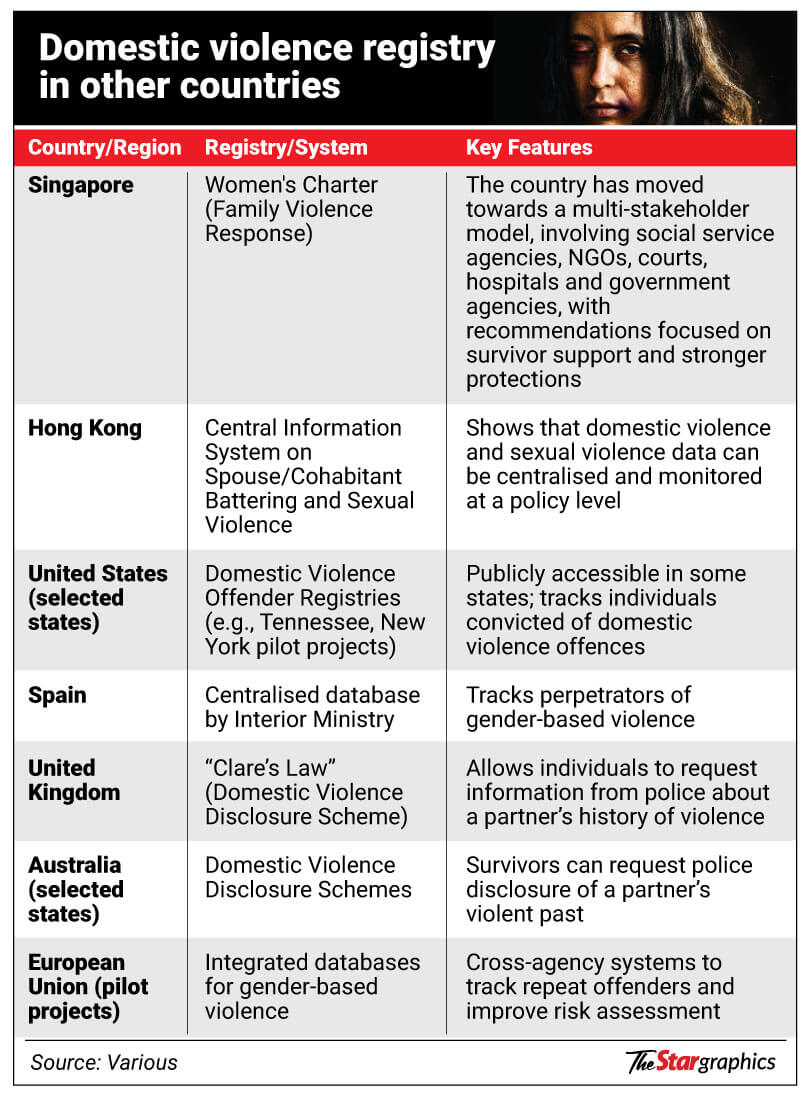
“This creates a gap in protection, as by the time a marriage is concluded, victims may already face legal and practical barriers to exit,” said Lim and Meera in a joint statement.
The registry, they said, could be placed under the Welfare Department, as it must operate in close coordination with other key agencies.
“This includes the National Registration Department (NRD) for marriage registration and identity verification, and law enforcement bodies such as the police and courts, which generate and rely on criminal and protection-related data.”
However, such a registry should be accessible only to enable checks on prospective spouses, they say, because unrestricted access may create a significant risk of misuse, such as harassment, vigilantism or reputational harm.
“A more proportionate approach would be to limit disclosure to specific legal contexts, such as marriage applications, where there is a clear and legitimate need for such information,” said Lim and Meera.
Malaysian Muslim Lawyers Association president Muhamad Hisham Marzuki said the shariah court currently does not have jurisdiction pertaining to domestic violence cases.
He said the religious department should not be held accountable for the recent case involving a convicted domestic violence offender who managed to marry nine times without their scrutiny.
“The religious department’s duty is to ensure that the marriage is registered according to the law. Regardless of how many times the applicant has been married, this matter is beyond the control of the religious department,” he said.
Women’s Aid Organisation (WAO) executive director Nazreen Nizam said domestic violence is often a pattern of coercive control, threats, intimidation and escalating violence.
“A man with multiple past reports, criminal records, previous victims and ongoing court proceedings should not be invisible to the system,” she said.
“Yet, this can happen when agencies operate in silos; the police may have one set of records, the courts another, welfare another, health services another, and marriage-related authorities (NRD and religious state agencies) may not be alerted to serious risk histories.”
Nazreen said the system must move from a complaint-by-complaint approach to a perpetrator-pattern approach.
“There should be stronger bail safeguards and monitoring in cases with a known history of domestic violence.
“Furthermore, immediate inter-agency case conferencing should be implemented for high-risk cases, alongside active tracking of protection order breaches.
“Additionally, a clear protocol for information sharing is essential. This will enable a perpetrator’s history to be used to create a foreseeable risk to another woman or child,” she added.
WAO handled 630 hotline calls and 1,415 WhatsApp enquiries related to domestic violence in 2025 alone.
Those seeking help or who are aware of victims of domestic violence may contact the police or reach out to Talian Kasih at 15999 or via WhatsApp at 019-251 5999.