



PETALING JAYA: The presence of the Undang, or the ruling chiefs, at the Negri Sembilan state assembly is customary rather than legally required, says a legal expert.
Constitutional expert Lim Wei Jiet said their absence from yesterday’s official opening ceremony of the state legislative assembly does not invalidate the meeting.
“Although it is customary for the four Undang to be present, the state assembly meeting is not invalidated just because the four Undang were not present,” he said.
He said the meeting would also continue.
“As for the adjournment of a legislative assembly meeting, it happens sometimes and is not something unusual,” he said.
While legally it may not invalidate the meeting, political pundits view this as an early warning sign.
Ilham Centre chief executive officer Hisommudin Bakar viewed the situation as an early warning of institutional vulnerability rather than an indication of political collapse.
“The postponement of next week’s meeting without a clear explanation also politically opens the door to speculation that there is uncertainty at the level of state administration,” he said.
The absence of the ruling chiefs, he said, has opened “a serious new chapter” regarding the dispute over the legitimacy of the Yang di-Pertuan Besar’s position.
“This development should not be viewed merely as a matter of protocol, but rather, it carries broader legal, customary, political and institutional stability dimensions,” he said.
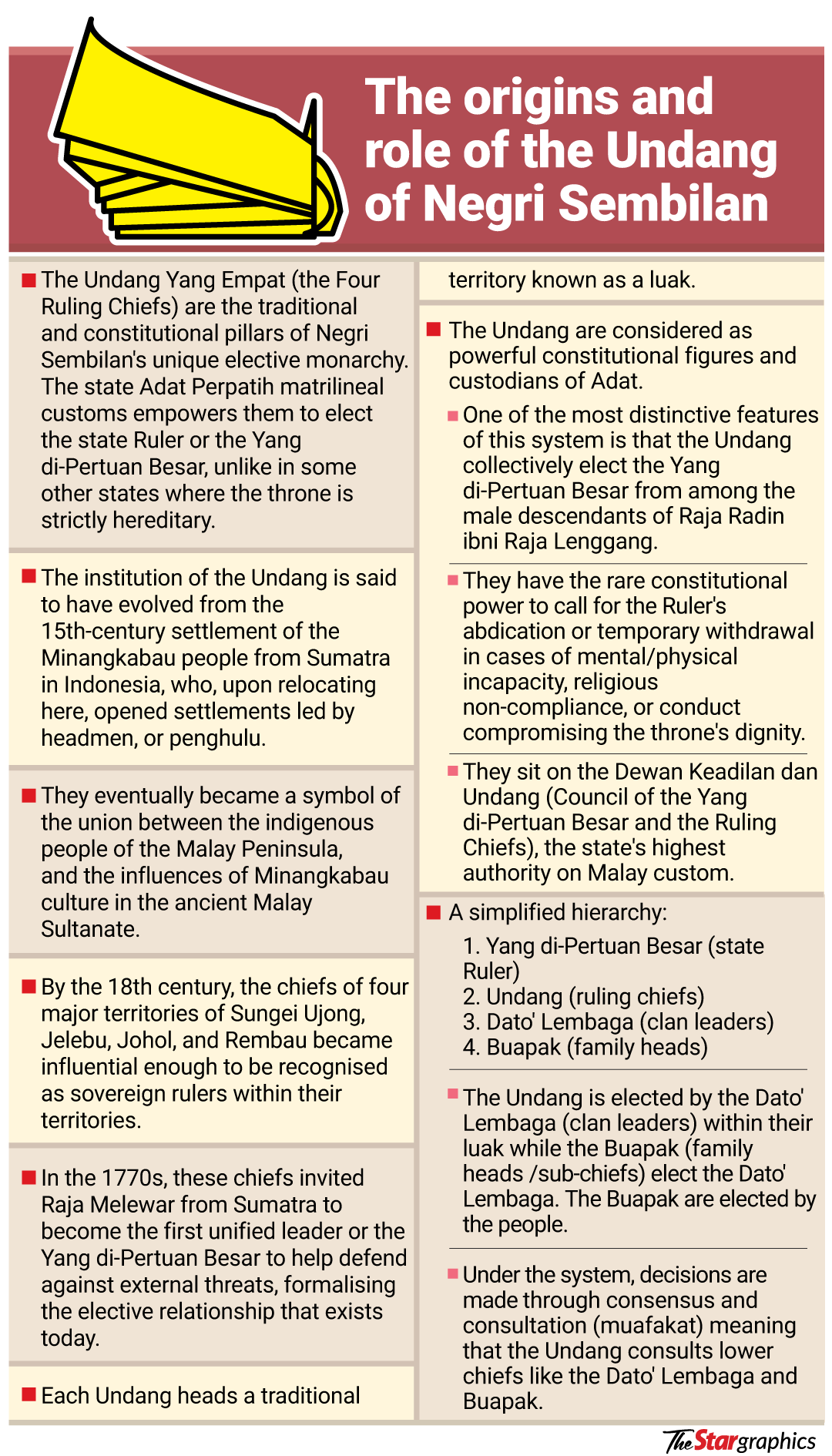
“This situation tests the capacity of the Adat Perpatih system as a unique institutional system to resolve disputes in a prudent and dignified manner,” he said.
“If a resolution is not reached promptly, it risks creating public unease, particularly in the areas of the four Undang, who play a direct role in the structure of the state’s governing legitimacy.”
He said any prolonged ambiguity may give rise to perceptions of political and institutional instability, which could put the state government and the mentri besar in a difficult political dilemma, as any stance taken could be interpreted as taking sides in an ongoing dispute.
Universiti Malaya socio-political analyst Prof Datuk Dr Awang Azman Awang Pawi said the matter should not necessarily be interpreted as an immediate sign of serious instability.
“In a constitutional monarchy system, particularly within the context of custom and institutions in Negri Sembilan, such actions may also be understood as a cautious space to ease tensions, recalibrate processes, and ensure that any decisions are made in an orderly manner, grounded in procedure and institutional wisdom.
“In that sense, it can be seen as a signal of institutional vigilance rather than a crisis,” he said.
On possible scenarios going forward, he said the state assembly meeting could proceed after consultations and coordination, with key institutions playing a role in stabilising the situation.
Alternatively, there could be a temporary postponement to allow space for resolution through legal, constitutional, or elite consultative channels, he said.
“Thirdly, this situation may act as a catalyst for reaffirming rules and boundaries of authority so that governance can move forward more clearly,” he said.
He said episodes like this could ultimately lead to a restructuring that strengthens legitimacy rather than weakening it.
