
KUALA LUMPUR: Tan Sri Azam Baki stayed cool in the heat of things when two men carrying banners disrupted his keynote address at an event here.
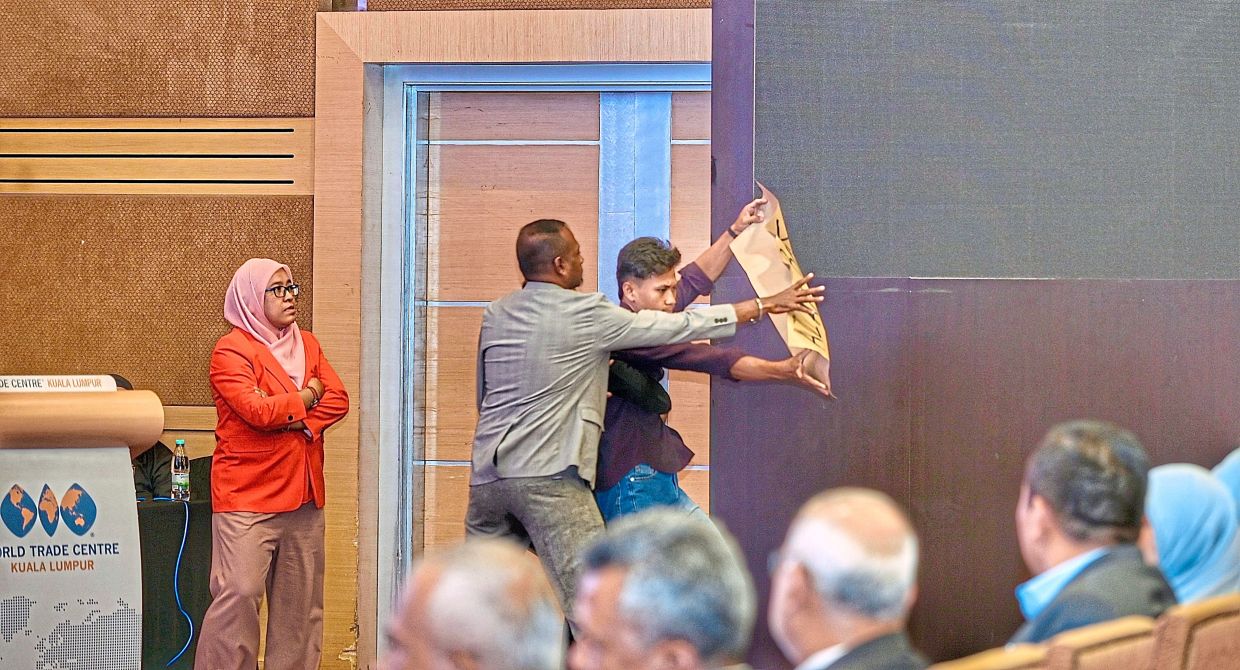
The Malaysian Anti-Corruption Commission (MACC) chief commissioner was speaking at the Wacana Ilmiah Perdana programme when one man shouted and rushed towards the front of the stage, causing a brief commotion.
Security personnel acted swiftly to contain the situation, escorting him out of the hall. Another man was seen standing at the back, displaying a banner.
Azam, however, remained composed and even lightened the mood with a spontaneous remark.
“Don’t switch your TV (channel),” he quipped before continuing with his speech yesterday.
Reporters on the scene observed that both men were wearing T-shirts bearing the word “Mandiri”.
It is understood that the same group is planning to hold a gathering on April 25 at Dataran Merdeka, calling for a thorough and transparent investigation into issues surrounding Azam’s alleged share ownership, as well as claims involving a “corporate mafia” which are said to have affected the MACC’s reputation.
In his speech, Azam said combating corruption requires more than laws and enforcement. Instead, it demands strong leadership, systemic reform, and a society-wide commitment to integrity.
“Corruption today is no longer confined to isolated acts.
“It has grown into organised, cross-border activities, including highly sophisticated financial crimes that leverage global networks and digital tools,” he said at the event held at the World Trade Centre here.
However, he said, corruption stems from weaknesses and gaps in governance systems.
“During Malaysia’s rapid development phases in the 1980s, 1990s and post-2000 period, the focus was largely on economic growth and infrastructure, with governance and integrity receiving comparatively less emphasis.
“Now that the nation has matured, we need to strengthen our systems, address weaknesses, and ensure integrity, which is the foundation of national development,” he said.
He added that while laws can punish wrongdoing, only integrity can prevent it.
To address this, MACC has adopted a “three-pronged approach”, focusing on effective enforcement, comprehensive prevention and efficient management, Azam said, adding that leadership was crucial.
“Strong political will, which is clear, firm and uncompromising, can drive reform even in imperfect systems,” he said.
He cited the National Anti-Corruption Strategy (NACS) 2024-2028 as a comprehensive and proactive framework to enhance governance, integrity and accountability.
Azam said MACC was shifting towards a proactive, risk-based and data-driven approach.
This includes developing a Corruption Risk Register and leveraging data analytics to identify high-risk sectors such as government procurement, enforcement agencies and public fund management.
“Our goal is not just to punish corruption but to build systems where it becomes difficult to occur,” he said.

Azam also highlighted education as a critical pillar in cultivating integrity.
He pointed to initiatives such as anti-corruption education programmes in schools, including the Wira Anti-Rasuah campaign, as well as the Integrity and Anti-Corruption Course (KIAR), which has been made compulsory for new students in higher education institutions since September 2023.
“These programmes aim to nurture a generation that rejects the abuse of power, upholds principles and makes ethical decisions,” he added.
“Corruption involves networks across sectors – public, corporate, financial and international.
“Our response must be equally comprehensive,” he said.