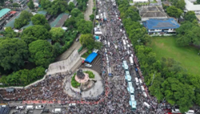
BAGUIO CITY: Around 5,000 students from major Benguet universities staged synchronized classroom walkouts that culminated in a centralized protest in Baguio on Tuesday (Nov 18), denouncing government corruption amid ongoing national budget controversies.
The demonstrations followed businessman Elizaldy “Zaldy” Co’s claim that President Ferdinand Marcos Jr and former House Speaker Martin Romualdez ordered P100 billion in budget insertions in the proposed 2025 national budget—P81 billion of which allegedly went to the Department of Public Works and Highways, according to Inquirer reports.
Malacanang has strongly denied the accusations.
Student groups said widespread corruption has robbed schools of much-needed resources, leaving them with inadequate services, outdated facilities, and cramped learning spaces despite rising education costs.
Representatives from Saint Louis University (SLU)—the largest university in Baguio—criticized the yearly tuition increases, saying students have not felt proportional improvements in campus services.
Earlier this year, SLU implemented a 6.25 per cent increase in tuition and other fees for incoming first-year students, and a 6.25% rise in other fees for all other year levels, according to a Feb 26 joint statement by the administration and the student council. The initial proposal had been a 9% hike.
Mark Toreno, SLU Supreme Student Council (SSC) president, said in Filipino that their presence at the protest showed their demands were “not being listened to,” and that students were being forced to shoulder “education with price tags.”
Another SLU student representative, Gab Balingit, added that education must be a state-guaranteed right, not “a privilege that must be paid for.”
At the University of the Philippines Baguio, students reiterated long-standing calls for increased funding amid numerous unfinished infrastructure projects on campus.
Student council member James Barra said UP students would “continue to suffer shrinking spaces and insufficient student services” after the university was again shortchanged in the national budget. UP requested P46.85 billion for fiscal year 2026, but only P25.8 billion was allocated in the National Expenditure Program, according to an Aug 13 statement from the UP Office of the Student Regent.
At Benguet State University (BSU), administrators had earlier warned that the walkout was “not endorsed or supported” by the university. In a Nov 16 Facebook notice, BSU urged students to “weigh the potential consequences” and instead use “official and constructive avenues” for expressing their concerns.
Despite the advisory, many BSU students joined the walkout. Social science student Jude Segovia said they were tired of the university’s attempts to muffle student concerns.
“We’re tired of age-old buildings and the smell of sewage in our buildings. This will not be our last walkout,” he said in Filipino.
UP instructor Ides Macapanpan told the Inquirer that universities should not police students who participate in mass actions, stressing that protests are themselves a form of critical thinking and civic engagement.
“Corruption means that there is less for the education sector. This means classrooms will continue to shrink, and teachers will continue to be overworked,” she said.
Another protest related to the corruption scandal is scheduled for Nov 30, coinciding with the birth anniversary of Filipino revolutionary Andres Bonifacio. - Philippine Daily Inquirer/ANN