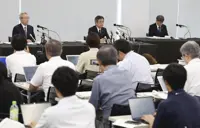
GEORGE TOWN: A report highlighting a growing imbalance in local university admissions will soon be made public, says Datuk Seri Dr Wee Ka Siong.
The MCA president said the report would support his claim that subsidised Universiti Pusat Unit (UPU) placements are shrinking, while full-fee places, although expanding, offer limited benefit to local students, particularly those from underprivileged backgrounds.
Citing an example, he said an electrical and electronic engineering intake at Universiti Kebangsaan Malaysia had about 17 Malaysian Chinese students compared with around 90 students from China, out of a total of 200 places.
“We can easily tell the difference just by looking at the surnames in the registry.
“For example, ‘Lee’ versus ‘Li’, ‘Ooi’ and ‘Ng’ versus ‘Huang’, ‘Wee’ versus ‘Wei’. From the spelling alone, we can identify who are locals and who are from China,” he said at the party’s state Chinese New Year dinner on Jalan Kelawai on Wednesday (March 18).
Dr Wee was referring to the contrast between Hanyu Pinyin, a standardised romanisation system for Mandarin pronunciation adopted in China in the 50s, and the dialect-based phonetic romanisation peculiar to Malaysian Chinese communities.
He said in the past, studying medicine under subsidised UPU placements cost about RM15,000, but now ranges from RM300,000 to RM500,000 under direct full-fee intake.
“For engineering courses, fees have increased by 10 to 13 times.
“This has deprived lower-income students of opportunities despite their capabilities,” he said.
Describing the situation as a “crisis”, Dr Wee said many local Chinese students are struggling to secure higher education.
“The number of subsidised places is shrinking, while more students are admitted through high-fee channels.
“In one intake, only one student entered through the subsidised route, while dozens entered through the high-fee route,” he said, expressing frustration over the lack of clarity in parliamentary replies.
While stressing that Malaysia welcomes international students, especially at postgraduate level, he questioned the rise in undergraduate intake if it comes at the expense of locals.
“I welcome international students, particularly at postgraduate level, but at undergraduate level, it must not disadvantage locals,” he said.
Dr Wee also claimed possible irregularities in admissions practices, adding that his report would detail such cases.
“I have completed a report on this issue and will make it public.
“In today’s world, nothing can be hidden. The truth will come out,” he said.
He attributed the trend to reduced government funding, which has pushed universities to rely more on fee-paying students.
Dr Wee said MCA-linked institutions have helped cushion the impact. Universiti Tunku Abdul Rahman (UTAR) and Tunku Abdul Rahman University of Management and Technology (TAR UMT) have collectively produced about 420,000 graduates from all races.
He said UTAR has produced 320,000 graduates over 57 years, while TAR UMT has produced 100,000 graduates.
“Without them, many students from struggling families would not have had the opportunity to pursue higher education,” he said.
Dr Wee added that the proportion of Chinese and Indian students in public universities has declined significantly.
“Today, it stands at about 11%, compared with more than 30% previously,” he said, citing Higher Education Ministry data.
He had earlier expressed frustration with parliamentary replies from the ministry, particularly on data involving undergraduate admissions through open channels at research universities and comparisons with UPU intake.
The ministry said research universities, as federal statutory bodies, must generate their own income in addition to receiving government allocations.