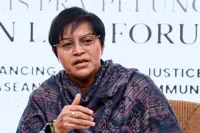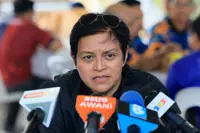
KUALA LUMPUR: The Parliamentary Special Select Committee (PSSC) aims to finalise its report on the proposed separation of the Attorney General (AG) and Public Prosecutor (PP) roles by mid-May, says Datuk Seri Azalina Othman Said (pic).
The Minister in the Prime Minister’s Department (Law and Institutional Reform) said the committee had scheduled several follow-up meetings to refine proposed amendments to the Federal Constitution before they are expected to be tabled during the parliamentary sitting in June.
The PSSC’s next meetings are set for April 9, 16 and 27, and May 4, with the target of finalising its report by May 18.
“The meeting on Monday also agreed to invite four legal and constitutional academics to provide views on the proposed amendments. Several NGOs will also be invited to submit written feedback, including objections, proposals, criticisms and alternative options.
“We want to gather as much input as possible from NGOs that have shown interest in constitutional matters,” she told reporters after the committee’s first meeting at Parliament yesterday.
According to Bernama, Azalina said preliminary discussions showed that MPs from both the government and opposition broadly agreed that separating the posts of AG and PP was necessary.
However, she noted that several issues required further scrutiny to ensure consensus before the amendments were tabled in Parliament.
Key parameters under discussion include the appointment mechanism, qualifications and restrictions, tenure and age limits, termination procedures and institutional accountability.
The committee will also examine the overall constitutional amendment Bill, including provisions relating to Articles 42, 132, 138, and 145, as well as the proposed new Articles 145A and 145B.
Responding to concerns raised by several PKR MPs over Parliament’s role in the appointment process, Azalina said the matter formed part of a broader discussion surrounding the proposed reform.
“I think most political parties understand the challenges that we are facing with certain positions.
“I am not going to deny that there is a big trust deficit today in reference to certain positions. I’m not talking about political positioning, I’m talking about certain posts,” she said.
Asked why stakeholder engagement sessions were held only after the Bill was tabled, Azalina said the approach was adopted to ensure the process was handled through the parliamentary select committee mechanism.
Although the proposed amendment involves fewer than 10 constitutional provisions, she said the Bill remained highly technical and required scrutiny.
“When it was presented, MPs from both sides asked for more time, more discussion and better understanding,” she said.
She added that the government was allowing the committee process to proceed to ensure a broader consensus, noting that the proposed split between the AG and PP was a historic institutional reform.
On whether the AG could be called to Parliament in the future, Azalina said it was still premature to comment in detail, but the expectation was that the AG, as the government’s legal adviser, might appear before Parliament.