PETALING JAYA: The days of pumping subsidised RON95 at RM1.99 per litre could be over if the Middle East conflict does not resolve within two months.
With crude oil prices soaring, Malaysians must be prepared to pay a higher price even for subsidised petrol, said Petroleum Dealers Association of Malaysia president Datuk Khairul Annuar Abdul Aziz.
“If the Strait of Hormuz remains closed after the next two months, the government will likely have to readjust the subsidised price.
“It would be completely financially unsustainable otherwise.
“Petroleum dealers’ costs will also increase since we have to buy at that new higher subsidised price,” he said.
The association is already making preparations. Khairul said they had already set up possible financing capital packages with banks.
These packages will give them additional rolling capital to sustain operations in the worst-case scenario where they have to buy RON95 at a higher price.
“A lot of people pay for petrol using credit cards and there is a 1% processing fee for that kind of payment, which eats into our margins.
“We are still discussing with Bank Negara Malaysia and the Finance Ministry on possibly reducing the 1% processing fee if the subsidised fuel price increases, but no resolution has been reached,” he said.
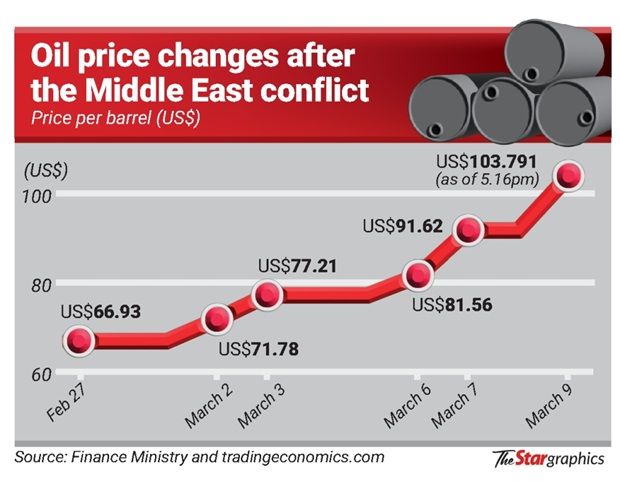
Universiti Malaya’s Social Wellbeing Research Centre director Emeritus Prof Datuk Norma Mansor said global oil prices could spike toward US$120 per barrel, or even US$150 in extreme scenarios.
“Such extreme levels are usually short-lived because high prices tend to trigger increased production from other countries, which help stabilise prices over time.
“But the government may need to accelerate further subsidy rationalisation or adjust fuel-pricing policies within the next one to two years if the conflict drags on,” she said.
She noted that Malaysia’s economy will both benefit and suffer if global oil prices increase.
“As an energy exporter, higher oil prices will increase government revenue, and contributions from PETRONAS. That can temporarily improve Malaysia’s trade balance.
“On the negative side, the government will have to absorb a large portion of the cost to maintain domestic subsidised fuel prices, which may limit fiscal space for other priority expenditures like education, healthcare and social protection,” she said.
High global energy prices will also increase operating costs for businesses, especially those in transport-intensive sectors such as logistics, manufacturing and agriculture, she said.
Centre for Market Education chief executive officer Carmelo Ferlito felt that global oil prices could retreat from the current panic levels if tensions ease.
“Currently though, the risk of a much higher range is real as long as [the Straits of] Hormuz remains impaired.
“If crude remains far above earlier assumptions for more than a few weeks or a couple of months, the subsidy burden will become increasingly difficult to defend,” he said.
“Subsidies drain fiscal room that could be used more productively elsewhere.
“We should start thinking about a fiscal system which is less dominated by oil revenues or subsidies, and instead, build on the sustainable pillars of responsible spending and fair taxation,” he said.