PETALING JAYA: As income tax filing season approaches and public attention has turned to the RM37,333 personal tax exemption threshold, taxpayers are calling for a broader overhaul of Malaysia’s personal tax relief system.
Besides an increasingly complex web of deductions, they are of the view that relief levels are outdated and no longer reflect the real cost of living.
Tax experts stressed that the tax-free income threshold should not be confused with the RM9,000 personal tax relief, as it is a technical outcome of Malaysia’s tax framework rather than a standalone policy measure.
The tax-free income threshold has been in place since the year of assessment 2023 and is derived from Malaysia’s progressive tax rate structure, a RM9,000 personal relief and a RM400 tax rebate for chargeable income of RM35,000 or below, said Datin Christine Koh, managing director of Owen KLCA PLT.
“However, the thresholds remain relatively low when measured against actual household expenditure, particularly for families.
“This is because tax reliefs apply only to specific categories of spending rather than overall living costs,” she said in an interview.
Koh said that several key reliefs, including the RM9,000 personal relief, have remained unchanged since 2010.
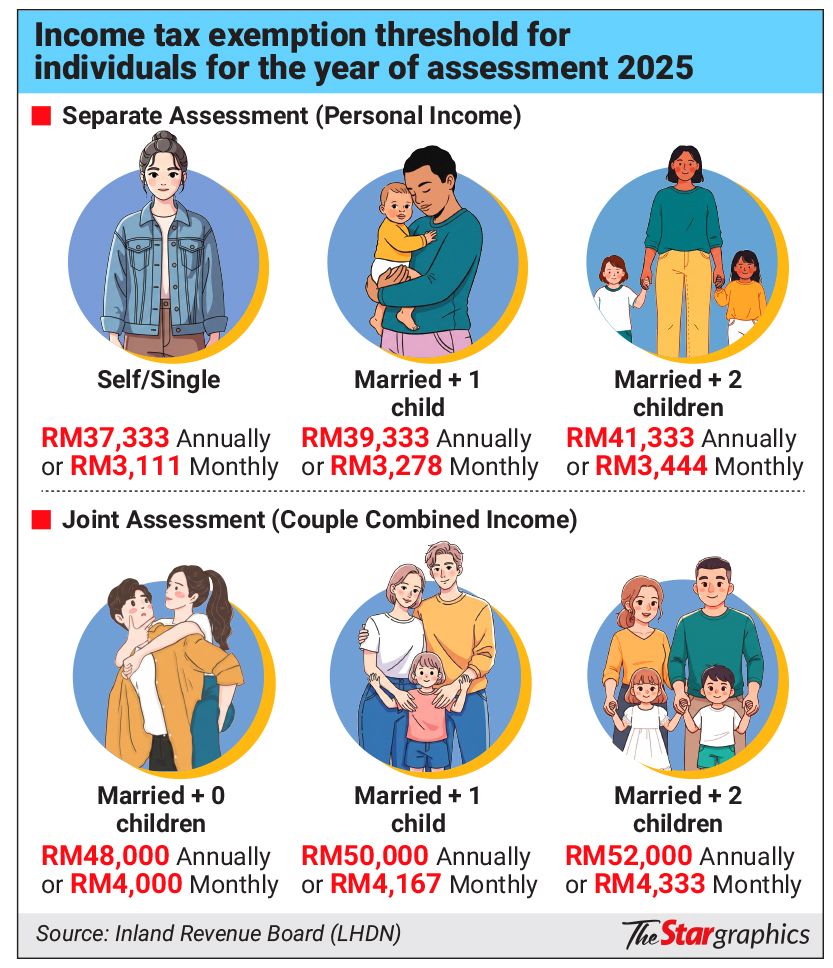
This means that the current exemption levels do not adequately reflect inflation or rising costs in housing, food, transport and education, especially in urban areas, she said.
“The current exemption levels lag behind real living expenses, and the overall effect on boosting household consumption is minimal,” she said.
Previously, The Star quoted stakeholder groups as saying that the RM9,000 individual income tax relief – unchanged for more than a decade – was out of touch with today’s cost of living and should be raised to at least RM12,000 to better reflect inflation.
Fomca (Federation of Malaysian Consumers Associations) chief executive officer Saravanan Thambirajah said the individual tax relief level has remained unchanged for years despite significant increases in the cost of living.
“The RM9,000 relief no longer reflects today’s household expenses,” he said, adding that raising the threshold is key to increasing disposable income for lower- and middle-income families.
“Some have proposed gradually increasing it to RM12,000 over a few years to reduce the fiscal impact while better reflecting current living costs,” he added.
Executive director of Tratax Sdn Bhd Thenesh Kannaa said the income levels outlined by the Inland Revenue Board do not mean that some individuals are fully exempt from all tax obligations.
He explained that individuals earning below the threshold may still be required to submit tax returns if their income is derived from business, freelance, rental or gig economy activities, such as ride-hailing services or social media content creation.
“Not having to pay tax does not mean a taxpayer does not need to file a tax return,” Thenesh said, adding that income from non-employment sources must still be declared regardless of whether it falls below the threshold.
In contrast, individuals who earn only employment income may choose not to file a return under the law, provided their salary is already subject to monthly tax deductions, he said.
Centre for Market Education chief executive officer Dr Carmelo Ferlito offered a different perspective, arguing that attempts to design “equitable” tax thresholds across diverse household types are inherently problematic, given differences in income structures, lifestyles and living costs.
He said cost-of-living benchmarks vary widely and should not be the central reference point for tax policy, adding that the more fundamental issue is the overall tax burden.
Any reduction in taxation, he said, is positive as it allows Malaysians to retain a greater share of their income and make their own spending, saving or investment decisions without state interference.