
PETALING JAYA: In the dead of night, fishing boats head out to sea. They are not going in search of fish, but something far more sinister – drugs.
The boats would dock with a bigger ship and drugs would be transferred from the ship to the boats.
The fishing boats would then sail back to shore with their illegal shipment.
This is one of the methods criminals are using in trying to turn Malaysia into a drug processing and transit hub.
ALSO READ: Drug fight must target masterminds, urge experts
The syndicates are diversifying their tactics, including using drug mules and international ports to transport the contraband.
While some of the drugs are meant for the local market, large quantities are sent overseas.
The criminals have not escaped detection from the authorities, who are coming down hard on them through efforts spearheaded by the Bukit Aman Narcotics Crime Investigation Department (NCID).
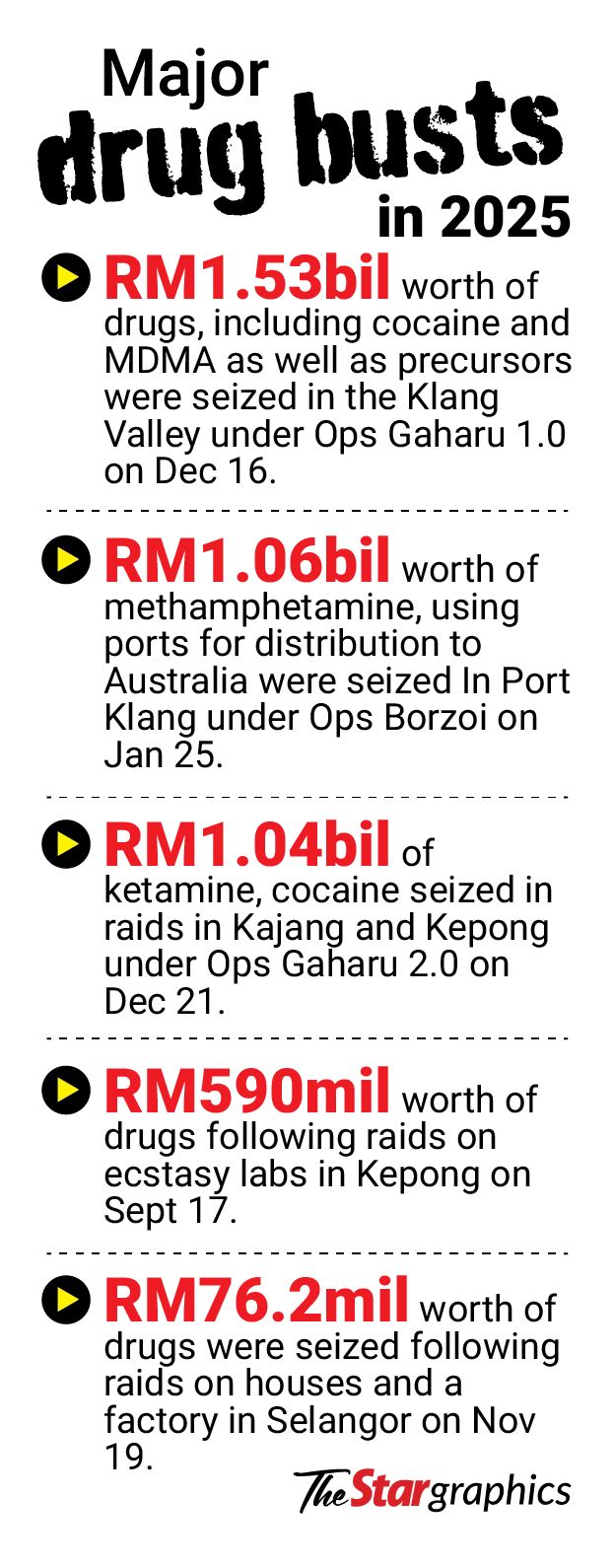
Between Jan 1 to Dec 21 last year, more than RM4bil worth of drugs had been seized, and over 200 drug syndicates were dismantled.
ALSO READ: Kajang drug bust uncovers major scam call centre
“Maritime transit in deep-sea waters, employing drug mules and using international container and cargo services are the three main drug smuggling modus operandi.
“Our investigations showed that syndicates are increasingly using sophisticated maritime routes, unsuspecting individuals as drug couriers, and international cargo services to move large quantities of drugs across borders,” Bukit Aman NCID director Comm Datuk Hussein Omar Khan said when contacted.
For maritime routes, the syndicates would sometime use fishing boats to sail offshore and collect drug supplies from so-called “mother ships” before smuggling them into Malaysian waters.
“This tactic was uncovered during Ops Gombe on April 23 following intelligence on drug smuggling activities from the Golden Triangle to Australia via sea routes near Terengganu waters.
ALSO READ: RM1.5bil global drug ring crippled
“The operation led to the arrest of two local men and the seizure of 590kg of methamphetamine and heroin base, valued at RM24.9mil.”
Comm Hussein said the second modus operandi involves the use of drug mules, where syndicates recruit individuals through social media platforms such as TikTok, Facebook and Instagram, as well as messaging applications including WhatsApp, Telegram and WeChat.
“These individuals are often promised free holiday packages or lucrative salaries but are in fact exploited as drug couriers.
“The contraband would be concealed on their body (body packing), or they would swallow drug pellets or hide drugs in luggage.
“Some travel to a third country before collecting drugs for delivery to the final destination,” he explained.
Comm Hussein said syndicates also use container and cargo services through various international ports.
“Syndicates declare legitimate goods in Customs documents but actually smuggle drugs in large quantities. On top of falsely declaring cargo contents, syndicates also modified container compartments to hide narcotics,” he added.
Given the evolving tactics used by the syndicates, Comm Hussein emphasised the importance of intelligence sharing and cross-border cooperation in combating drug trafficking.
“We are working closely with our counterparts from various countries to combat drug smuggling effectively.
“On home soil, we focused on gathering actionable intelligence and continuous enforcement to ensure the syndicates are dealt with decisively,” he said.
So far, the NCID has dismantled 270 drug syndicates following 609 operations conducted nationwide, he said.
“The syndicates cater to the local market as well as ship the drugs overseas.
“We are working with counterparts to fully curtail the drug network,” he added.
Of the overall drugs seized this year, Comm Hussein said the biggest was the recent one under Ops Gaharu, where 24.7 tonnes of drugs worth RM2.6bil were seized in December.
“The syndicate operated out of 14 premises – four factories and 10 residential properties – which were used as drug-processing laboratories and storage facilities,” he said.
According to Comm Hussein, the international syndicate hired locals to act as coordinators for its operations.
“Based on the equipment seized, it is clear that this was a large-scale and well-organised drug operation,” he added.
Since Jan 1 last year, 234,567 investigation papers have been opened, and syndicates have been financially crippled with RM141mil worth of assets seized while RM29mil was acquired due to forfeiture, Comm Hussein said.
“About 808 individuals were detained under the Dangerous Drugs (Special Preventive Measures) Act 1985 to sever syndicate links and prevent repeat involvement in trafficking,” he added.