
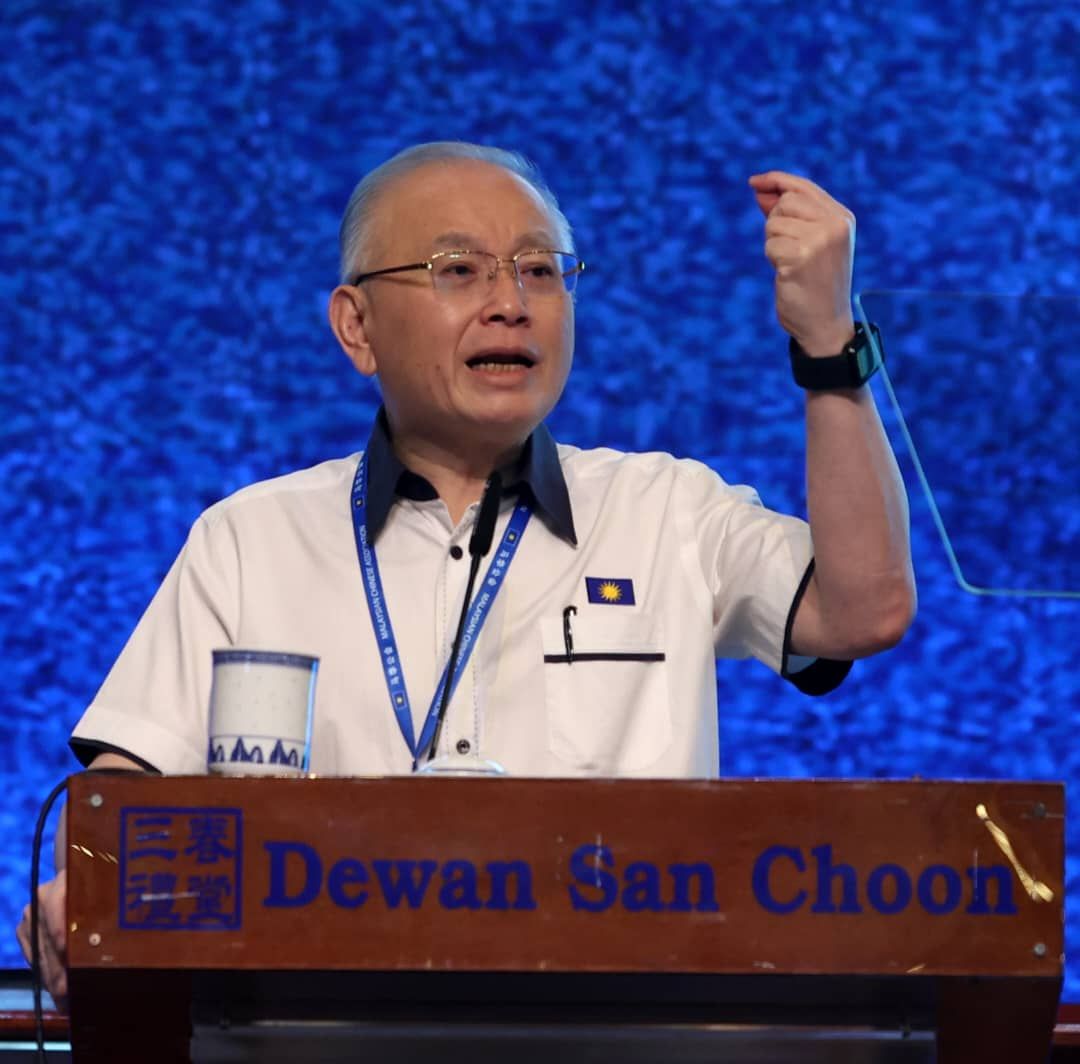
KUALA LUMPUR: The outcome of the Sabah state election was not only a message to certain parties but a clear warning to the Unity Government in Putrajaya, says MCA president Datuk Seri Dr Wee Ka Siong (pic).
Dr Wee said the “political tremor” in Sabah should not be dismissed as an isolated state development, cautioning that the sentiment could easily spread across the South China Sea.
“The Sabah voters not only sent a message to certain parties, but they also sounded a loud alarm to the Unity Government at the federal level.
"If the Unity Government treats this as business as usual and continues its current governing style and attitude, the Sabah tsunami will certainly reach Peninsular Malaysia,” he said in his address at the MCA 30th Central Delegates 3rd General Assembly on Sunday (Dec 7).
ALSO READ: MCA president urges party to build support independently
He noted that the political calendar ahead leaves little room for complacency, with state polls in Melaka and Sarawak due in 2026 and Johor expected to go to the polls by early 2027.
The next general election could be held at the same time as the Johor and Melaka state elections.
“There is not much time left, with only about a year to go. We must learn from the Sabah elections. Starting today, every branch, division and leader must return to the battlefield with full commitment and urgency,” he said.
Dr Wee said winning back public trust requires serious groundwork and genuine engagement, not cosmetic appearances or large-scale activities without depth.
ALSO READ: MCA's election setback in Sabah is a call for ground-level reform, says Dr Wee
“Working the ground is about quality, not quantity. It is not about doing many things, but doing them well and in a way that reassures voters. Only then can we build strong trust, credibility and a solid voter base that allows us to stand firm even in turbulent political storms,” he said.
He stressed that candidates must be equipped with a complete team, strong personal networks and the organisational ability to run a campaign independently.
“They must be self-reliant, able to secure and prepare their own resources, plan and drive the entire campaign, and ultimately win the seat for the party,” he said, adding that leaders must also be ready to speak up during critical moments, including taking positions that may not be comfortable.
“We must dare to voice out, dare to propose solutions, and dare to criticise the authorities when necessary, no matter how unpleasant it may be,” he said.
Dr Wee also urged the party to rethink the long-held notion of “traditional seats”, saying such assumptions no longer hold in today’s political environment.
“Since the political tsunami of 2008, there is no longer such a thing as a guaranteed traditional seat. We must use a scientific approach to identify constituencies where we realistically have a chance of winning, where the candidates are strong and full preparation has been made,” he said.
He said divisions must be able to show that their candidates enjoy local recognition across communities and can communicate effectively in three languages.
Preparedness also means having a full campaign team ready to activate—from publicity and new media to house-to-house outreach, voter mobilisation, legal support and PACABA (Polling Agent and Counting Agent).
Equally important, he said, is the division’s relationship with Barisan Nasional allies, local associations, youth groups, residents’ organisations, chambers of commerce, NGOs, local media and online community networks.
“To defend any traditional seat, divisions must be able to answer these questions. They must be capable of convincing the central leadership that they are fully prepared.
"Only then can the central leadership, backed by strong data and evidence, persuade the Barisan leadership or any political coalition,” he said.