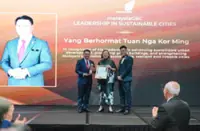
PETALING JAYA: Sustainable and resilient cities cannot be left to be built by a single ministry, agency or local authority, said Housing and Local Government Minister (KPKT) Nga Kor Ming (pic).
Calling for a whole-of-government approach and strong synergy across all sectors to tackle the challenges of urbanisation and climate change, Nga said it was important to institutionalise city-to-city knowledge exchange so that lessons, toolkits and proven solutions can be adopted nationwide.
He cited ongoing collaboration between KPKT and the Natural Resources and Environmental Sustainability Ministry (NRES) on nationwide flood mitigation through nature-based solutions as an example of this integrated approach.
"Urban sustainability can never be achieved by a single ministry, a single mayor or a single agency yet it requires every sector to come together," said Nga during the Cities: Possibilities 2025 conference in Kuala Lumpur on Tuesday (Nov 18).
Highlighting the collective responsibility in shaping the future of cities, Nga who is UN-Habitat Assembly president described urban areas as the frontline of the global climate challenge.
"Our task is to deliver solutions that are not only smart, but sustainable, inclusive as well as locally grounded and Malaysia is committed to leading globally while delivering locally,” he added.
Under Malaysia’s leadership, the UN-Habitat–COP30 collaboration is institutionalising the urban-climate linkage to secure a global mandate for multilevel governance. Within Asean, Malaysia has championed a more inclusive and resilience-driven smart city agenda, including plans to elevate the Asean Smart Cities Network (ASCN) to a ministerial-level platform by 2026.
Malaysian best practices are also being adopted regionally, from Melaka’s heritage-based urban conservation to Penang’s participatory planning model.
Nga also shared that at the 14th Mayors Forum in Vienna in July, Malaysia had proposed three pathways to strengthen global city networks, namely establishing joint innovation funds to co-develop solutions for shared urban challenges, creating regional solution hubs to pool expertise on priorities such as coastal resilience and informal settlement upgrading, and adopting standardised urban metrics to enable cities worldwide to measure progress and learn from one another effectively.