PETALING JAYA: With several state polls coming soon, it’s time for Malaysia to have laws that ensure women make up 30% of state assemblymen.
Such is the call from various groups and women leaders in view of the lack of females in political leadership roles.
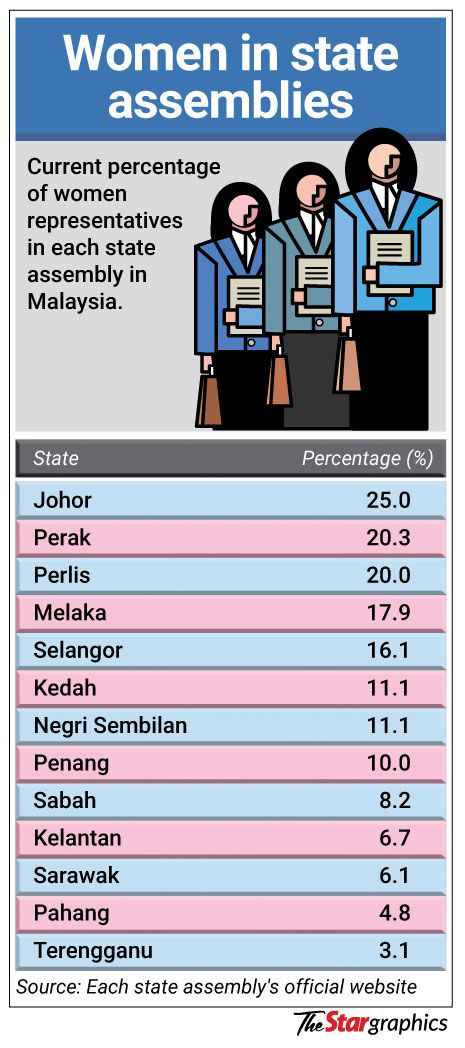
At present, none of Malaysia’s state assemblies have had women comprise at least 30% of assemblymen – it ranges from 3.1% in Terengganu to 25% in Johor.
The push is also timely as several states are due for polls soon, beginning with the Sabah Legislative Assembly which will automatically dissolve on Nov 11.
ALSO READ: Selangor, Penang and Sarawak to see more women reps
After Sabah, the state election for Melaka is expected to be held next year, while the next Sarawak polls must be held by April 2027.
In 2004, the government agreed to a policy of at least 30% involvement of women at the decision-making level in the public sector.
This has since been achieved, with women making up 38.9% of top posts in the public sector as of last year.
Some 30.7% of directors in Malaysia’s top 100 public listed companies are also women.
However, women are still under-represented in politics with them only accounting for 13.5% of MPs, 18% of senators and 12% of assemblymen.
In October, women’s rights organisation Empower is planning to issue a memorandum to the government to call for all political parties to field at least 30% women by the 16th General Election.
“We are urging for a change to the relevant electoral laws to mandate this at all levels, namely the state and federal level (Parliament),” Empower executive director Gopal K Papachan said when contacted.
“It needs to be a national law so that all states comply,” he added.
On Tuesday, a proposal was made to increase female representation in the Selangor State Assembly to 30% to ensure a stronger voice in decision-making.
Women Leadership Foundation founder and chairperson Datuk Dr Hafsah Hashim said stronger political will is needed to push for laws that ensure a minimum 30% of women representation.
“The immediate opportunity lies in our nomination processes – political parties must commit to fielding at least 30% women candidates, particularly in the coming state polls.
“When we fail to nominate women at the grassroots level, we effectively eliminate their pathway to leadership,” she said, adding that the current number of female candidates remains significantly below the proposed target.

Hafsah said one reason for the low number of women in political leadership is the lack of succession planning.
“We must become more intentional about identifying emerging female leaders, providing them with substantive experience, and positioning them in high-visibility roles that prepare them for greater responsibility,” she said.
Bersatu Srikandi chief Datuk Mas Ermieyati Samsudin said Malaysia should not be left behind in having more women representatives at the Parliament and state legislative levels.
The Public Accounts Committee chairperson, who attended the recent Asian Women Parliamentarians’ Caucus in Mongolia, said the representation of women was among the main topics discussed.
“Mongolia wants to achieve 40% by 2028, and now they have 25% representation of women, so why can’t Malaysia do the same?
“Now is the right time to do this because by having legislation we can have all hands on deck with both men and women,” she said.
Additionally, she said during the recent Bersatu annual general assembly, its president Tan Sri Muhyiddin Yassin announced the formation of a committee on ensuring women’s involvement.
Former International Trade and Industry Minister Tan Sri Rafidah Aziz said one way to increase women representation was to appoint them to the Senate first.
“I was appointed as a senator in 1974, just after I turned 30.
“Then I was invited to be an Umno member and not long after that, I won a seat at the party’s supreme council and Wanita executive committee,” she said.
Wanita MCA chief Datuk Wong You Fong said that having a law in place will help realise the needed rate of representation.
“As you know, in our society, there is still an unconscious discrimination against women, so all along if you compare statistics in our Dewan Negara, Dewan Rakyat and state assemblies, the average representation is still considered low.
“Even the 30% set target, in reality, it is not enough compared to our competency levels, capabilities and population. So we agree and support this call,” she said.