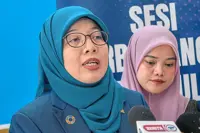
PETALING JAYA: Selangor, Penang and Sarawak are moving to close the gender gap in politics, with plans to raise the number of women elected representatives in their respective legislative assembly to at least 30%.
This is in line with international calls for greater female participation in decision-making roles.

Selangor women empowerment and welfare committee chairperson Anfaal Saari said it was acknowledged in the 1995 Beijing Declaration that there was a need for a higher percentage of women decision makers in governments.
The Beijing Declaration was aimed at initiating gender equality and women empowerment by addressing 12 critical areas such as economic equality, increased involvement in decision-making, eradication of violence against women as well as education and training, among others.
ALSO READ: Closing the political gender gap
“The minimum is 30% representation. Inclusion helps women representatives raise issues related to women, families and equitable perceptions,’’ Anfaal said when contacted.
According to Anfaal, women in Selangor were satisfactorily represented in the economic, education and health domains but still at an unsatisfactory level within the political sphere.
Given this, she said, efforts were underway to increase the current 16% of women elected representatives in the Selangor legislative assembly to the desired 30%.
“But for transformation to happen, there has to be change at the grassroots level which requires the commitment of political parties in terms of party structure,’’ said Anfaal.
She added discussions to increase women representation in the state legislative assembly was currently ongoing and will become a reality in time to come.
“The discussions have begun and I hope this process will happen within the next five to 10 years,’’ Anfaal said, adding that potential women leaders must be knowledgeable, gender sensitive and brave.
In George Town, social development committee chairman Lim Siew Khim said the state government is pushing for the Top-Up Women-Only Additional Seats (TWOAS) initiative so that there will be 30% of female representation in the state assembly.
She said the initiative was presented as a White Paper a few years ago.
“We are working hard for it. The additional female representatives will be appointed to represent the state as a whole rather than just the constituencies.
“But first, TWOAS will need to be tabled and passed in the state assembly for it to be implemented,” she said.
TWOAS was first introduced in 2020, aimed at ensuring a minimum of 30% women participation in the Penang Legislative Assembly.
For example, if there are fewer than 12 women elected out of the 40 state seats in Penang, then TWOAS could be implemented to ‘top up’ the percentage to 30%.
Before the general election, each political party will have to submit a nomination list of their female representatives before a general election.
There are now four assemblywomen out of the 40 seats in Penang, which translates to a mere 10%.
Penang Women’s Development Corporation chief executive officer Datuk Ong Bee Leng said there are plenty of women-centric issues that are not touched upon in Penang.
Penang Chief MInister Chow Kon Yeow said TWOAS required further discussion with all stakeholders and political parties before it could be implemented.
“There was no shortage of capable women to take up political leadership in Penang.
“In fact, data shows that women are excelling academically with more female students in our universities, which means we have a strong pool of well educated talent.
“One way forward is through legislation. DAP is committed to fielding at least 30% women candidates in the coming elections,” he said.
In KUCHING, Parti Rakyat Sarawak women’s chief Datuk Seri Doris Sophia Brodie said it was time to legislate a quota of at least 30% women representation not only in the Sarawak Legislative Assembly but Parliament as well.
She said the legislation must bind political parties to recommend a sufficient number of women candidates.
“Without such a mandate, advocacy alone will not deliver results,” she said when contacted yesterday.
“Since the mid-1990s, female enrolment in Malaysia’s higher learning institutions has consistently outpaced that of men, proving that women are more than qualified to lead,” she said.