
PETALING JAYA: Malaysia is a major global importer of used and waste textiles, some of which are resold as pre-loved clothes while a portion ends up in landfills.
According to the United Nations Unwaste Trendspotting Alert report, Malaysia ranked fourth in the world in imports of used and waste textiles.
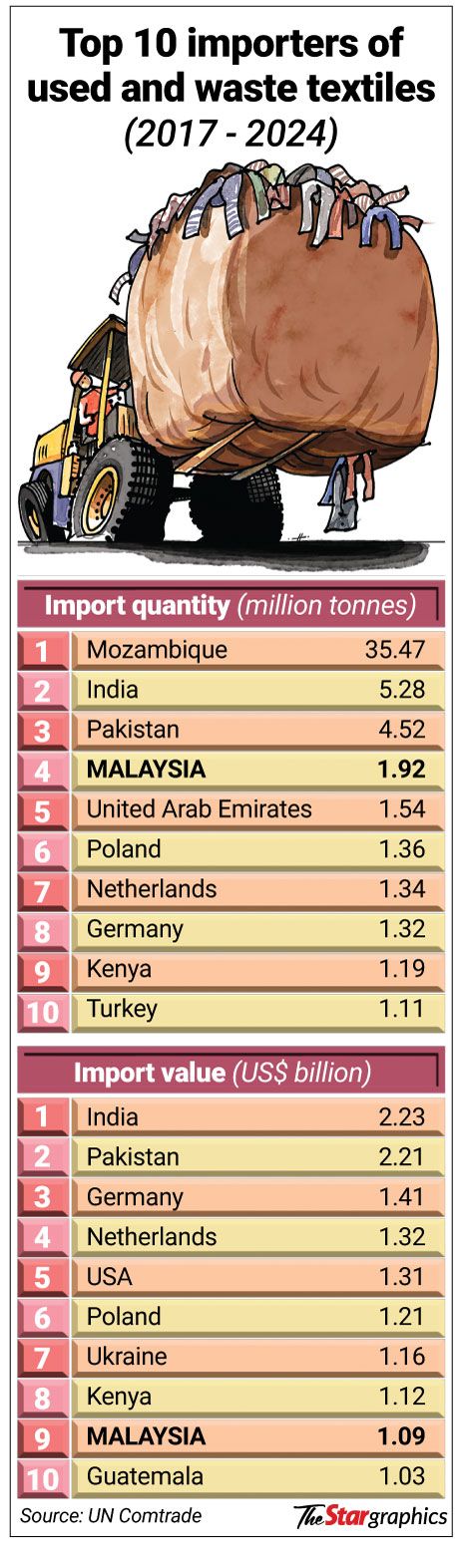
From 2017 to 2024, Malaysia imported 1.92 million tonnes of used and waste textiles worth US$1.09bil.
Mozambique was the leading global importer with 35.47 million tonnes, followed by India (5.28 million tonnes) and Pakistan (4.52 million tonnes).
ALSO READ: Putting used clothes to good, meaningful use
Malaysia topped the list among Asean countries, with Thailand at number two at US$640mil, and Cambodia at third at US$432mil.
Experts said some of the used and waste textiles sent to Malaysia end up at thrift stores – more commonly known as bundle shops – where they are resold as pre-loved clothes.
Najua Tulos, senior lecturer at the School of Industrial Techno-logy, Textile and Apparel Pro-gramme at Universiti Teknologi Mara, said a portion of the higher-quality, wearable items is sorted in large facilities.
They are then either sold through local bundle shops or re-exported to countries with high demand for pre-loved clothing, such as those in other parts of Asia or Africa.
She said a significant share is also reprocessed into lower-value products like wiping rags for factories or shredded for stuffing, insulation or other industrial uses.
“The uncomfortable truth is that a substantial portion of it is low quality and cannot be economically recovered.

“Leftovers from sorting often end up in landfills, illegal dumpsites or incinerators, contributing to pollution and health hazards,” she said.
According to figures from the Solid Waste Management and Public Cleansing Corporation, 432,901 tonnes of fabric or textile waste ended up at its landfills in 2021.
Social enterprise Kloth Circularity co-founder Nik Suzila Hassan said fast fashion is one of the predominant contributing factors to global textiles and clothing waste.
“It is claimed that over 100 billion pieces of garments are produced annually, yet over 70% of these goods are landfilled or incinerated,” she said, adding most garments are often made from low-quality materials for short-term usage.
Nik Suzila said a systemic approach to reducing textile waste in Malaysia is being developed though the Malaysian Extended Producers Responsi-bility (EPR) framework.
The framework ensures manufacturers, retailers and all other parties involved in the textiles and clothing value chain take responsibility by paying for what they produce and put into the market.
“The Housing and Local Government Ministry is preparing the EPR framework for textiles.
“It is aimed for all – retailers, brands, importers, manufacturers and recyclers – to share responsibility for the collection, recycling and sustainable management of post-consumer textile waste.
“A central part of the framework is a Producer Responsibility Organisation, which will coordinate compliance, logistics, reporting and public awareness across stakeholders,” she said.
Environmental engineer Najah Onn said consumers need to make sustainability a priority.
“The best way to do this is to think before you buy. First, ask yourself: Do I need this?
“Some people buy items for single-use occasions, such as parties or weddings, but we should not buy into trends as they don’t last,” she said.
Najah said consumers should also think about cost per wear.
“For example, if you buy something for RM100 and wear it 10 times, each wear costs RM10, and if you wear it 100 times each wear would cost only RM1,” she added.