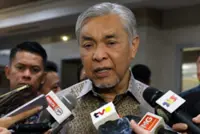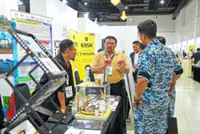
KUALA LUMPUR: Another 500 spots have been allocated for Indian youths under the Malaysia–China Youth TVET Training (MCYTT)-Mitra programme this year, Deputy Prime Minister Datuk Seri Dr Ahmad Zahid Hamidi announced at the International Youth Centre on Thursday (Sept 4).
The Rural and Regional Development Minister said this is part of 5,125 places from hundreds of TVET institutions in the country secured specifically for Malaysian children.
Ahmad Zahid, who is also the National TVET Council chairman, announced this at the Appreciation and Send-off Ceremony for 500 MCYTT-Mitra participants.
“The Madani government, through Mitra, has allocated an additional RM3mil to ensure youths can participate in this training without being overly burdened by costs.
Today, we celebrate a portion of that group—147 participants who will depart throughout September.
Previously, 175 participants have successfully completed the training, with another 178 to follow in October and November.
We are here to support. Once we make a commitment, we stand firm to ensure our young Indian leaders are empowered, equipped, and enabled to succeed,” he said.
Additionally, Ahmad Zahid said that two universities in China have offered full scholarships to MCYTT participants who wish to continue their studies to degree level.
This came after the Chinese universities were satisfied with the competence of Indian youths previously sent.
The two universities are Taizhou Vocational College of Science & Technology, offering 25 quotas in Logistics Technology, and Tangshan Polytechnic University, offering 20 quotas in Electrical Automation Technology and another 20 in Automotive Inspection and Maintenance Technology.
The main requirement is that students must sit for the Hanyu Shuiping Kaoshi (HSK) Mandarin Test at a minimum of Level 3.
Ahmad Zahid said even if some students may not excel academically, they can still prove themselves through the TVET education ecosystem, which can generate a premium salary compared to other fields.
He urged the Education and Higher Education Ministries to ramp up efforts in the education ecosystem through conventional and academic methods.
He said the TVET system was created to ensure new approaches, methodology, and pedagogy in education because the country needs skilled workers.
To make this happen, Ahmad Zahid said it requires the cooperation of all, which is why 12 ministries offering TVET have been brought under one Cabinet committee to fulfil market requirements.
Also present were Malaysia-China Institute board chairman and RISDA chairman Manndzri Nasib and Mitra special task force committee chairman P. Prabakaran.
The MCYTT-Mitra programme is a collaborative initiative between the Indian Community Transformation Unit (Mitra), Malaysia-China Institute (MCI), BELIA MAHIR, and the TANG International Education Group from China.
It is also the brainchild of Ahmad Zahid as a holistic approach to enhance graduate marketability through an international-class “finishing school” concept.