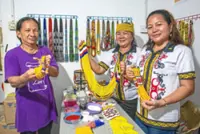
KENINGAU: Every morning, Mariam Sakai threads tiny manik between her fingers, patiently weaving them into intricate patterns as she has done for years.
Each bead carries a fragment of her heritage, but her own story of belonging has never been simple.
Born in 1969, Mariam grew up in Kampung Kuala Puntih, a quiet village nestled among rolling hills in Keningau, about 115km south of Kota Kinabalu.
She is the eldest of 15 siblings in a Lundayeh family, one of Sabah’s recognised bumiputra communities. Her parents had come to Sabah from Indonesia in the early 1960s, when borders were still porous and movement across Borneo was free.
But in 1963, while the territory was still under British administration, they were issued work permits instead of citizenship – a decision that would quietly shape Mariam’s life for decades.
“I was born here, went to school here, grew up here but for most of my life, I held a red MyKad.”
“Same mother, same father, same home... same Lundayeh blood. But all my younger siblings had blue MyKads. I didn’t.”
It wasn’t until she was 12 that Mariam realised how different her life would be.
A birth certificate was not enough to unlock the privileges of citizenship.
“Applying for government help was almost impossible,” she said.
“Even my third child couldn’t get a PTPTN loan. And every time someone asked why my MyKad was red, I didn’t know what to say. I felt incomplete.”
It took Mariam decades to finally secure her blue MyKad.
The process was long and draining – endless forms, photocopies of documents and even finding witnesses to vouch that she had lived in Sabah her entire life. She was in her 30s when she finally held the blue card in her hand.
“The difference was like night and day,” she said, a faint smile breaking through.
“I could vote. I could travel. I could finally access benefits that were out of reach for so long. I felt like I finally belonged.”
Today, Mariam works as an entrepreneur, creating and selling traditional Lundayeh manik handicrafts, keeping alive the heritage passed down through generations.
As National Day approaches, Mariam said being recognised as a Malaysian carries a deep meaning for her.
“I feel proud to finally be recognised as a Malaysian citizen after so many years of struggle.
“I’ve promised myself to do good for this country – even if it’s in the smallest ways, as long as it doesn’t go against the law.”
She admitted that National Day celebration used to be bittersweet.
“I used to feel overwhelmed, sometimes even to the point of tears. Holding a red MyKad made me feel small and invisible. Today, I can’t describe the gratitude I feel knowing I am finally acknowledged,” she said.
Her wish this year is simple: that others like her won’t have to wait so long.
The Lundayeh is an indigenous community whose ancestral migration routes once spanned what is now Malaysia, Brunei and Indonesia.
Bureaucratic hurdles, lack of access to registration services and historical cross-border ties have left some of them without citizenship even after decades of living in the state.