
Analysts say meetings among top diplomats show the bloc’s increasing relevance
KUALA LUMPUR: The slew of unprecedented high-level meetings held between top diplomats at the just concluded Asean Foreign Ministers’ Meeting (AMM) underscores the relevance of Asean as a geopolitical middle ground, say analysts.
They said these meetings, which involved diplomats from global powers, showed that Asean is becoming more credible.

“This means being involved in outside issues such as the conflicts in Gaza, Russia-Ukraine, Iran-Israel and India-Pakistan.
“So, credit should be given to the chairman, who tried to elevate Asean to be respected by other nations,” he said.
Azmi said the joint communique issued at the end of the four-day AMM from July 8 to July 11 showed that Asean wants to exert influence on global issues.
“The side meetings held among these global superpowers on the sidelines of the AMM are very important,” he said.
Among top diplomats present at the AMM were Russian Foreign Minister Sergey Lavrov, Chinese Foreign Minister Wang Yi and US Secretary of State Marco Rubio.
Among the important bilateral meetings on the sidelines of the conference was one between Lavrov and Rubio, which concluded after about 50 minutes.
Rubio spoke with Lavrov here on Thursday evening, having already met with the 10-member Asean bloc.
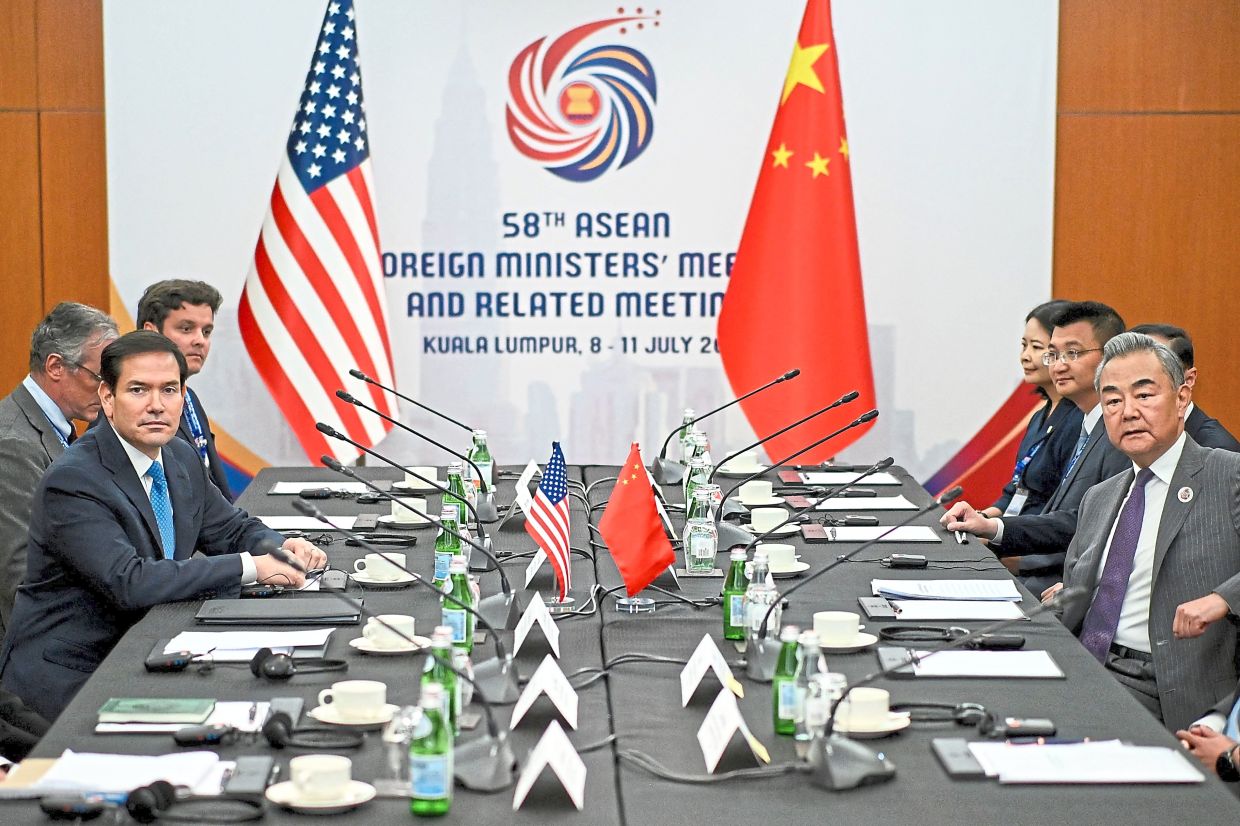
Rubio, who was on his first Asia trip since taking over the State Department, also held a meeting with Wang and described it as “positive and constructive”.
In the joint communique issued on July 11, Asean foreign ministers said they are strengthening ties with global partners while maintaining their neutral and central role in the region.
Asean also reaffirmed its commitment to an open and inclusive regional order, stressing that the regional group remains a platform for dialogue, not rivalry.
Assoc prof Khoo Ying Hooi of Universiti Malaya International and Strategic Studies Department said Asean has long positioned itself as a neutral and inclusive regional convener.
The AMM this year had underscored that role in an unprecedented way, as many bilateral meetings were held on the sidelines, she said.
“These engagements, especially the Wang Yi-Rubio dialogue, suggest that Asean is increasingly considered a geopolitical middle ground where rivalries can be managed diplomatically.
“That said, we should not romanticise this role too much. Asean’s ‘centrality’ works precisely because it offers a low-stake platform, one that avoids tough commitments or binding rules,” she said.
Khoo said global superpowers are showing up at the AMM because the presence reflects their desire to shape regional norms in their own terms.
“Asean may be hosting the table, but it doesn’t necessarily mean it’s controlling the menu,” she said.
Khoo said US-China tensions and escalating trade disputes, as well as varying tariff rates announced by the United States, had dominated the headlines during the AMM last week.
“This placed Rubio in a challenging position during his visit, as he sought to reassure South-East Asian partners while Washington’s economic policies threatened their interests.
“The regional reaction was mixed; some Asean countries expressed frustration, while others began exploring deeper trade ties with China as a counterweight,” she said.
Khoo said Beijing capitalised on that moment and used the AMM’s sidelines to present itself as a more stable partner.
She noted that issues pertaining to Palestine, the South China Sea and Myanmar were also raised.
“But it was the broader structural clash between the US and China through economic tools like tariffs and diplomatic influence that shaped the tone and urgency of this year’s AMM discussions,” she added.
Khoo described the AMM as a diplomatic litmus test on managing rivalries and maintaining unity.
“The Asean Summit in October will be pivotal. Timor-Leste is expected to be formally admitted. Malaysia has been signalling a desire for renewal, not a radical overhaul, but a recalibration.
“The 47th Summit presents a potential opportunity for Asean to demonstrate greater confidence and cohesion.
“However, this will largely depend on the willingness of member states to transcend the usual practice of consensus and actively pursue structural reform,” she stated.
Asia West East Centre director and co-founder Abdolreza Alami said Asean has emerged as a trusted platform due to its strategic geographical and economic position at the intersection of the East and West.
“The region sits at the heart of one of the world’s most vital geopolitical crossroads – the Indo-Pacific – where the interests of major global players such as China, the US, the European Union and others increasingly converge.
“The growing interest in Asean, evident from the unprecedented number of high-level bilateral and multilateral meetings on the sidelines of the AMM, underscores how the organisation is seen as a valuable venue for diplomacy and strategic dialogue,” he said.
Abdolreza also said the AMM is a clear precursor to a highly significant 47th Asean Summit in October, which will be potentially attended by heads of state from major powers.
This, he said, is symbolically and strategically important, especially at a time when global polarisation is intensifying.
“The challenge for Asean will be to navigate these dynamics carefully, reinforcing its unity and ensuring that it remains a space for cooperation – not competition – between great powers,” he said.
“If managed wisely, Asean could play an increasingly critical role in shaping a stable and inclusive regional order,” added Abdolreza.
The 47th Asean Summit will be held in Kuala Lumpur from Oct 26 to 28.