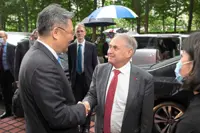
CANBERRA: Australia wants to double its A$187bil (RM578.4bil) trade with Asean countries by the end of the year, says its Trade and Tourism Minister Don Farrell, who describes the current trade activity as “not enough”.
“Our trade with China last year was A$300bil (RM928bil). Our trade with South-East Asia in total was only A$187bil. So we think we can do a lot more.
“As the Trade Minister, I want to boost our trade links with our South-East Asian neighbours,” he said in an interview with a group of South-East Asian journalists during the Asean-Australia Special Summit International Media Visit to Australia recently.
During the nine-day visit, journalists from Malaysia, Brunei, Thailand, Indonesia, Vietnam, Cambodia, Laos, the Philippines and Timor-Leste met with Australian officials, academics and leaders.
Australia is celebrating its 50 years of links with Asean this year.
The media visit was a precursor to a special summit in Melbourne, happening from March 4-6, which is expected to be attended by Asean leaders.
Following his recent trips to Vietnam, Indonesia and the Philippines, Farrell said that he would soon travel to other South-East Asian countries to build more trade links, citing numerous opportunities for collaboration.
For instance, he said Australia intends to become an energy superpower as it has all the necessary resources for building the cars of the future, particularly electric vehicles.
“Our abundant sunshine and vast open spaces allow us to significantly increase our contribution to renewable energy.”
As Australia sets its sights on becoming a renewable superpower, Farrell said the country had all the necessary resources to achieve this objective.
And it is eager to collaborate with Asean to accomplish its renewable energy goals, he said.
“We are fortunate to possess either the largest or second largest reserve of critical minerals required for future technologies.
“We also recognise the digital and the cyber world, which is the future,” he said.
Asked about new and emerging trade areas since the Covid-19 pandemic struck, Farrell said the field of renewable energy and creating a net-zero future was the way forward.
This is alongside Australia having a factory in Malaysia dedicated to smelting lithium, a vital component for energy storage.
“We need to work with South-East Asia to ensure we are producing all of the products we need for a renewable and net-zero future,” he said.
Farrell added that this topic would be an important part of any of the discussions at the Asean-Australia Special Summit in Melbourne next month.
In terms of digital trade, he said the growing population of young people in South-East Asia presents numerous opportunities for collaboration.
“With their interest in the digital world, we can work together in various ways.”
The minister also said that Australia has a strong agricultural sector with a clean and green image.
He said the country can produce an excess of food, meeting the needs of around 70 to 80 million people, far greater than Australia’s population of nearly 27 million.
“We can play a vital role in supplying the protein requirements of South-East Asia,” he said.
Farrell said many of Australia’s Cabinet ministers including himself have ties to the South-East Asian region. His wife, for example, is from the Philippines.
“Our Foreign Minister (Penny Wong) was born in Malaysia and raised in my hometown of Adelaide, establishing a strong connection with South-East Asia,” he said.
Asked about Australia’s plan to further facilitate trade and investment flow with Asean countries, Farrell said the government has rolled out the “South-East Asia Economic Strategy”, which emphasises establishing a physical presence in the region.
“It talks about sending Australians into the region ... to build those relationships and get the contracts that we need to increase our trading relationship.
“There are going to be 100 CEOs in Melbourne in a few weeks, a mixture of South-East Asian and Australians.
“We are hopeful that it will create some links that build those trading relationships,” he added.
Recognising the inadequacy of over-relying on one trading partner in the past, Farrell said Australia now wants to broaden and diversify its trade links, with the South-East Asian region being an important part of this.
“We’ll be looking forward to working with all of our friends in the region to achieve that,” he said.
Recalling fond memories of seeing students from Malaysia and Singapore coming to Australia to pursue their higher education in the 1960s and the 1970s, Farrell said education was another way Australia can build links with Asean.
“One of the things that we have been very successful at providing is educational services to Vietnam and many of the other countries in the region.
“We’ve been encouraging students from South-East Asia to come to Australia.
“For greater milestones, more Australians need to go and study in South-East Asia, so we get an appreciation of your cultures and the differences between the countries in the region.”
Farrell also highlighted the need to have face-to-face engagements between Australian ministers and their Asean counterparts.
“One of the things that happened during the Covid-19 period was there was no connection between Australian ministers and our equivalents.
“When I came into office, most of the ministers had never met in person ... we had only, at best, talked about things on Zoom.
“We need to re-engage face to face because it allows you to meet and improve relationships,” he said.
Already a subscriber? Log in
Get 20% OFF The Star Digital Access
Cancel anytime. Ad-free. Unlimited access with perks.