
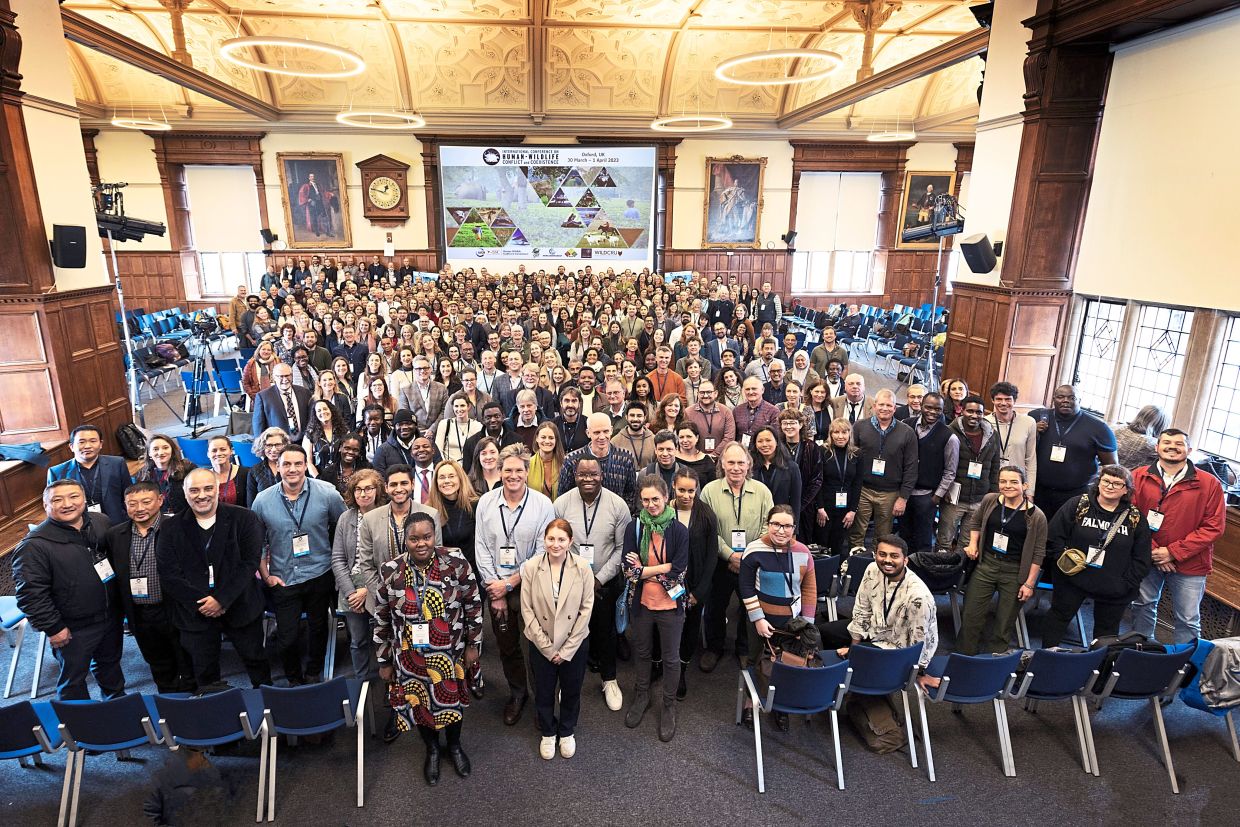
MALAYSIAN conservationists were among over 500 people from 70 countries who gathered for the first-ever global summit on human-wildlife conflict in Britain recently. Held in Oxford from March 30 to April 1, 2023, the three-day International Conference on Human-Wildlife Conflict and Coexistence was also attended by representatives from governments, businesses, academia, and community groups.
The summit also saw the publication of the IUCN SSC Guidelines on Human-Wildlife Conflict and Coexistence. The Species Survival Commission (SSC) of the International Union for Conservation of Nature (IUCN) is a science-based network of more than 10,500 of volunteer experts from almost every country in the world working on conserving nature.
The event was also held in response to Target 4 of the Kunming-Montreal Global Biodiversity Framework agreed during the United Nations Biodiversity Conference in December 2022, which calls for countries to “effectively manage human-wildlife interactions to minimise human-wildlife conflict for coexistence”.
It brought together participants from fields such as ecology, animal behaviour, psychology, law, conflict analysis, mediation, peace-building, international development, economics, and anthropology.
“The guidelines produced by the IUCN specialist group nudges us to consider not only human-wildlife conflict but also potential human-human conflict that could take place,” she said in an interview in Malaysia recently.
During the conference, Wong presented her research as well as the results so far of MEME’s collaboration with several plantations and nonprofits on its Achieving Coexistence with Elephants (ACE) project in the southern part of Peninsular Malaysia, mainly in Johor.
“I highlighted that plantations are important stakeholders in managing conflict and play key roles in establishing coexistence with wild elephants.
“We hope the ACE efforts will attract others to join in, and we are happy to share our outreach and awareness resources,” she said, adding that MEME works closely with the Wildlife and National Parks Department (Perhilitan), the Forestry Department, and the Improving Connectivity in the Central Forest Spine Project (IC-CFS) to align ongoing efforts on the ground.
Among the plantations that MEME works with are Felda, FGV, IOI Plantations, Aramijaya, Kulim Plantation, and Sime Darby Plantations.
Perhilitan conservation director Mohd Taufik Abdul Rahman, who also attended the conference, said the department is looking into human-tiger conflicts, which are becoming more rampant in several states in Peninsular Malaysia.
“Several plantations have lost livestock, and the safety of people are our concern as well. We recommend that plantations build tiger-proof paddocks and consider the use of electrified fencing to protect livestock from tigers, especially at night. Plantation staff and workers should avoid going out alone in areas close to the forest at night.
“We could share information on safety with plantations via government-linked channels, as well as with independent channels like the ACE coalition,” he added.
Another attendee, Chrishen Gomez from WildCRU Oxford, said the guidelines issued at the summit provided a new framework for thinking about conflict with wildlife.
“The addition of ‘Coexistence’ to the guidelines changes much of how we strategise and approach these challenges,” he said when contacted via e-mail.
Gomez, who works in Malaysia observing, quantifying, and analysing signals of interactions between humans and wildlife, said statistics are crucial as anecdotal accounts could lead policy down dangerous paths.
“The issue of human-wildlife conflict in Malaysia is at a stage of immense opportunity. We are coming round to realising the need for a framework of coexistence – there is only so many times we can resort to killing animals we don’t like before realising that it does not solve problems.
“I draw tremendous inspiration from the indigenous people of Malaysia, who have long coexisted and exhibit a calm relaxation around wildlife that we ought to all share,” he added.
In her speech, chair of the IUCN SSC Human-Wildlife Conflict and Coexistence Specialist Group, Dr Alexandra Zimmermann, said human-wildlife conflict presents a challenge in every country, with disagreements over how to coexist with wildlife leading to stalemates and eroding support for protecting nature.
“Effectively managing how humans interact with wildlife is fundamental to achieving conservation goals, as highlighted in the recently agreed Global Biodiversity Framework.
“This event, the largest ever convening of human-wildlife conflict and coexistence experts from around the world, is vital to supporting all those working towards enabling coexistence with wildlife, and to achieving this component of the Framework by 2030,” she said.
The guidelines, developed by an interdisciplinary team of 50 experts from the IUCN SSC Human-Wildlife Conflict and Coexistence Specialist Group and external co-authors, provide the most comprehensive recommendations for good practice on the topic to date.
They are aimed at providing foundations and principles for policy, decision-making and good practice, with clear, practical guidance on how best to manage a range of situations to facilitate coexistence with wildlife. The guidelines focus on approaches and tools for analysis and decision-making and are not limited to any particular species or region of the world.
Already a subscriber? Log in
Get 20% OFF The Star Digital Access
Cancel anytime. Ad-free. Unlimited access with perks.