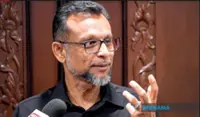
PETALING JAYA: Tun Dr Mahathir Mohamad was "adamant" that Datuk Seri Anwar Ibrahim should not succeed him as prime minister, says Parti Pribumi Bersatu Malaysia supreme council member Wan Saiful Wan Jan.
In an essay as part of the “Trends in Southeast Asia” series published by ISEAS-Yusof Ishak Institute, Wan Saiful said that Dr Mahathir was "never enthusiastic" about handing over the premiership to Anwar.
“In various closed-door discussions and meetings after GE14 attended by this author, Dr Mahathir was both adamant and consistent that he did not want to see Anwar succeed him as prime minister despite his public statements.
“To Dr Mahathir, Anwar is someone who would neither champion the Malays nor defend the privileges accorded to ethnic Malays by the Federal Constitution, ” he wrote.
Wan Saiful said Dr Mahathir wanted to bring together the three major Malay parties - Bersatu, Umno and PAS - so that a new Malay-led government could be formed.
He added that in a Bersatu supreme council meeting chaired by Dr Mahathir in March or April 2019, it was agreed that conversations would be started with Umno and PAS on the possibility of working together.
Wan Saiful said however that Dr Mahathir surprised people when he said he wanted to fulfil his promise to hand over the premiership to Anwar in the fateful Bersatu supreme council meeting on Feb 23, right before the collapse of the Pakatan administration.
“Prior to this meeting, behind closed doors, Dr Mahathir had always been clear about not wanting to pass the baton to Anwar, and he was also open to partnering with Umno.
“But at that meeting, Dr Mahathir suddenly changed his mind. Up until the present, Dr Mahathir has not explained the reason behind this significant change of heart, ” he said.
He added that Dr Mahathir had also objected to partnering with Umno en bloc, and had preferred to encourage individual Umno members to join Bersatu.
He said Dr Mahathir eventually relented, and it was decided that Bersatu will leave Pakatan Harapan with Dr Mahathir remaining as the prime minister.
However, he said Dr Mahathir caught everyone off-guard when he resigned.
“The door suddenly became wide open for Anwar to claim that he held sufficient support to succeed Dr Mahathir.
“(Tan Sri Muhyiddin Yassin) announced that Bersatu was leaving Pakatan effective immediately, which meant that Pakatan - and therefore - Anwar no longer had the majority in Parliament.
“According to Muhyiddin, this move saved the party from having to accept Anwar as Prime Minister, which was a situation that neither Dr Mahathir nor Bersatu wanted, ” he said.
Wan Saiful then said that Muhyiddin had explained in a closed-door meeting that Dr Mahathir had agreed to support him as the next prime minister if he could garner enough support.
Reflecting upon Pakatan’s 22 months in government, Wan Saiful noted that the tussle between Dr Mahathir and Anwar concerning the power transition issue was a “major distraction”.
“It also diverted public attention from the various reforms and good work that the administration had undertaken, ” he said.
Wan Saiful added that although the Pakatan parties were united in wanting to defeat Barisan Nasional, the ideological differences between Pakatan component parties were never truly resolved.
“Unlike the Barisan coalition, where the sheer size of the Malay party Umno makes them the dominant party, Pakatan Harapan had very different intra-coalition dynamics because no one party could claim the leadership position by default.
“The component parties were seen more as equals, leadership roles had to be negotiated, and parties had to prove their influence and strength to claim authority.
“In a country where citizens were used to seeing Barisan as a united coalition led by a dominant Umno, the equality among Pakatan’s component parties created a perception that they were incoherent and weak, ” he said.
Umno and PAS, he added, had also capitalised on the Malay sentiment that Pakatan was not looking after their interests.
He said the two parties had formalised their partnership through setting up Muafakat Nasional, working together in by-elections and going on a media campaign to discredit the Pakatan administration.
Most importantly, he added, Umno and PAS were also open to discussing the uniting of Malay parties alongside Bersatu.
“This was a significant move because even though in public Umno and PAS portrayed Bersatu as an enemy, behind the scenes, negotiations were taking place at the highest level.
"Umno and PAS leaders did not just converse with Bersatu through (Datuk Seri Hamzah Zainuddin), they also maintained a cordial relationship with Dr Mahathir himself.
“The organisation of the Malay Dignity Congress, and Dr Mahathir’s presence in it, may have been a decision made by the Bersatu supreme council.
“But it was also the clearest indication yet that the strategy taken by Umno and PAS to woo Bersatu out of the Pakatan coalition had started to work, ” he said.
The Malay support, he added, had also largely eroded for Pakatan and yet its administration “did not make any real attempt to woo Malay voters”.
“Outside of the ‘Bangsar bubble’, the Malays were not ready for the equality agenda perceived to be championed by DAP and to some extent by PKR.
“Despite the widespread anxiety among the majority of the population, Pakatan did not make any real attempt to rectify the situation. Top Pakatan leaders were dismissive of the need to tackle Malay fears and insecurity.
“Instead, they continued to prioritise institutional reforms, which although important for the country, were not the priority for a considerable proportion of the population, who were more worried about their livelihoods and the soaring cost of living, ” he said.
Already a subscriber? Log in
Get 20% OFF The Star Digital Access
Cancel anytime. Ad-free. Unlimited access with perks.