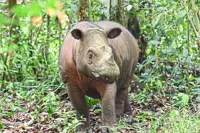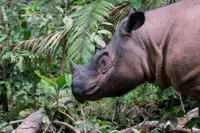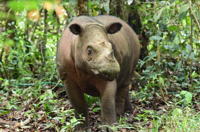
KOTA KINABALU: Both Malaysia and Indonesia are taking what may be the first step in saving the Sumatran rhino from extinction with the arrival of an expert from Germany next month to help extract eggs from Iman, the sole surviving female animal in Sabah.
Wildlife reproduction expert, Professor Thomas Hildebrandt from the Leibniz Institute for Zoo and Wildlife Research in Berlin, has developed a technology that allows for the collection of eggs from the ovaries of rhinoceroses.
Deputy Chief Minister Datuk Christina Liew said this was part of the artificial breeding programme that had been agreed upon for collaboration with the Indonesian government.
Hildebrandt, who is expected to conduct the procedure at the Borneo Rhino Sanctuary (BRS) in the Tabin Wildlife Reserve, Lahad Datu, where Iman is currently housed, is also involved in the work to save the virtually extinct northern white rhino in Africa.
On Sunday, Liew had visited Iman to see the 23-year-old rhino’s condition to see if the animal is medically fit for in vitro fertilisation (IVF). IVF is a medical procedure whereby an egg is fertilised by a sperm inside a test tube or elsewhere outside the body, after which the resulting embryo is implanted in the womb of a surrogate mother, in this case, a surrogate rhino mother.“I am happy to see Iman having a good appetite and eating well. She is recovering after going through an intensive regimen of medical treatment and feeding.
“Although she cannot bear any offspring, she is still producing eggs so there is hope for IVF.
Iman’s eggs will be harvested to be fertilised in a specialist lab in Indonesia.
“The Indonesian Rhino Foundation, on the other hand, will assist in getting the sperm needed,” she said in a statement here yesterday. On Aug 9, the governments of Indonesia and Sabah-Malaysia had agreed in principle to sign the Memorandum of Understanding (MoU) on Conservation of the Sumatran Rhinoceros in Indonesia next month.
Iman, who was captured in Danum Valley in 2014, was translocated to the reserve and kept at BRS.
Borneo Rhino Alliance (Bora), a non-governmental organisation based in Sabah, operates the sanctuary for the Sabah Wildlife Department.
In his briefing to Liew, Bora executive director Datuk Dr John Payne said Iman, which now weighs 530kg, was treated for the growth of non-malignant tumours in its uterus. “Last December, Iman suffered a ruptured tumour in its uterus, leading to massive bleeding.
“As a result, we had to postpone the IVF procedure then,” he added.
Wildlife reproduction expert, Professor Thomas Hildebrandt from the Leibniz Institute for Zoo and Wildlife Research in Berlin, has developed a technology that allows for the collection of eggs from the ovaries of rhinoceroses.
Deputy Chief Minister Datuk Christina Liew said this was part of the artificial breeding programme that had been agreed upon for collaboration with the Indonesian government.
Hildebrandt, who is expected to conduct the procedure at the Borneo Rhino Sanctuary (BRS) in the Tabin Wildlife Reserve, Lahad Datu, where Iman is currently housed, is also involved in the work to save the virtually extinct northern white rhino in Africa.
On Sunday, Liew had visited Iman to see the 23-year-old rhino’s condition to see if the animal is medically fit for in vitro fertilisation (IVF). IVF is a medical procedure whereby an egg is fertilised by a sperm inside a test tube or elsewhere outside the body, after which the resulting embryo is implanted in the womb of a surrogate mother, in this case, a surrogate rhino mother.“I am happy to see Iman having a good appetite and eating well. She is recovering after going through an intensive regimen of medical treatment and feeding.
“Although she cannot bear any offspring, she is still producing eggs so there is hope for IVF.
Iman’s eggs will be harvested to be fertilised in a specialist lab in Indonesia.
“The Indonesian Rhino Foundation, on the other hand, will assist in getting the sperm needed,” she said in a statement here yesterday. On Aug 9, the governments of Indonesia and Sabah-Malaysia had agreed in principle to sign the Memorandum of Understanding (MoU) on Conservation of the Sumatran Rhinoceros in Indonesia next month.
Iman, who was captured in Danum Valley in 2014, was translocated to the reserve and kept at BRS.
Borneo Rhino Alliance (Bora), a non-governmental organisation based in Sabah, operates the sanctuary for the Sabah Wildlife Department.
In his briefing to Liew, Bora executive director Datuk Dr John Payne said Iman, which now weighs 530kg, was treated for the growth of non-malignant tumours in its uterus. “Last December, Iman suffered a ruptured tumour in its uterus, leading to massive bleeding.
“As a result, we had to postpone the IVF procedure then,” he added.
Already a subscriber? Log in
Get 20% OFF The Star Digital Access
Cancel anytime. Ad-free. Unlimited access with perks.