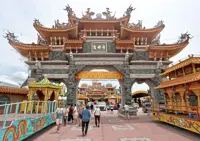
GEORGE TOWN: Investors should seize economic opportunities in Penang by mid-year, when prospects are expected to peak before tapering off towards year-end, according to a prediction during the annual flame-watching ceremony at the 176-year-old Ban Ka Lan Snake Temple (Hock Hin Keong) in Bayan Lepas.
The ceremony, known as “chneah hoay”, saw sacred flames ignited three times from an incense urn on the altar at intervals of about one minute, with each flame representing the outlook for a four-month period of the year.
Cheng Hoe Seah Association chairman Teoh Hock Guan, whose association has held a long-standing role in overseeing traditional Taoist rituals and customs in Penang, including those related to the Snake Temple, said the flames were observed within a short span of time at 11.55pm, 11.56pm and 11.57pm respectively on Saturday (Dec 21).
“The first flame burned weakly at a moderate level, indicating gradual but steady economic momentum in the first four months of the year.
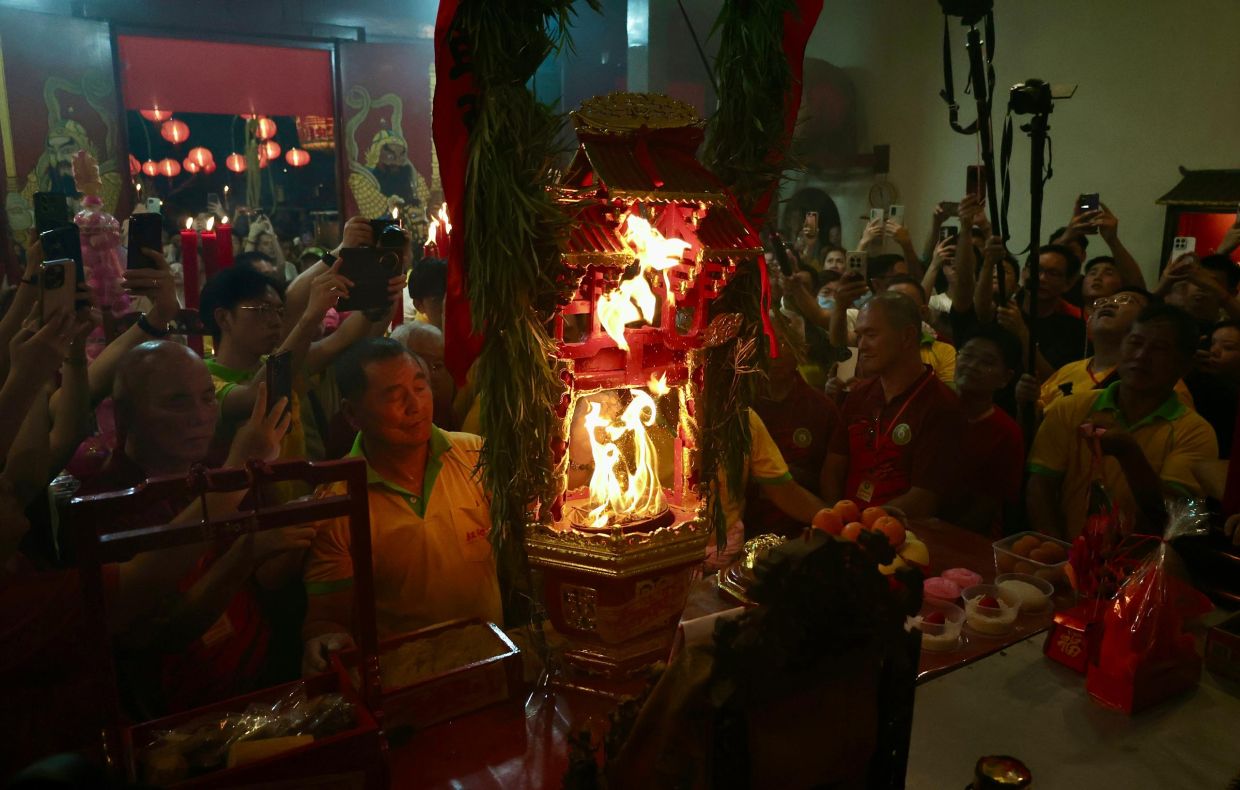
“The second flame rose fully ignited and vigorous, reflecting a period of strong growth and prosperity in the middle four months.
“The third flame, however, burned more slowly, signalling a cooling phase and a potential economic slowdown towards the latter part of the year.
“Overall, the flames were interpreted as indicating gradual improvement, leading to more favourable times in the middle of the year,” he said after the ceremony.
Teoh, however, clarified that the reading served only as a guide and should not be relied upon entirely.
The half-hour ceremony saw the temple's committee members and elders gathered around the altar before embarking on the ritualistic prayer session.
The annual tradition reads the deity’s divination based on the stability, brightness and strength of three bursts of flames in the incense urn, each representing a four-month cycle of the year.
The Ban Ka Lan Snake Temple, also known as Hock Hin Keong Temple, was believed to have originated about 1820 as a private shrine established by a monk from An Xi devoted to Chor Soo Kong, a deified God of Medicine.
About 1850, it moved to its present site on donated land, and was later opened to the Chinese community under the care of Penang’s Chinese leaders and entrusted to the Hokkien Kongsi.
Built in honour of Master Choo Sor Kong, a Buddhist monk from the Song Dynasty (960–1279), he was venerated as “Chor Soo”, meaning an eminent historical figure, after a lifetime of good deeds.
Legend has it that he sheltered snakes from a nearby jungle, and when the temple was completed, the snakes moved in and were regarded as its protectors.