IT’S useless if we have high incomes but are not happy – Prime Minister Datuk Seri Najib Tun Razak had commented when the 2017 World Happiness Report ranked Malaysia as the 42nd happiest country in the world last month.
The young in Malaysia should take heed of that.
A survey by the International Islamic University Malaysia found that the millennials, or those aged 21 to 35, are not satisfied with their income and job situation.
“Maybe, it is partly due to the restlessness of youth. But many of the millennials we surveyed said they were not happy with the material aspect of their life, especially their employment situation and income,” says Prof Datuk Seri Dr Syed Arabi Idid, who led the public opinion study on current issues from March to April.
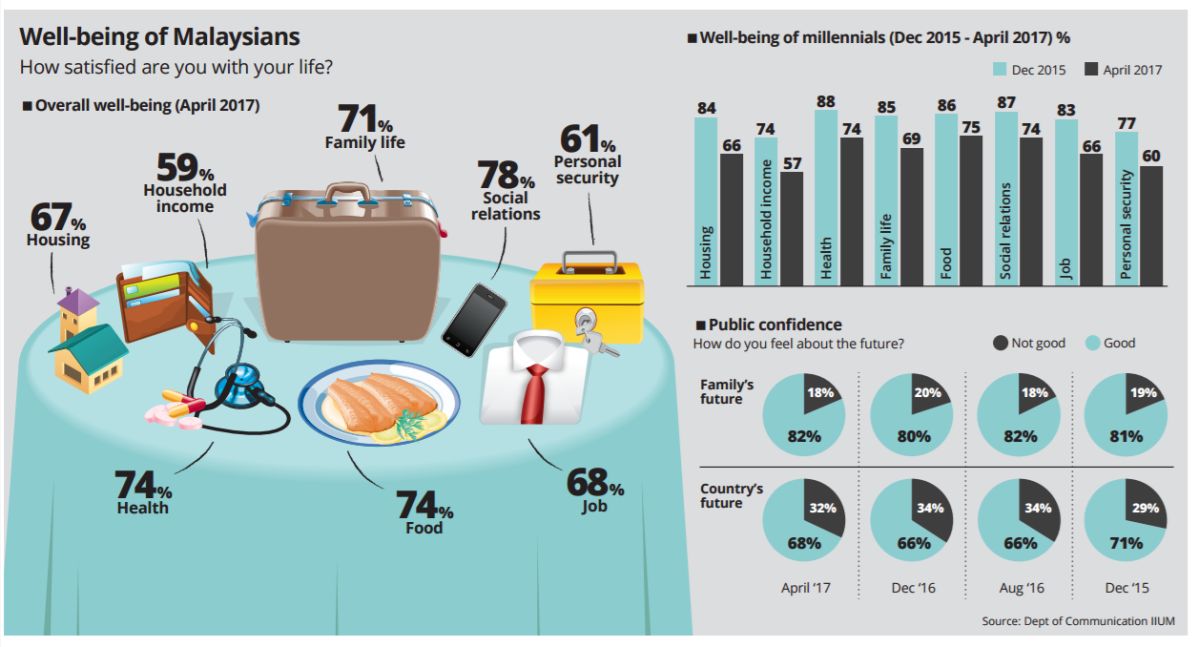
The study conducted by the university’s Department of Communication looked at what the adult population in Malaysia think of their well-being in various aspects of their life – from housing, health, job and household income to family life, food, social relations and personal security – ranking each one on the scale of “very good”, “good”, “not good” and “not very good”.
A total of 515 millennials out of 1,326 people nationwide, randomly sampled based on their age, gender and race, were interviewed.
Money topped the list of dissatisfaction with almost half of the respondents in the demographic cohort saying they were not satisfied with their household income while 34% said they were not satisfied by their housing and job situation.
Personal security is also a concern with 40% saying they were not satisfied with it.
In contrast, the older demographic group (51 years old and above) said they were fairly satisfied with their overall well-being, with 70% recording satisfaction in housing and 71% in their job.
A reason for the dissatisfaction among the young, Dr Syed Arabi feels, is because it is the first time they are starting out on their own in a world that is full of uncertainties.
“They are also entering the job market which is now competitive with many more graduates. Their pay is not high and it is not easy to start a family or buy a house.
“For most, the economy was good when they were growing up, and they have had it easy, so now it’s a reality check for them,” says Dr Syed Arabi, who also heads the Special Project of the National Council of Professors on Media, Democracy and Electoral System.
The overall level of satisfaction is a drop from December 2015, he adds, attributing it to the fall in global oil prices in early 2016 which had affected the global economy, including Malaysia’s.
The tumultuous international politics inadvertently also had an effect on the local mood.
“For example, the global uncertainties sparked by Brexit and the election of Donald Trump as the US president last year caused some worry that the global economy will be further hit,” he adds.
There were drops in the satisfaction level in housing from 87% in 2015 to 66% in 2017; household income from 77% to 57%; job situation from 82% to 66%; and personal security from 77% to 60%.
What is significant is that there were also non-material drops: in health, from 89% to 74%; social relations, from 86% to 74%; and even food, from 87% in 2015 to 75% in April this year, Dr Syed Arabi says.
This dissatisfaction is something that the Government will have to address under its 2050 National Transformation (TN50) initiative, he says.
Having just concluded its “first phase” comprising 90 days of dialogue sessions with various groups since it was launched in January, the TN50 movement, it was reported, received various feedback from the youth on the Malaysia they want in the future.
Many also said they want to see their incomes increase drastically in the next 30 years, as Youth and Sports Minister Khairy Jamaluddin was quoted in the press: “A lot of them also say they want more flexible working conditions. For example, they want to have a permanent day job that allows them to work from home. This would enable them to have a second or freelancecareer.”
Dr Syed Arabi believes it is time for Generation Y (the millennials) to just bite the bullet.
“The millennials have to scale down their expectations and accept the harsh reality now.
“Previously, you can easily get a job after you graduate and a few years after starting work, you can start a family and buy a house. Not anymore. Now the competition is stiffer with the rising number of graduates in the market, and if you reject a job because it is ‘low paid’, many more others will take it,” he says.
Likewise, he adds, the Government can address their woes by promoting “new” areas of work like agriculture, more internship and training programmes.
Dr Syed Arabi highlights another study he did on the people’s outlook on the future.
The survey, which was conducted on 2,864 people from December 2015 to April 2017, revealed that the people’s level of confidence in the country’s future had dropped from 71% in December 2015 to 65% in December 2016. However, recent figures showed a rise as some 68% of the respondents in April this year said they think Malaysia has a good future.
“Everything is a cycle, and we can see the rise in confidence among Malaysians about the state of the country and their life because the Government’s initiatives to address the people’s concerns about housing and livelihood are starting to bear fruit while the world’s leaders are working to resolve their issues, even Trump.
“Trump still holds the trump card to the world’s well-being but he is making an effort to reach out to the different factions of the world and hold dialogues with the leaders. Same as the European Union and Britain which are trying to work out their separation deal amicably. These efforts are creating some stability in the world order and economy,” he says.
Acknowledging how the young are sometimes misunderstood when it is the environment and culture that had changed, Dr Syed Arabi says they will also have to do their part.
“For example, some people feel that the young are over-pampered by their parents and bosses, when it is really the culture that has changed where there is less formality between different social groups – the relationship between children and parents or bosses and employees is no longer so strict.
“But ultimately, the millennials just have to go out and do their part in the world... they have to work,” he adds.
Already a subscriber? Log in
Get 20% OFF The Star Digital Access
Cancel anytime. Ad-free. Unlimited access with perks.