ROSELINE Rabouine was eight when British soldiers showed up at her family’s home on the Chagos Islands and told them they had to leave.
To make way for a joint British and American military base on the islands in the middle of the Indian Ocean, Rabouine and most of the roughly 2,000 inhabitants were sent on an eight-day journey to Mauritius, and never allowed to return.
That was nearly six decades ago, she said.
“If they told me I could return, I would go today,” said Rabouine, sitting on a dimly lit porch in her working-class neighbourhood in Port Louis, Mauritius’ capital.
That wish seemed tangible this year as Britain prepared to return the Chagos Islands to Mauritius, which has vowed to let displaced Chagossians like Rabouine, 61, go home.
Then the United States bombed Iran.
Now the tiny Chagos Archipelago is caught in a geopolitical tussle involving US President Donald Trump, British politics, China and the conflict in the Middle East.
Trump initially supported the British plan to ratify a treaty that would return the islands to Mauritius. But he withdrew his support shortly before the United States attacked Iran in February, saying he did not want to relinquish control of the joint military base on Diego Garcia, an atoll in the archipelago.
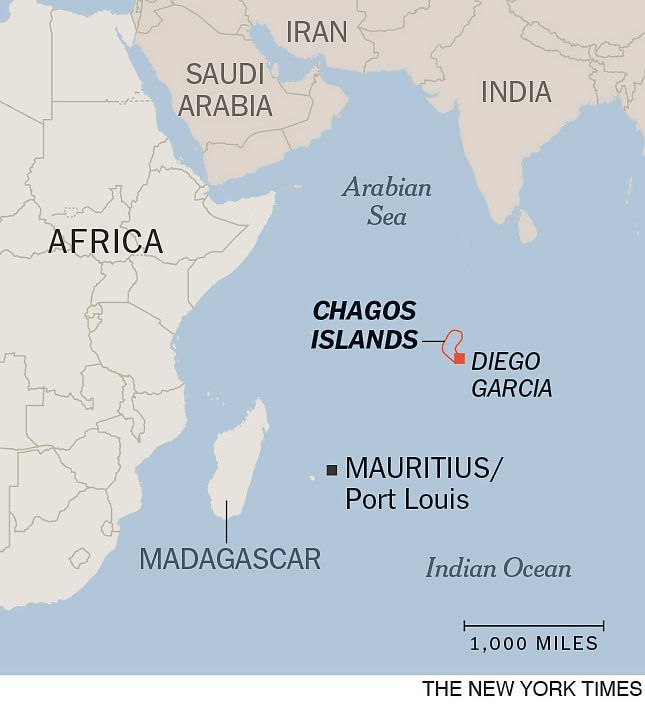
The islands remain largely uninhabited and off-limits, except for the forces on Diego Garcia.
The White House said in a statement in July that Trump would “never allow the US presence at Diego Garcia to be undermined or threatened for any reason”.
The treaty to return the islands, which was created after an international court said Britain had failed to fully decolonise Mauritius, has also been criticised by conservative British politicians.
It also allows for American and British forces to continue operating on Diego Garcia on a 99-year lease.
Diego Garcia is central to US efforts to project power in the Indian Ocean, according to Nitya Labh, a fellow at Chatham House, a London-based think tank.
Its landing strips are long enough for large military aircraft and it has a deep-sea port, where warships can be stocked and serviced. There is also speculation that some covert operations are based on Diego Garcia.
Officials in Washington and London have also raised concerns that ratifying the treaty could create an opening for China to build its own base on the Chagos Islands.
As the debate rages, people born on the islands say time is running out. Only a few hundred are still alive, and they fear that if they are not allowed to return, their culture and history will be lost.
They say they want to visit the graves of their ancestors and swim in the same turquoise waters and walk the same white sand beaches.
Survivors of the expulsion are themselves in disagreement about the archipelago’s future.
Some, like Jeanine Sadrien, 69, and born on the islands, say Mauritius deserves full sovereignty, and that under British rule, “we were not given the right to go back”.
Others, like Rabouine, would rather see the islands remain under British control, arguing that the diaspora community has been discriminated against in Mauritius.
While Rabouine, a retired domestic worker, and her husband, who worked construction, built a solid home in Port Louis with concrete walls and granite-tile floors, she said many survivors were trapped in a cycle of generational poverty.
She recalled life on the Chagos Islands, where families were self-sufficient and didn’t worry about money.
It was common to build your own home and eat fresh-caught lobster for dinner. On Friday evenings, everyone gathered on the beach for traditional singing and dancing, she said.
After being expelled to Mauritius, many struggled to navigate mundane routines like opening bank accounts and paying rent because they could not read or write, Rabouine said. They could barely afford to buy chicken feet for dinner.
“Too many people died,” she said. “Too many people lived in despair here in Mauritius because they didn’t choose to be here.”
Mauritian government officials argue that Chagossians have long enjoyed the same rights and benefits as all Mauritians, including free health care and education.
The government was planning to facilitate heritage visits to the Chagos Islands this year, but postponed them because of the Iran conflict.
The British Parliament must approve the treaty for it to take effect, including a provision for Britain to pay Mauritius more than US$135mil a year to lease Diego Garcia.
Keir Starmer, the former British prime minister, had said he would not move that process forward without the Trump administration’s support.
It is unclear how the current prime minister, Andy Burnham, will proceed.
Should Britain fail to ratify the treaty, Mauritius may escalate the issue, said Gavin Glover, the country’s attorney-general.
“We’re going to make noises everywhere,” he said. “We are going to start sending boats and landing on the islands. What we will have to do is to actually create a situation of conflict.”
The goal would be to get a new case before the international court.
In the meantime, the best that Chagossians in Mauritius can do is to keep their folk traditions alive, they said.
They cook traditional coconut milk stew with chicken or fish, known as seraz. They beat drums known as ravannes and perform song-and-dance rituals to sega music.
At a community centre in Port Louis recently, Sadrien, who was 10 when she last lived on Chagos, swayed her hips and twirled with a vigour that belied her age. She flapped her red and blue floral skirt and flashed a smile.
“When I close my eyes and dance,” she said, “it’s like I’m on Diego Garcia.” — ©2026 The New York Times Company
This article originally appeared in The New York Times
Already a subscriber? Log in
Get 20% OFF The Star Digital Access
Cancel anytime. Ad-free. Unlimited access with perks.