WHEN night falls in the small Colombian village of Doradal, the quiet is broken by the wet, heavy thuds of the town’s 1,360kg unofficial mascots trudging past gardens, schoolyards and patios.
Along Colombia’s main river, fishing nets once filled with catfish are coming up emptier – replaced by the wake of churning beasts that shouldn’t be there. Fishermen are terrified to cast their hooks at night.
“They’ve changed our lifestyle,” said Giovanny Contreras, a fisherman, as he navigated his boat past the bulbous eyes of a male hippo peering at him.
Thousands of kilometres from their native Africa, hippopotamuses are multiplying in the heart of Colombia, taking over watering holes and wading further into the lives of Colombian communities near the Magdalena River.
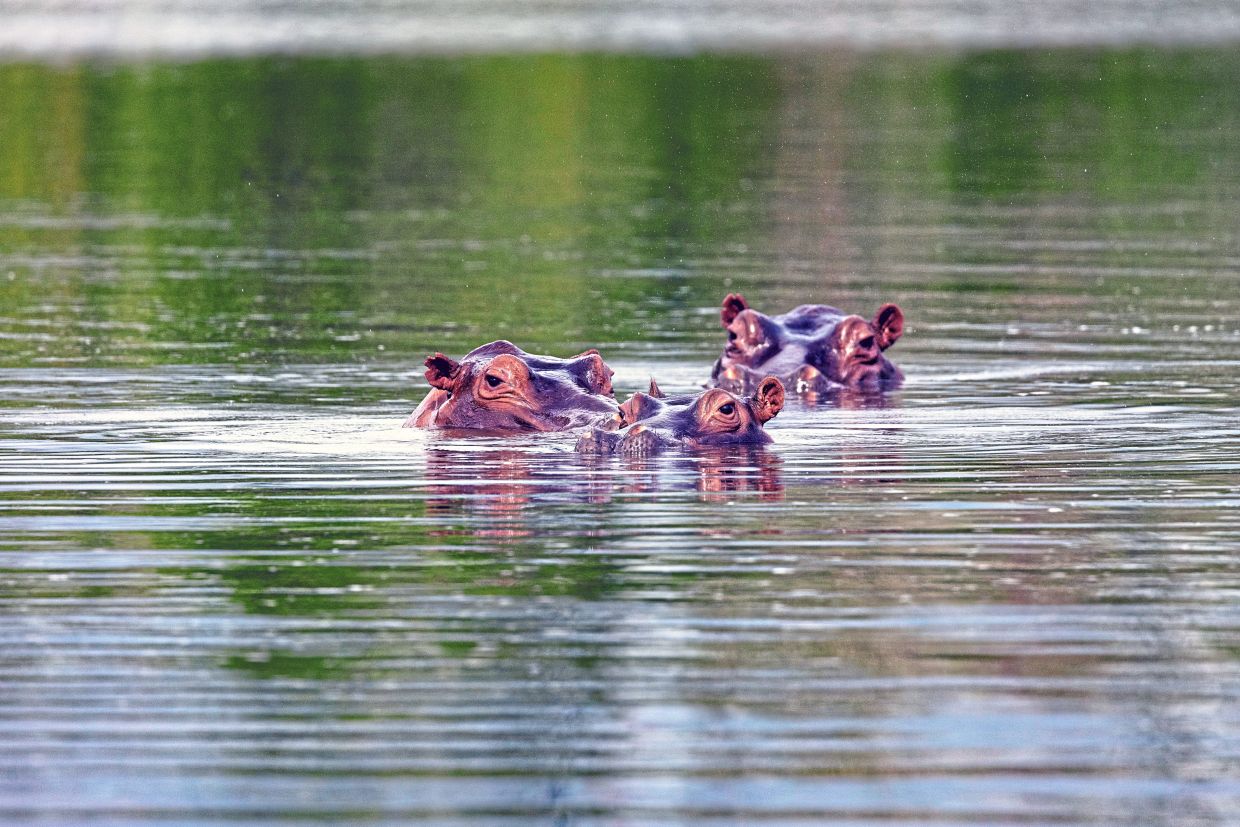
It began as a drug lord’s whim: four hippos that Pablo Escobar brought as exotic pets for his sprawling estate in the 1980s.
After the kingpin was felled in 1993, his 2,000ha estate fell with him.
Left to their own devices in the lush Colombian countryside, the semiaquatic mammals did what they do best: they lolled in the water, grazed and procreated.
Today, about 200 hippos – native to Africa and declared an invasive species in Colombia – are estimated to be roaming freely, drawing fury, affection and global intrigue.
Scientists project their numbers to reach more than 1,000 by 2035, a potential threat to Colombia’s ecosystem.
The government has tried relocating the hippos across the world, but has found few takers.
Veterinarians have tried castrating them, but it is a dangerous, herculean effort requiring at least eight people to trap, sedate and operate on each animal.
Then, in April, officials announced a US$2mil plan they had sought to avoid: culling the population by euthanising 80 hippos, while continuing the effort to relocate the rest.
Under the plan, which could begin this year, hippos that scientists are able to corral would be put down with a lethal chemical injection. Others could be shot between the eyes and buried in place, officials said.
The plan has pitted animal rights groups against conservationists who say the hippos, without natural predators in Colombia, could displace native species.
In Doradal, home to Escobar’s former hacienda, the planned killing has divided a town where the only population of wild hippos outside Africa has become a lucrative tourism engine and defined the community’s identity.
It has also resurfaced Escobar’s haunting legacy in a country trying to bury it.
“I’m personally conflicted because I’m conscious that they have to eliminate or move them,” said Samy Castano, 35, whose house is across from a hippo-filled pond.
“But they’re also just animals, animals that aren’t to blame for the decisions of Pablo Escobar,” he added, faulting the government for failing to take decisive action years ago.
“I don’t want them to kill them!” his 11-year-old daughter, Luciana, chimed in, recounting the time a hippo tried to poke its head through their living room window while she was watching television.
The hippos have long lent a touch of magical realism to daily life in Doradal.
Visitors are greeted by kitschy hippo statues, locals offer hippo-watching tours, and some residents have reportedly stolen baby hippos to try to breed them as pets.
Many residents regard the beasts with a mix of pride, pity and prudence.
Hippos – the largest land mammals after elephants and rhinos – are notoriously territorial, capable of outrunning humans, and have killed people in Africa. So far, attacks in Colombia have been limited, despite anecdotes of close calls.
Near the height of his power, Escobar acquired 2,000ha of land in Doradal, which served as a retreat from his billion-dollar empire smuggling cocaine to the United States.
He dug dozens of human-made lakes and built a Mediterranean-style mansion, a private airstrip and a bullfighting ring. He also smuggled into the country a coterie of exotic animals – elephants, giraffes, camels, rhinos, kangaroos, ostriches and deer.
And, of course, four hippos.
“All the animals had their specialised feeders,” said Jose Conrado Montoya Toro, 85, who said he was hired in the 1980s as a caretaker of Escobar’s zoo.
“When the vegetable truck came, there was cabbage, carrots and lettuce for all the animals.”
The estate, Hacienda Napoles, fell into disrepair after police killed Escobar in a rooftop shootout in Medellin.
Most animals were transferred to zoos, but the hippos were abandoned and escaped, reproducing beyond the premises.
A few kilometres from Hacienda Napoles, dozens of hippos have waded north along the Magdalena, a biodiverse artery that flows about 1,600km through Colombia. Unlike in Africa, there are no lions or crocodiles to curb their growth.
If the hippos continue unabated, many scientists say they could displace manatees and capybaras from their feeding areas, alter riverbanks, and change aquatic chemistry with their excrement – threatening fish.
The government’s first attempt at a solution turned into a political nightmare.
After state-sanctioned hunters shot an especially aggressive male named Pepe in 2009, a leaked photo of smiling soldiers standing over his carcass led to national outrage.
A judge soon banned further killings, forcing officials to find non-lethal ways to manage the herd.
In 2021, a group of scientists published an exhaustive study concluding that culling the hippos was one of the most effective ways to protect the ecosystem.
And in 2022, the government declared the hippos an invasive species, opening the door to euthanasia. — ©2026 The New York Times Company
This article originally appeared in The New York Times