
DENYS Khomenko betrays no emotion recalling the night last year when a Russian strike drone tore into the protective arc covering the part of the Chernobyl nuclear plant that suffered the world’s worst nuclear disaster – narrowly avoiding another tragedy.
Maintaining composure at all times was critical to the high-stakes job of keeping the stricken plant powered and protected as it is slowly decommissioned 40 years on, he said.
“Emotions get in the way of logic, so you need to work calmly,” the deputy director for technical operations said during a recent visit to the plant in its eerily calm wooded exclusion zone some 100km north of Kyiv.
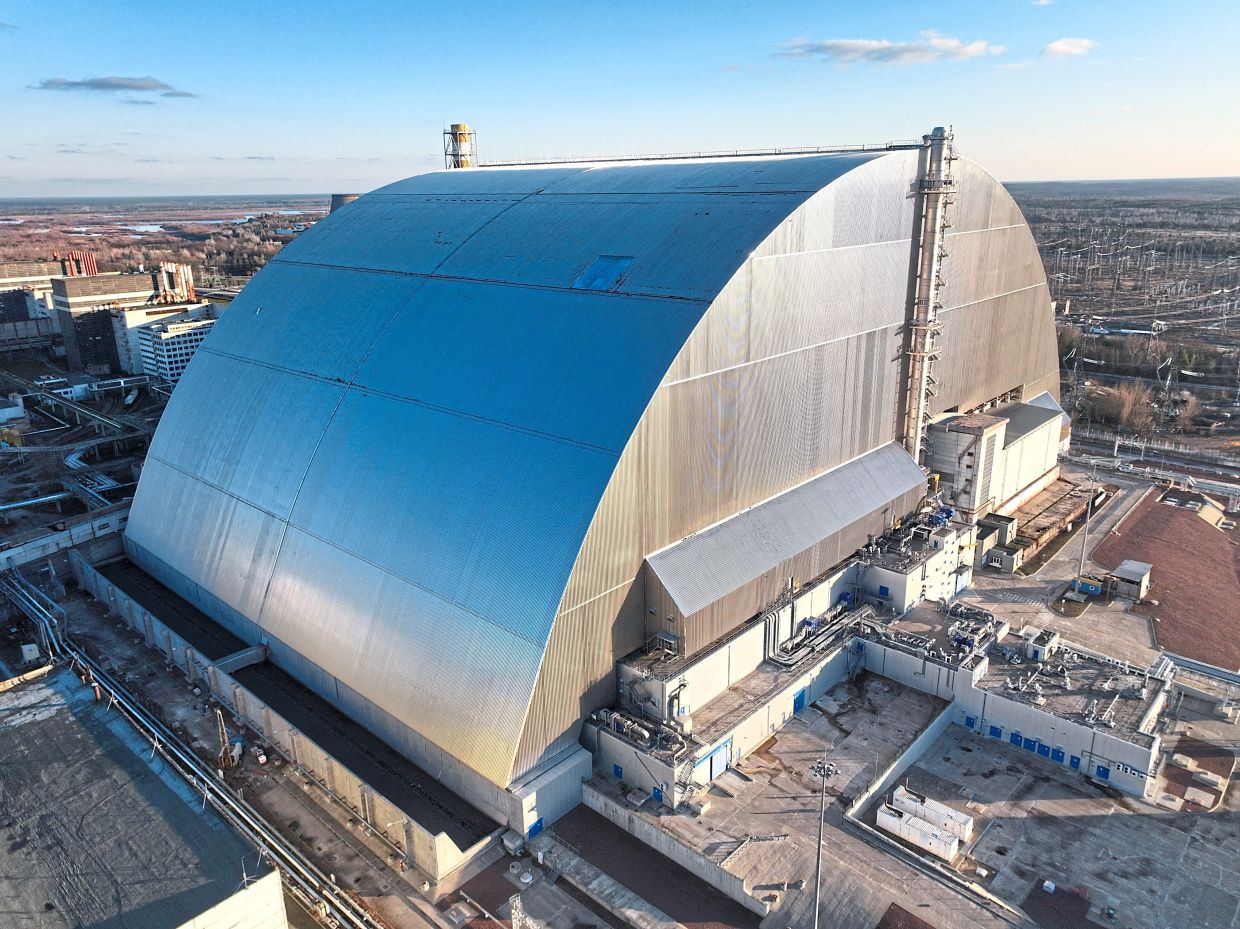
Workers have since patched up the hole with a large panel dwarfed by the hulking, 256m-wide steel structure that covers the damaged reactor four. But further repairs are needed in an environment still too dangerous to linger in.
Large swathes of the exclusion zone have close to normal levels of radiation, but some areas, particularly around the destroyed reactor, remain highly contaminated.
“A welder or other highly qualified personnel may only be able to work there for a few minutes, or perhaps a few hours,” Khomenko said, noting that meant repairs required a large number of such workers, who are not readily available.
It is a reminder of the acute risks at the facility more than four years into a war involving regular Russian air strikes on infrastructure across Ukraine.
Just outside, wild moose roam the approach road and the nearby abandoned town of Prypiat, which has succumbed to nature.
The drone strike means Ukraine marked the 40th anniversary of the disaster needing to reshield the old sarcophagus covering tonnes of radioactive debris inside reactor four, which exploded on April 26, 1986, spewing radioactive clouds across much of Europe.
Khomenko is among around 2,250 employees who still work at the facility, which was briefly occupied by Russian forces in the first few weeks of the 2022 invasion that has postponed plans to dismantle the doomed reactor.
The Feb 14, 2025, drone strike sparked a weeks-long fire, damaging the membrane sealing the original steel-and-concrete structure hurriedly built over the reactor by Soviet authorities in 1986.
Experts say the €2bil structure, which was meant to last 100 years when it was built in 2016, must be repaired within the next few years to avoid permanent damage.
“The risk is corrosion and the structure will be undermined, and then this creates a risk in terms of nuclear safety,” said Odile Renaud-Basso, the president of the European Bank for Reconstruction and Development.
The bank is seeking to raise funding for the repairs, which it estimates will cost at least €500mil.
No radioactive leaks have been detected; inside the arc, the original sarcophagus – grey and rusted – remains intact.
The control room of reactor four is a darkened space littered with dilapidated Soviet-era equipment.
Russia denied involvement in the attack, which Ukraine’s security service said involved a Shahed drone – a weapon Ukrainian forces do not use.
Moscow said Kyiv had attacked its own plant to get more weapons and money from the West.
Ukraine’s top state prosecutor said Russia has repeatedly sent drones and missiles on a flight path near the facility.
Ruslan Kravchenko said radars had detected at least 92 Russian drones that had flown within a 5km radius of the shield since June 2024.
Khomenko, the deputy director for technical operations, said other parts of the facility are also vulnerable, such as a nuclear-fuel storage site near reactor four.
“It was not designed for the impact of aerial vehicles, planes, or anything else of that kind,” he said.
National Guardsmen patrol the plant, which is harder to reach for many workers who spend 13 days at a time there on duty because the route they used to take through Russian-allied Belarus has been cut. — Reuters