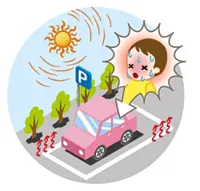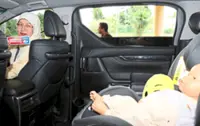
IN January, what began as a routine morning in Seremban turned into every parent’s worst nightmare when a two-year-old toddler was accidentally left in his mother’s car for almost nine hours.
The mother had forgotten to drop him off at the babysitter before heading to work at a bank early in the morning, only realising what had happened around 5pm. But by then, it was too late and an innocent life was lost – the child had died from heat exhaustion in another case of Forgotten Baby Syndrome (FBS).
Many people cannot understand how a parent can forget their child; unfortunately, devastating incidents like these are not isolated.
In the United States, an average of 38 children die every year from being left in vehicles, with more than half of the deaths due to caregivers accidentally leaving the child in the car. A 2014 United States study found that nearly one in four parents with children under the age of three admitted to having forgotten their child in a car. Researchers from Universiti Malaysia Pahang Al-Sultan Abdullah found that between 2012 and 2024, 17 children in Malaysia died after being left alone in vehicles, with vehicular hyperthermia, or heatstroke, identified as the primary cause of death.
With several similar cases reported over the years and Malaysia currently experiencing temperamental weather – a scorching heatwave despite the bouts of heavy rain – experts say vigilance and simple precautionary steps can make the difference between life and death.
A ticking clock
According to consultant paediatrician and child-disability activist Datuk Dr Amar-Singh HSS, less than 20 minutes in full sun in a closed vehicle is all that is needed to kill a young child.
As young children are far more sensitive to heat than adults, heatstroke, or thermal injury, can lead to cerebral oedema (brain swelling), multiorgan haemorrhage (bleeding), and necrosis. Death is often the result.
Dr Amar-Singh says incidents of FBS often follow a similar pattern: a young child, usually under five, is being transported in the back seat by a parent or caregiver.
He stresses that the safest place for a child remains in the back, strapped into a car seat. Often, however, the child falls asleep, leaving no vocal clues for the adult in front. The adult transporting the child to a childminder or kindergarten then experiences a disruption in routine, resulting in a break in habit.
This could be something as simple as a different parent handling the school run that day, or an urgent call before work.
“The key factor is a distracted parent, one who has too much on his or her mind and is rushing to complete many tasks on a busy day,” Dr Amar-Singh explains.
Occasionally, he adds, this also happens in school buses when a young child falls asleep at the back and is missed when other children disembark.
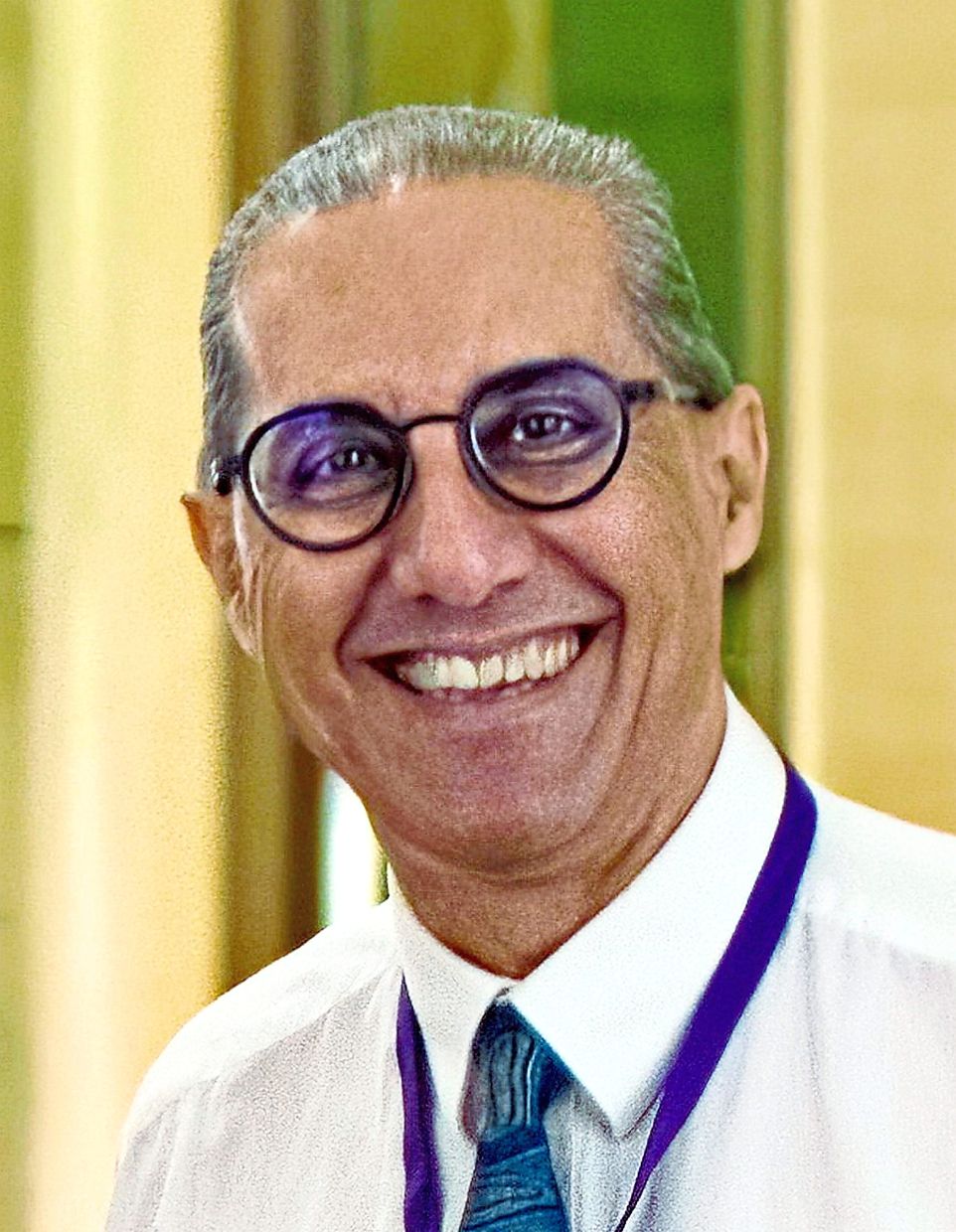
To reduce FBS, he says caregivers need disciplined habits, cross-checking mechanisms, reminders, and support from the wider community, alongside in-car safety devices.
“Vehicular hyperthermia deaths are preventable with systematic change, especially technological modification to vehicles. We need to work together as a community to reduce these tragic child deaths,” he says.
ALSO READ: Parents taking precautionary steps to mind the baby
He also calls on the government to create more sustained public awareness campaigns and work with automobile companies to introduce legislation to prevent child car deaths.
“Malaysia is not peculiar in having these tragic deaths and we can learn from other countries to put in place prevention measures,” he says.
Stress and routine lapses
On social media, there has been public sympathy towards parents involved in such cases, with some arguing that punishment may be excessive as families are already enduring the loss of a child.
In such situations, Dr Amar-Singh suggests punitive measures may not always be the most appropriate response.
“We must remember that the parents this tragedy happens to are not bad or uncaring parents. This is not a neglect issue but one of the busyness and taxing demands of modern life,” he says.
“If we listen to their stories, we may realise that we are not that different from them and that it could happen to any one of us. We cannot begin to understand the anguish that these parents are experiencing with the death of their precious child.”
Children’s Protection Society Malaysia vice-chairman (KL branch) Nawiza Ariff explains that oftentimes, cases of FBS are not about negligence or lack of love but largely linked to how the brain functions under stress, fatigue, and distraction.
“I wouldn’t put the blame solely on the parents, but as a community – workplaces, schools, and caregiver centres – we all play an important role,” she says.
Nawiza explains that the issue is rarely caused by a single failure, but rather the result of several small breakdowns happening at the same time: disrupted routines, communication lapses between caregivers, inadequate verification systems by childcare providers, and parents dealing with stress and cognitive overload.
All hands on deck
Nawiza says prevention must happen at three levels: individual, organisational, and policy.

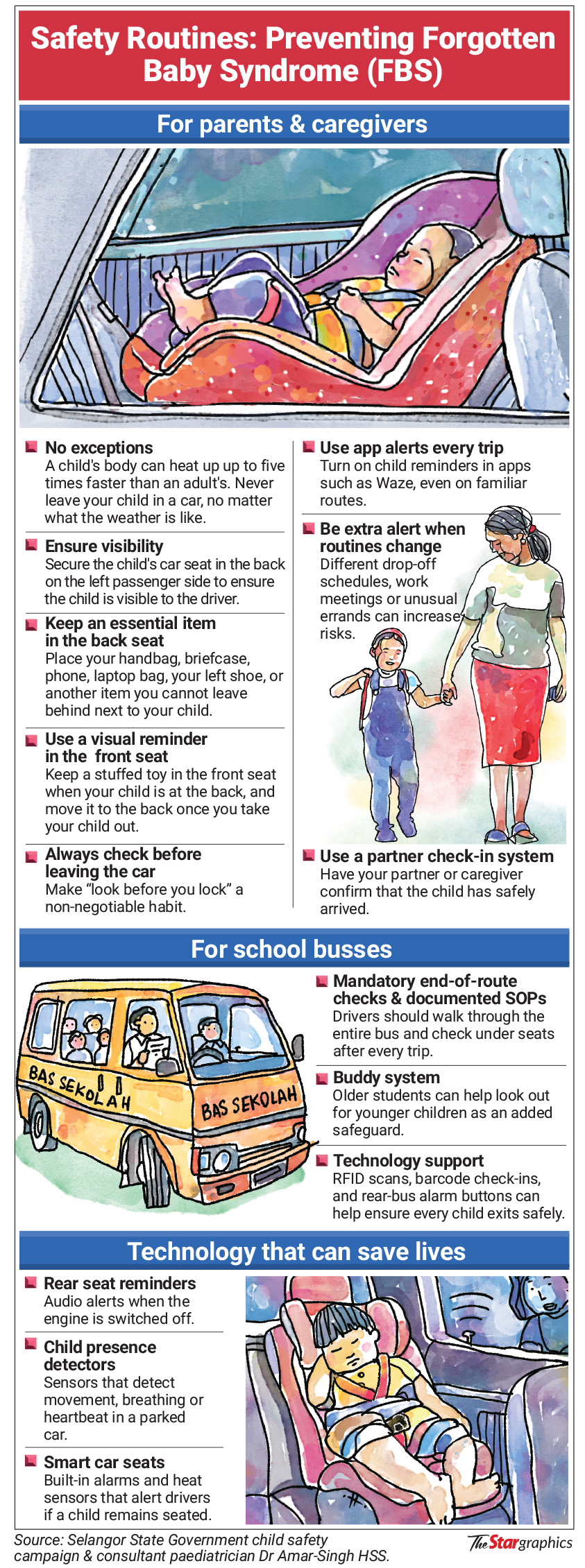
At the family level, caregivers should adopt non-negotiable habits rather than rely on memory alone. This includes putting a work bag or essential item in the back seat, placing a stuffed toy in the front seat when the baby is in the back, and practising “look before you lock” checks.
At the childcare, school, and transport-provider levels, she says simple written SOPs can remove ambiguity, such as taking headcounts at the end of drop-off routes and calling parents if a child has not arrived by a certain time.
Workplaces, too, should help protect employees from burnout and mental fatigue, she says.
Others can also play a role. Car park attendants and traffic police issuing summonses can remain alert to the possibility of children being left in parked cars as they go about their duties.
“FBS requires a whole-of-society safeguarding approach. Employers, communities, and policymakers each play a critical role in building layers of protection so that a single human lapse does not lead to a fatal outcome.”