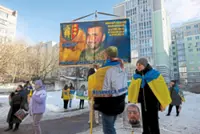
LARYSA Gladka was among hundreds of Ukrainians lining the road stretching towards the northern border, holding flags as they anxiously fixed their gaze at the horizon.
Their northern region of Chernigiv was occupied when Russian forces invaded four years ago. Now liberated, it is the gateway for freed Ukrainian prisoners of war heading home.
The 50-year-old Gladka, whose husband was killed fighting Russian troops and whose son is serving in the army, took a place at the roadside with her neighbours to be the first to welcome a convoy of Ukrainians freed from gruelling Russian captivity in early March.
“You rejoice and cry, and you tremble inside from the emotion – seeing those eyes that are both sad and joyful and filled with tears,” she said during a recent prisoner exchange.
She had parked her car over on a hill overlooking the road for a better view into the distance.
Others scanned the horizon with binoculars.
After an agonising wait, the column of vehicles came into view. Ambulance sirens blared and bus horns wailed.
From the windows, out peered the emaciated faces of the newly freed Ukrainian prisoners, heads shaved and wounds visible.
Gladka and the others stood with tears in their eyes, waving their hands and gripping giant Ukrainian flags.
Prisoner swaps – and the exchange of remains of dead soldiers retrieved from the battlefield – are one of the only areas of cooperation between Moscow and Kyiv.
Since Russia’s invasion in February 2022, Kyiv says more than 8,000 PoWs have been returned, as well as the bodies of more than 17,000 dead soldiers.
The locals’ tradition of heralding home the returnees, many of whom were detained for years, started with a small group of five or six people.
It has since grown into a network stretching the roads from the border with Belarus, where the swaps take place, with dedicated social media groups set up to track the buses, alerting the next town to get ready.
“It’s a sign of gratitude, to thank the guys for protecting us, and so that they know that we are waiting for them,” said Anna Kondratenko, an employee of a local village council.
“It is not our obligation, but our duty,” the 33-year-old, whose brother-in-law was released after more than two years in Russian detention, said.
“These are our children, these are our warriors, they defended us,” said a woman who gave her name only as Olga, 55.
The latest exchange – 500 Ukrainian for 500 Russian soldiers – took place over two days in March, agreed as part of US-mediated talks on ending the war.
But with those negotiations now derailed by the war in the Middle East, the timing for the next release is unclear.
Driver Andriy, 53, is one of the first Ukrainian faces many of the freed soldiers see as they clamber onto his bus.
“The guys are surprised that they are being welcomed like this,” he said.
“It’s like a second birthday. There are no words. You get goosebumps. It brings tears to your eyes,” Yaroslav Rumyantsev, who was released after 39 months in Russian captivity, said.
Many soldiers report ill-treatment or torture while in Russian captivity and are told nobody is waiting for them back home.
Bogdan Okhrimenko, who works with the Coordination Headquarters for the Treatment of Prisoners of War that facilitates the swaps, said the organisation is constantly working to bring more Ukrainians home.
“As soon as we have achieved results in the negotiations, we are ready to carry out the next planned exchange,” he said.
The war has displaced millions of Ukrainians, killed thousands of civilians and hundreds of thousands of soldiers, with much of eastern and southern Ukraine devastated.
Both sides claim to be capturing dozens more soldiers by the day.
With no end to the fighting in sight, the locals in Chernigiv say they will keep flocking to the roadside for as long as the buses keep coming.
“Until the end – until everyone is exchanged. We will wait for each one. We will wait for all our guys,” Kondratenko said.
Fifty-year-old Anatoliy Devitsky was more direct: “Until every last Russkiy is taken out and peace comes.” — AFP